

On this page
When you pass an electric current through a coil of wire, it behaves exactly like a bar magnet. A solenoid generates a magnetic field with a distinct North and South pole (Wikipedia). But how do you know which end is which? When you are working on an exam problem or building a simple electromagnet, you need a reliable way to map the current to the magnetic field. In physics, we use a simple visual trick called the clock rule to determine the magnetic polarity of a solenoid.
What is the clock rule to find north and south pole of a solenoid?
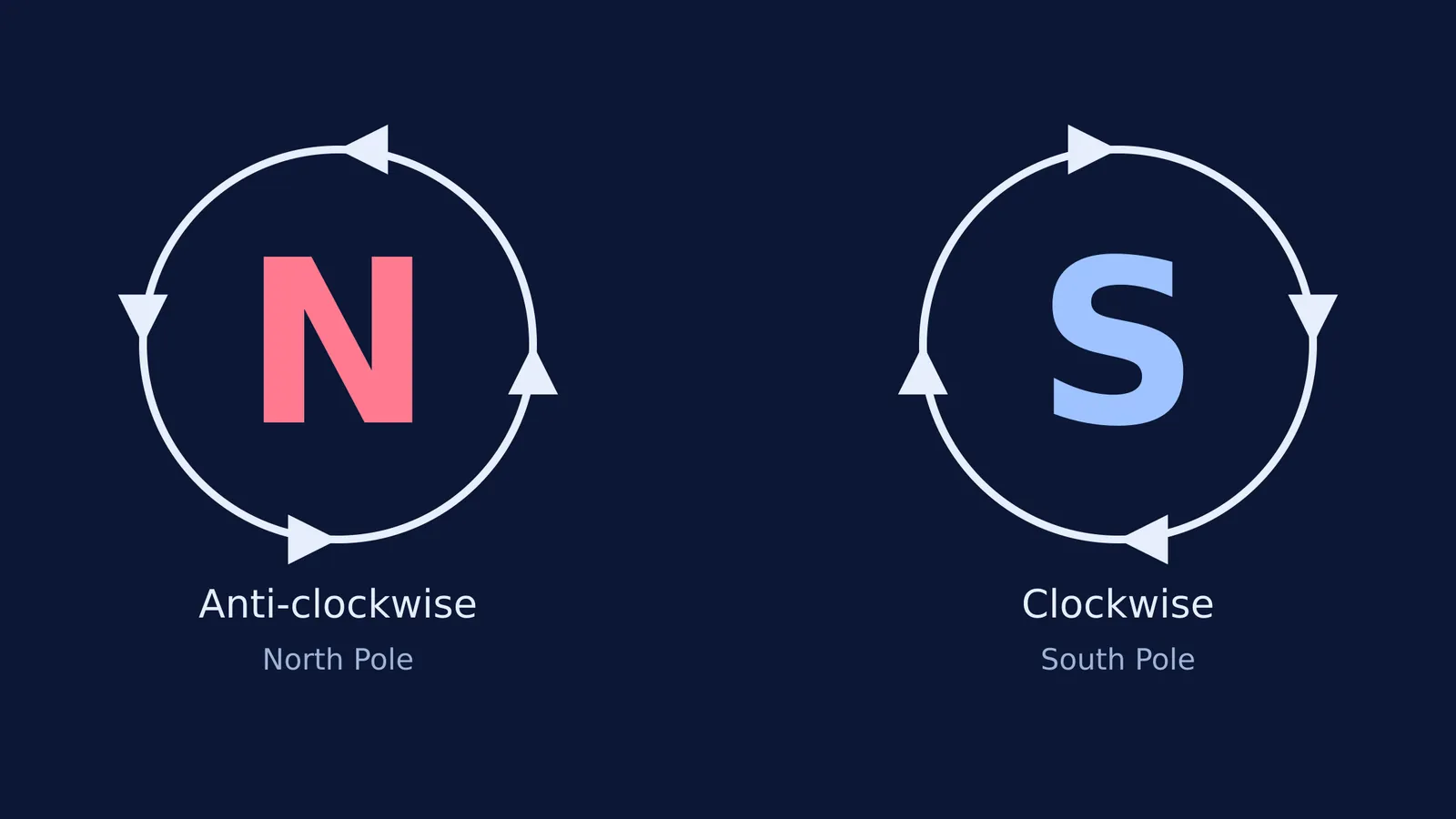
The clock face rule states that a clockwise current forms a South pole, while an anti-clockwise current forms a North pole.
To apply the rule, imagine you are looking directly at one circular face of the current-carrying coil:
South Pole: If the conventional current flows in a clockwise direction around the face you are looking at, that face behaves as a South magnetic pole.
North Pole: If the conventional current flows in an anti-clockwise (or counter-clockwise) direction, that face behaves as a North magnetic pole.
A quick and standard way to remember this is by drawing the letters S and N. The tips of the letter "S" can be drawn with arrows pointing in a clockwise circle, mirroring the current. Conversely, the tips of the letter "N" follow an anti-clockwise circle.
If you are studying for your board exams, you will encounter this exact principle in chapters on Magnetic effects of current in Class 10: fields, rules and home wiring. This rule is essential for working out how two side-by-side coils will interact, or which way a permanent magnet will be repelled when it is pushed into a closed loop of wire.
How do you use the right-hand grip rule for a solenoid?
If you prefer a physical method over visualizing a clock face, you can use your hand. According to the right-hand grip rule, if you wrap your right hand around a solenoid with your fingers pointing in the direction of the current, your thumb points toward the North pole (Wikipedia).
Here is how to apply it step by step to any solenoid problem:
Hold out your right hand, ensuring you are not accidentally using your left hand (a very common mistake in exams).
Curl your fingers as if you are gripping the cylindrical solenoid, pointing your fingertips in the direction that the conventional current (from the positive terminal to the negative terminal) wraps around the tube.
Stick your thumb straight out parallel to the coil's central axis.
Because a solenoid mimics a bar magnet, the magnetic field lines emerge from the North pole where your thumb points, travel through the space around the outside of the coil, and enter through the opposite South pole. This rule is particularly useful when dealing with more complex calculus derivations, like finding Faraday's law for a changing B: the circulating E inside a solenoid.
Why does the polarity of a solenoid matter?
Knowing the polarity of a solenoid is not just an exam trick to gain a quick mark. It is the functional basis for engineering electromagnets, electric motors, magnetic locks, and relays. If you place two solenoids end-to-end on a circuit board, you must know their poles to determine whether their magnetic fields will pull them together or push them apart.
Similarly, if you push a permanent magnet into a closed coil, Lenz's Law dictates that the induced current will create a magnetic pole that actively opposes the motion of the magnet. You need the clock rule to figure out which way that induced current will actually flow to achieve that opposition.
Many students drop marks by confusing their left and right hands under pressure, or by drawing the current arrows backwards on their diagrams. If you frequently mix up the directions when applying these rules, the Fermi Concept Library holds every concept in physics, chemistry, biology, mathematics and computing, each with its own lesson and its place in the map. It can help you practice these foundational ideas step by step until they become second nature.
When solving numerical problems, getting the direction wrong means your final force or magnetic field vector will have the wrong sign. This single error cascades through the rest of your calculations. You can read more about avoiding these common pitfalls in Magnetic force on charges and wires: right-hand-rule mistakes.


