

On this page
The question decides the hand. Is the current given and you want the motion, or is the motion given and you want the current? Get that right and the rest is finger-pointing.
When do you use Fleming's left-hand rule?
Use the left hand when current already flows through a wire in a magnetic field and you need the force on it. That is an electric motor: current and field are the causes and motion is the result, as the entry on Fleming's left-hand rule for motors puts it.
Hold the thumb, forefinger and middle finger of your left hand at right angles to each other. Then:
Forefinger: the magnetic field, from N to S
Middle finger: the current (conventional current, + to −)
Thumb: the force on the wire, and so the way it moves
The rule is a shortcut for the vector equation F = IL × B, which OpenStax University Physics writes with magnitude F = ILB sin θ, where θ is the angle between current and field. The force is zero when the wire runs along the field and largest at right angles to it. The rules are named after the British engineer John Ambrose Fleming; here is who invented the Fleming left-hand rule.
When do you use Fleming's right-hand rule?
Use the right hand when a wire is pushed through a magnetic field and you need the induced current. That is a generator: you supply the motion and the current comes out.
Fleming set out a hand rule for the direction of the induced electromotive force in his book Magnets and Electric Currents, first published in 1898. In the form given by the entry on Fleming's right-hand rule, hold the thumb, forefinger and middle finger of your right hand at right angles to each other. Then:
Forefinger: the magnetic field
Thumb: the motion of the conductor relative to the field
Middle finger: the induced current
For a straight rod moving across the field, the size of the induced emf is ε = Blv, as the OpenStax section on motional emf shows. The same section goes on to a coil rotating in a field, which it calls "the basis for an electric generator".
Why does a motor need the left hand and a generator the right?
Cause and effect swap places. A motor takes in current and gives out motion; a generator takes in motion and gives out current. Your hands are mirror images, so the wrong hand gives exactly the opposite direction. To compare the machines, see the difference between an AC generator and a DC motor.
Worked example: one magnet, two questions
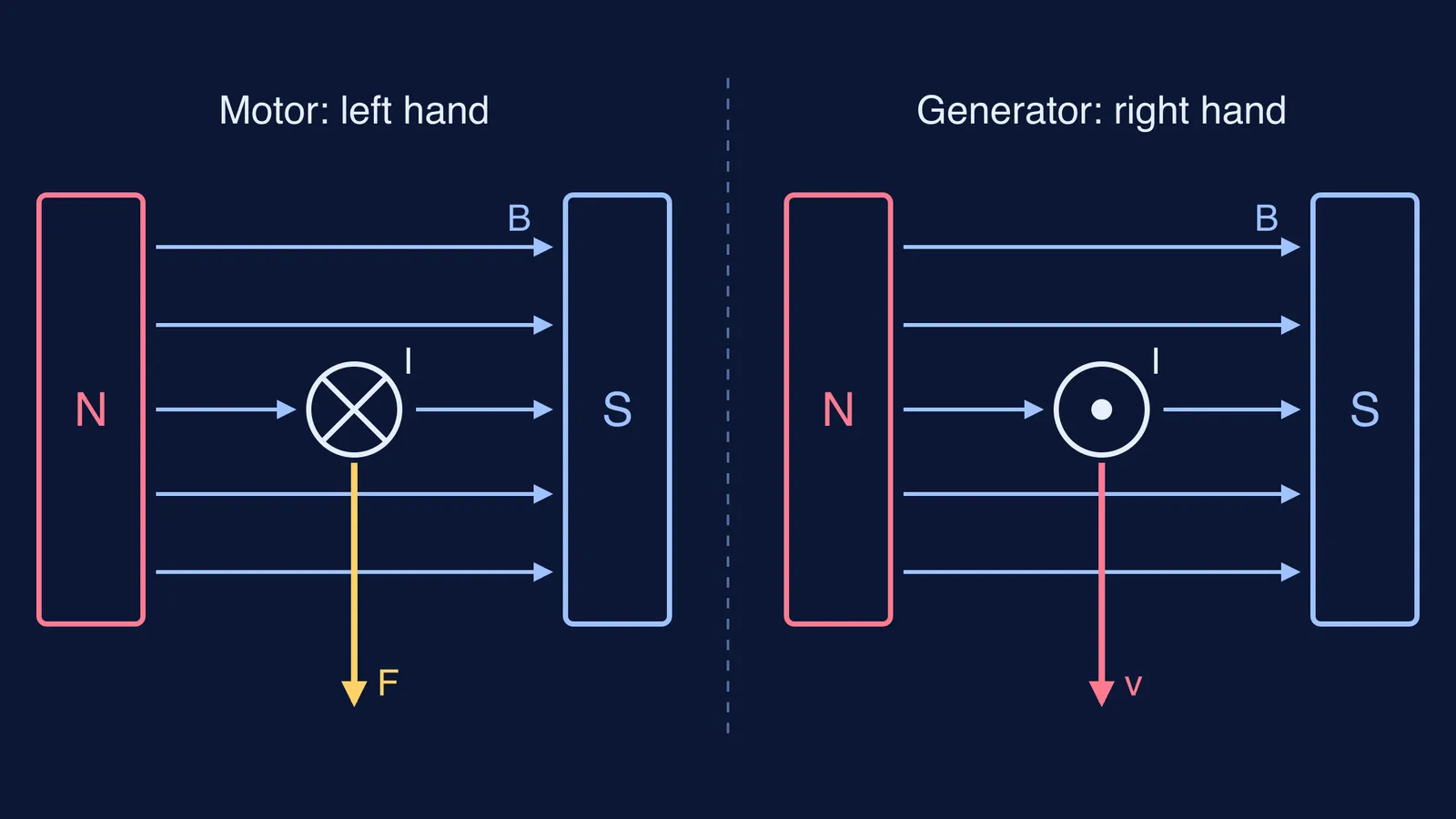
Put the N pole on your left and the S pole on your right, so the field B points to the right. A straight wire runs between them, as in the diagram above. Take x to the right, y up and z out of the page.
Question 1 (motor). A current flows into the page. Which way does the wire move?
Point your left forefinger to the right (field).
Point your left middle finger into the page (current).
Your left thumb points down. The force is downward.
Check with vectors: F = IL × B points along (−z) × (+x) = −y, which is down.
Question 2 (generator). Remove the battery. You push the wire down through the same field. Which way does the induced current flow?
Point your right forefinger to the right (field).
Point your right thumb down (motion).
Your right middle finger points out of the page, towards you. The induced current flows out of the page.
Check with vectors: the force on positive charges is along v × B = (−y) × (+x) = +z, out of the page.
Compare the answers. To drive the wire down as a motor, you needed current into the page. Pushing it down as a generator makes current flow out of the page, and that current feels a force along (+z) × (+x) = +y, which is up, against your push. This is Lenz's law, and it is why a generator is harder to turn when current is drawn.
How do you stop mixing up the two hands?
Before every direction question:
Underline what the question gives you: a current, or a motion.
Current given, force wanted: left hand. Motion given, current wanted: right hand.
Set the forefinger first. Outside a magnet, the field runs from N to S.
Use conventional current. If the question describes moving electrons, point your middle finger the opposite way to their motion.
For the right-hand rule, check with Lenz: the induced current should push back against the motion.
If you lose the direction inside a longer problem, the Fermi Problem Library has worked problems with a step-by-step solver that explains the reasoning, so you can see which step flipped. If the three axes are hard to hold in your head, the Fermi Simulation Lab has interactive simulations for ideas that are easier to see than to read.
Now redo Question 2 with the wire pushed up, and predict the current before you lift a hand.


