

On this page
When a wire carrying an electric current is placed in an external magnetic field, it experiences a force. The left-hand rule is a simple visual way to remember which direction that force will push the wire. It is primarily used to understand the "motor effect" that drives electric motors.
Who invented the Fleming left-hand rule?
The rule was created in the late 19th century by Sir John Ambrose Fleming, a British engineer and physicist.
Fleming served as the first professor of electrical engineering at University College London from 1885 to 1926. While he is best known in the scientific community for inventing the thermionic valve—the technology that made early radio and electronics possible—he developed his famous hand rules purely as a physical teaching aid.
Why did Fleming need a teaching aid?
During Fleming's time, the electricity industry was expanding rapidly. He worked as a consultant for major electrical firms and taught the next generation of engineers.
Fleming noticed a gap between complex mathematical equations and the practical understanding needed by engineering students to build real-world machines. His students often struggled to picture the three-dimensional relationship between a magnetic field, the flow of current, and the resulting physical force. To solve this, Fleming created a standardized mnemonic using the human body to make the abstract physics intuitive.
How do you apply Fleming's left-hand rule?
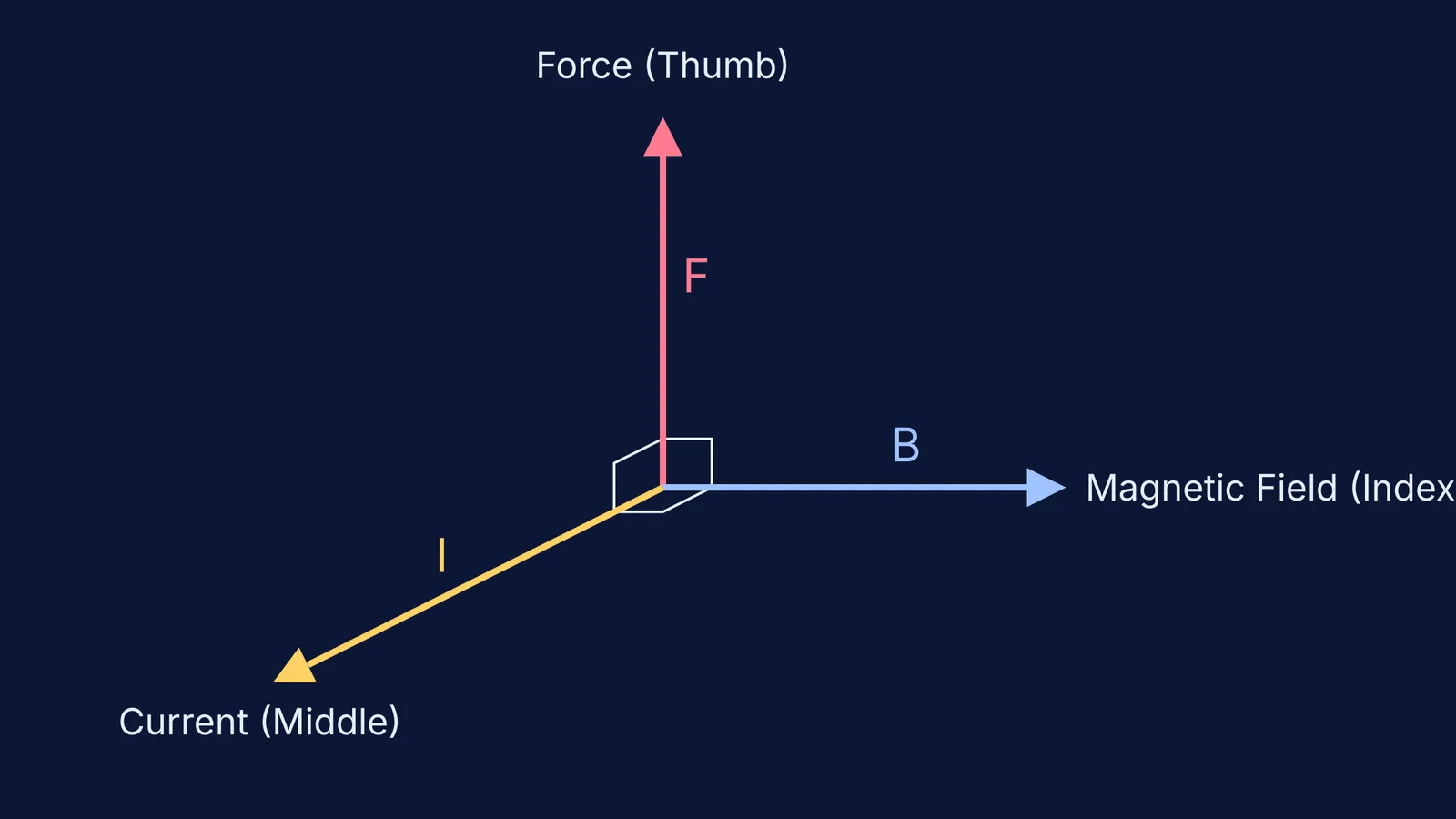
Hold your left hand so that the thumb, first finger (index finger), and second finger (middle finger) all point at right angles to each other, like the corners of a cube.
First Finger: Point this in the direction of the magnetic Field (from the North pole to the South pole).
Second Finger: Point this in the direction of the conventional electric Current (from positive to negative).
Thumb: Your thumb now naturally points in the direction of the Thrust or force that causes the motion.
This is famously remembered in classrooms across the world as the "FBI" rule: Force, B (the symbol for magnetic field), and I (the symbol for current).
Why is it so hard to picture electromagnetic forces?
The mathematics of electromagnetism rely heavily on cross products, meaning the force produced is perpendicular to both the magnetic field and the current. If you try to imagine the helical path of a charge in a magnetic field, your brain has to constantly track three axes at once. A flat diagram on a textbook page often fails to capture this depth.
This is exactly where modern interactive tools pick up where Fleming left off. If you are struggling to picture forces in 3D, the Fermi Simulation Lab provides interactive simulations for the ideas that are easier to see than to read. You can rotate the fields, reverse the currents, and instantly observe how the force vector changes.
A practical framework for exam questions
When predicting the trajectory of a charge crossing into a B-field region, identifying the initial direction of force is the crucial first step. If you are facing a physics problem on electric motors or magnetic forces, use this step-by-step checklist to avoid common mistakes:
Identify the rule: Motor effect (force generated) = Left hand. Generator effect (current induced) = Right hand.
Check the particle: Is it an electron or a proton? Conventional current assumes a positive charge. If the question involves an electron beam, point your second finger in the *opposite* direction of the electrons' motion.
Align the field first: It is physically easier to lock your first finger (field) in place North-to-South, and then rotate your wrist to align your middle finger with the current.
Confirm the force: Once the first two fingers are locked in position, your thumb is pointing precisely at the answer.
Here is a worked example to practice with: imagine a vertical wire carrying a current straight down into the floor, while Earth's magnetic field points towards the geographic North. First, point your index finger North. Next, keeping that finger locked, point your middle finger down toward the floor. Your thumb will naturally stick out to the East. The wire is pushed East.
By grounding these invisible forces in a physical action, John Ambrose Fleming's 19th-century teaching hack remains the fastest way to get to the right answer. When you get stuck on the underlying concepts or need a structured approach to harder numerical problems, the Fermi Problem Library has worked problems with a step-by-step solver that explains the reasoning rather than printing an answer.


