

On this page
If you have ever turned a hand-cranked emergency radio or a classroom demonstration generator, you probably noticed an immediate change in resistance when the circuit closed. With no electrical load connected, the handle spins smoothly with minimal effort. But the moment you switch on a light bulb or connect a resistor, the crank instantly stiffens, requiring steady physical exertion to keep it moving at the same speed.
This sudden resistance is neither a mechanical fault nor bearing friction. It is electromagnetic back-torque in action—a direct manifestation of Lenz's law and the conservation of energy.
Why does a generator spin freely on open circuit?
An electric generator works by rotating a conductive armature coil through a magnetic field. As the coil turns, the magnetic flux passing through its area changes continuously over time. According to Faraday's law for a changing magnetic flux, this time-varying flux induces an electromotive force (EMF), or voltage, across the terminals of the coil.
When the generator terminals are open, the electrical circuit is incomplete. Although a voltage exists across the terminals, no electrical charge can complete a loop, meaning zero current flows through the windings. With zero current flowing, the magnetic field exerts no net magnetic force on the coil wires. The only resistance you feel at the handle is the negligible mechanical friction of the bearings and brushes against the axle.
The situation changes completely the moment you close the circuit across an electrical load. Closing the circuit allows charges to circulate, transforming the spinning coil into an active electromagnet.
How does drawing current create counter-torque?
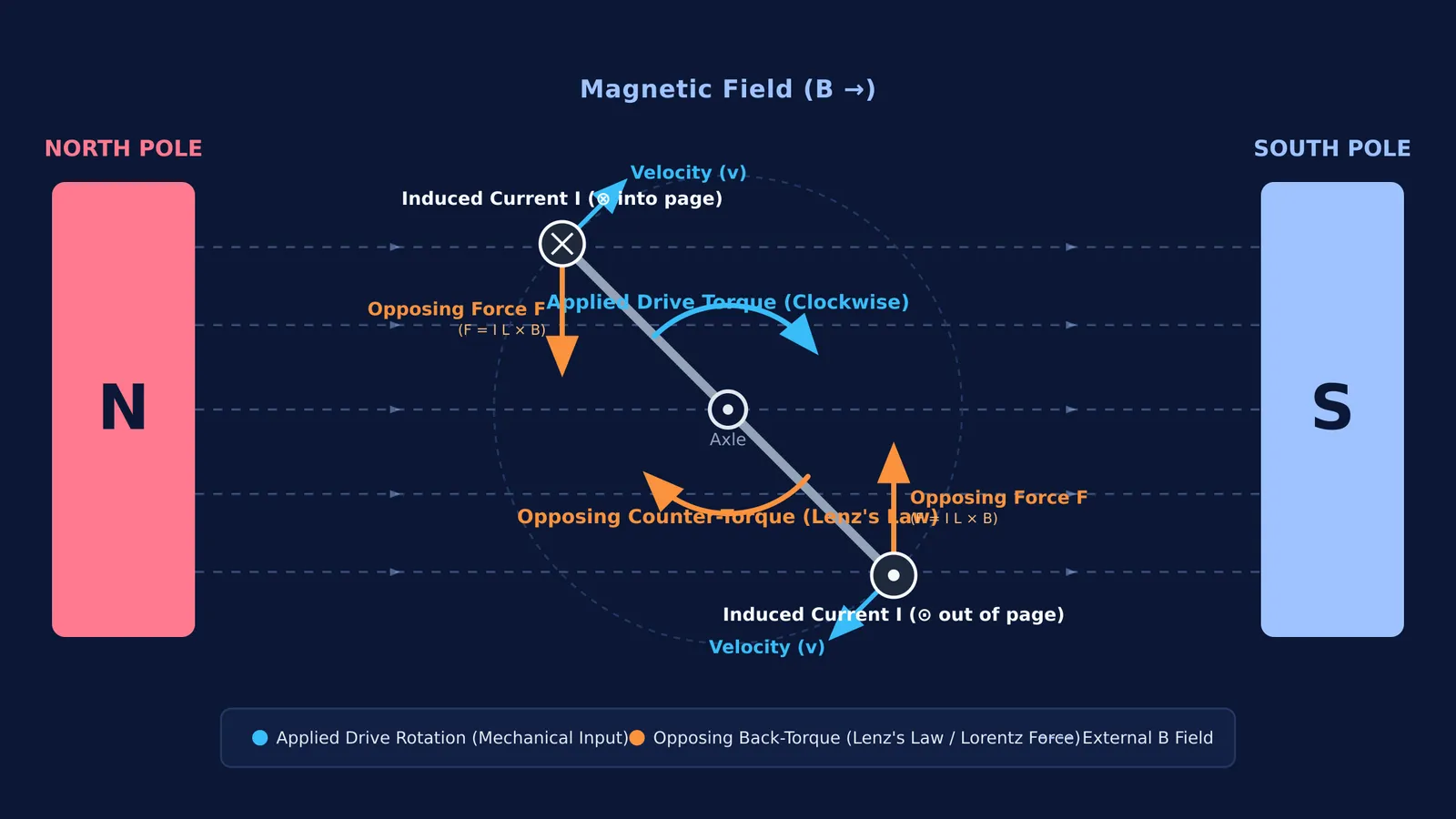
When electrical current flows through the spinning armature, the conductors carry moving charges through an external magnetic field. Each segment of current-carrying wire experiences a magnetic Lorentz force given by F = I(L × B).
The direction of this force is governed by the direction of induced current under Lenz's law. Heinrich Lenz established that an induced current always flows in a direction such that its magnetic field opposes the change in magnetic flux that produced it (HyperPhysics).
Because the flux change is caused by the physical rotation of the coil, the resulting Lorentz force on the conductors acts in the opposite direction of the coil's motion. For example, if you crank the generator clockwise, the magnetic forces on opposite sides of the coil form a couple that pushes counter-clockwise. This opposing torque—often called counter-torque or back-torque—directly resists your cranking effort. Connecting a heavier electrical load draws more current (I = V / R), which directly increases the opposing force (F ∝ I) and makes the handle noticeably harder to turn.
If you are connecting induction, field vectors and magnetic forces, the Fermi Concept Library covers every concept in physics, chemistry, biology, mathematics and computing, each with its own lesson and its place in the map.
Visualising how magnetic fields interact in 3D can be tricky on paper, but you can explore interactive simulations for the ideas that are easier to see than to read in the Fermi Simulation Lab.
Why does conservation of energy demand mechanical resistance?
The physical stiffening of the generator crank is required by the first law of thermodynamics: energy cannot be created from nothing.
If turning a generator felt equally effortless whether drawing current or disconnected, you could generate unlimited electrical power without doing extra physical work. You could connect a powerful spotlight or a heating element and spin the crank with a single flick of a finger.
In reality, electrical power (P = V × I) represents real energy leaving the system every second. To deliver that electrical power, an equal or greater amount of mechanical power (P = τ × ω, where τ is torque and ω is angular velocity) must be supplied at the input shaft. The opposing counter-torque is nature's mechanism for enforcing energy conservation. The harder your muscles push against that magnetic counter-torque, the more mechanical work you perform per second, and that work is converted into the electrical energy lighting the bulb.
How do you solve generator and back-torque problems?
When solving physics problems involving generators, induced currents, and rotational dynamics, use this four-step method:
Calculate the induced electromotive force: Determine the rate of change of magnetic flux dΦ/dt to find the induced EMF using Faraday's law. For a flat coil of N turns rotating at angular speed ω in a uniform field B, the peak EMF is ε = N B A ω.
Determine the load current: Apply Ohm's law to find the circuit current, I = ε / R_total, where R_total includes the internal resistance of the generator windings and the external load.
Compute the opposing magnetic torque: Use rotational torque as r × F on the coil conductors to calculate the counter-torque τ_opp = N I A B sin θ.
Apply power conservation: Verify that the instantaneous mechanical power delivered to fight counter-torque, P_in = τ_opp × ω, equals the instantaneous electrical power generated, P_elec = ε × I.
For practice balancing electromagnetic forces and mechanical torques, the Fermi Problem Library has worked problems with a step-by-step solver that explains the reasoning rather than printing an answer.


