

On this page
An electric motor in a desk fan and a generator in a hydroelectric power plant look remarkably similar on the inside. Both contain a coil of wire (an armature) spinning between the poles of a strong magnet. However, they perform exactly opposite jobs, using different physical principles and different mechanical connections to the outside world.
What is the difference between an AC generator and a DC motor?
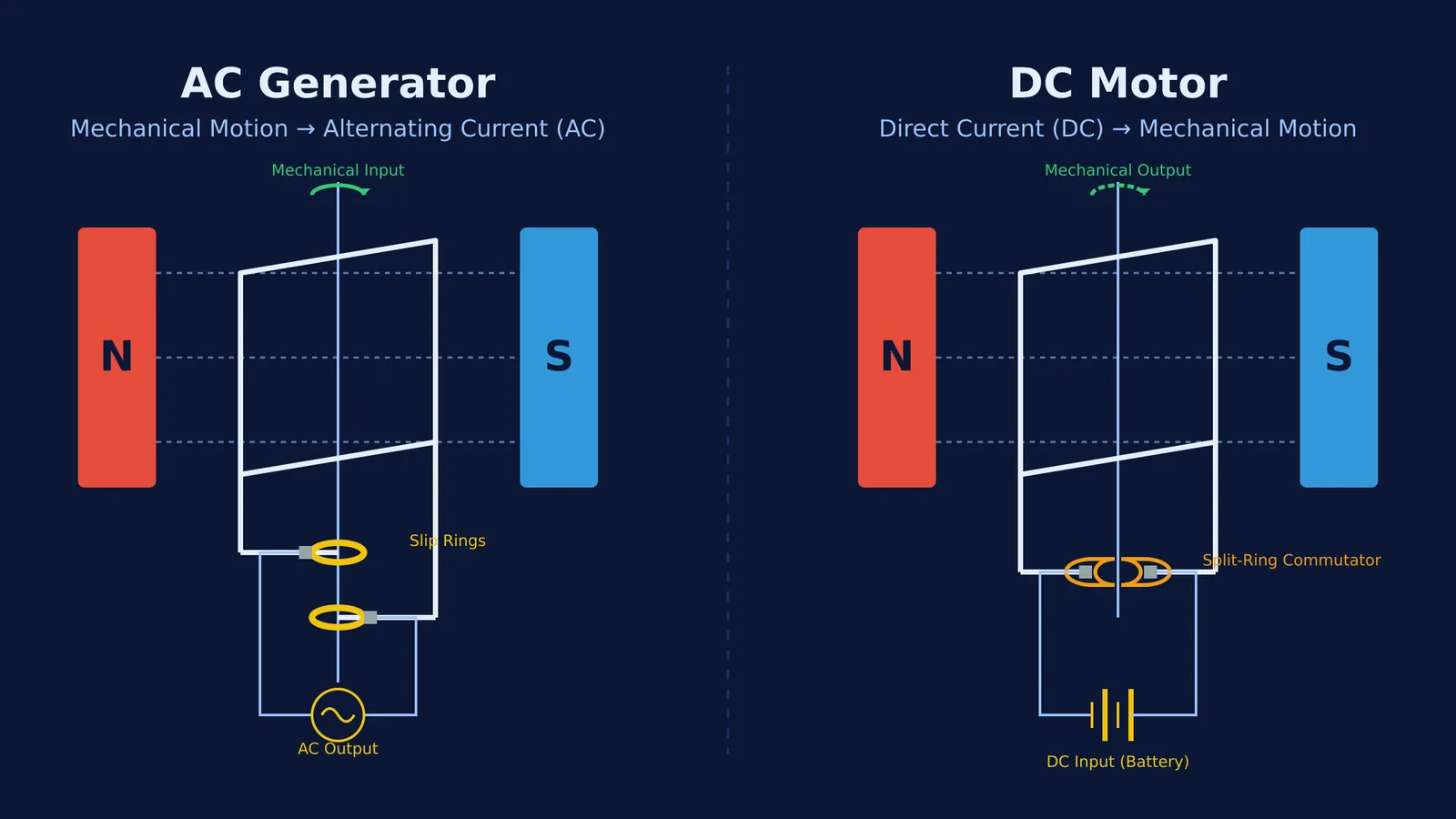
The fundamental difference lies in the direction of energy conversion and the laws of physics that govern them. According to HyperPhysics, an AC generator converts mechanical motion into electrical energy through electromagnetic induction. When an external force—such as a turbine turned by wind, water or steam—physically rotates the coil within the magnetic field, the magnetic flux passing through the coil constantly changes. This changing flux induces an electromotive force (EMF), driving an alternating current (AC) out into the circuit.
A DC motor operates in reverse: it converts electrical energy into mechanical motion. When you supply direct current (DC) from a battery to the coil, the magnetic field exerts a force on the current-carrying wire. This is known as the Lorentz force (HyperPhysics). Because the current travels down one side of the coil and up the other, the magnetic field pushes one side up and the other side down, creating a torque that forces the entire coil to spin.
If you find yourself stuck trying to figure out the direction of these forces or visualising how the flux changes during your revision, the Fermi Concept Library contains every concept in physics, chemistry, biology, mathematics and computing, each with its own lesson and its place in the map to help you trace exactly how the current and field interact.
How do slip rings and split rings differ?
The way the rotating coil connects to the stationary external circuit defines whether the machine produces alternating current or runs on direct current.
An AC generator uses slip rings. These are two complete, separate circular rings attached to the ends of the rotating coil. Carbon brushes press gently against these rings to maintain a continuous, unbroken electrical connection with the outside circuit. As the coil rotates, the side of the loop that was moving up begins moving down every half-turn, meaning the induced current naturally reverses its direction. The slip rings simply let this alternating current flow out unchanged, exactly as it was generated.
A DC motor relies on a split-ring commutator. Instead of two full rings, it uses a single ring split into two separate halves, with a small insulating gap between them. To keep a motor spinning continuously in one direction, the magnetic torque on the coil must always push the same way. However, as the coil flips over, the side that was on the left moves to the right. The commutator solves this by reversing the direction of the direct current inside the coil every half-turn. Because the current reverses at the exact moment the coil flips over, the two changes cancel out, and the force continues to push the coil in the original direction.
How fast does AC change direction?
The alternating current produced by massive generators at power stations is what reaches our homes and schools. In India, the standard grid frequency is 50 Hz, meaning the current completes 50 full cycles every second (Wikipedia).
Because each complete cycle involves the current flowing one way and then the opposite way, a 50 Hz frequency means the current changes direction 100 times per second. Therefore, the time interval between each reversal is exactly 1/100 of a second.
By contrast, the DC supplied to a motor by a battery has a frequency of 0 Hz. It flows continuously in one single direction with a steady voltage, which is why the motor relies on its internal split ring to do the reversing.
How to tell them apart in exams?
When revising for exams like JEE, NEET, or your Class 10 board practicals (such as those on magnetic effects of current), keeping the differences straight is crucial. Use this simple comparison framework to quickly distinguish the two devices when answering questions:
Input energy: A generator takes mechanical rotation as its input, whereas a motor takes electrical current (DC) as its input.
Output energy: A generator outputs an alternating electrical current, whereas a motor outputs mechanical torque to spin a shaft.
Internal rings: A generator connects via two complete slip rings, whereas a motor connects via one split-ring commutator.
Governing rule: A generator relies on Faraday's law of electromagnetic induction, whereas a motor relies on the magnetic force acting on a current-carrying conductor.
If you are solving numerical problems on Faraday's law or calculating the torque on a motor's coil and cannot find where you went wrong, you can bring your work to the Fermi Problem Library. It offers worked problems with a step-by-step solver that explains the reasoning rather than printing an answer.


