On this page
This chapter rewards care more than algebra: a flipped sign, a dropped π or the wrong meter resistor turns a right method into a wrong answer. Here is the official syllabus, four worked problems with our own numbers, the common traps and a ten-day plan.
What does the JEE Main syllabus include for magnetism?
NTA's Syllabus for JEE (Main) - 2027 (linked from the JEE Main website) lists it as Unit 13, "Magnetic Effects of Current and Magnetism". It names Biot-Savart for a circular loop, Ampere's law for a long wire and a solenoid, force on a moving charge in uniform E and B fields, force between parallel currents, torque on a current loop, and converting a moving coil galvanometer to an ammeter and voltmeter.
The unit also covers the bar magnet and magnetic materials, which NCERT treats in Chapter 5, Magnetism and Matter.
Your main textbook is NCERT Class 12 Physics Chapter 4, Moving Charges and Magnetism. The 2026-27 chapter has no section on the cyclotron: it mentions the machine only in passing (introduction, section 4.3 and the summary, which gives the cyclotron frequency), and the syllabus does not name it. Learn why that frequency does not depend on speed, not how the machine is built.
Which formulas should you know cold?
Lorentz force: F = q(E + v × B). The magnetic part changes direction, never speed.
Circle in a uniform field: r = mv/(qB), and frequency f = qB/(2πm), which does not depend on v.
Pitch of a helix when v has a component along B: p = v∥ × 2πm/(qB).
Centre of a circular loop: B = μ0I/(2R). Long straight wire: B = μ0I/(2πr).
Long solenoid: B = μ0nI, with n turns per metre.
Two parallel wires: force per metre = μ0I1I2/(2πd); like currents attract.
Torque on a coil: τ = NIAB sin θ, with magnetic moment m = NIA.
For directions, use one rule every time; our guide to the right-hand thumb rule for magnetic fields shows how.
How do you solve typical magnetism problems?
Take μ0 = 4π × 10⁻⁷ T m/A, proton mass 1.673 × 10⁻²⁷ kg and e = 1.602 × 10⁻¹⁹ C.
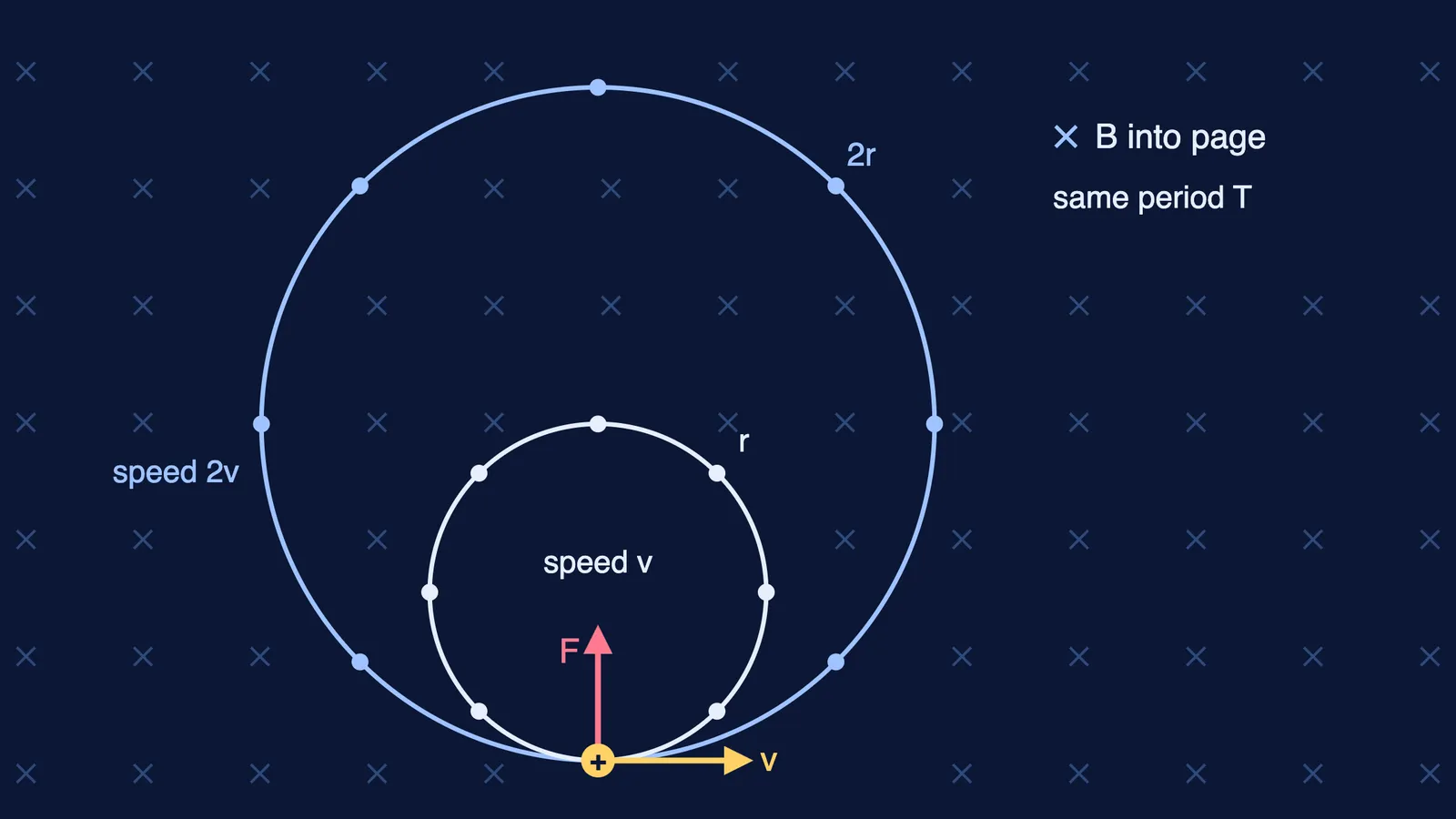
A proton in a field. A proton moves at 2.0 × 10⁶ m/s at right angles to a 0.50 T field. r = mv/(qB) = (1.673 × 10⁻²⁷ kg × 2.0 × 10⁶ m/s) / (1.602 × 10⁻¹⁹ C × 0.50 T) = 4.2 × 10⁻² m, about 4.2 cm. The frequency is f = qB/(2πm) = 7.6 × 10⁶ Hz, so one turn takes about 0.13 µs. Double the speed: the radius doubles to 8.4 cm, the period stays the same (the picture at the top).
Galvanometer to ammeter. A 60 Ω coil gives full-scale deflection at 500 µA. For a 0-2.0 A ammeter, a parallel shunt carries the rest: S = IgG/(I − Ig) = (5.0 × 10⁻⁴ A × 60 Ω) / (1.9995 A) = 0.015 Ω.
The same galvanometer as a voltmeter. For 0-5.0 V, add R in series: R = V/Ig − G = (5.0 V / 5.0 × 10⁻⁴ A) − 60 Ω = 9,940 Ω.
Loop or wire? With 3.0 A and 5.0 cm, a loop's centre has B = μ0I/(2R) = 3.8 × 10⁻⁵ T, while a long wire at 5.0 cm gives μ0I/(2πr) = 1.2 × 10⁻⁵ T. The ratio is exactly π; matching answers mean a dropped π.
If your method goes wrong, the Fermi Problem Library has worked problems with a step-by-step solver that explains the reasoning rather than printing an answer, so you can find the step where yours went off.
What are the common traps in Moving Charges and Magnetism?
Charge sign: flip the force for an electron.
Thinking the magnetic force does work. It never changes kinetic energy.
Using the full-loop formula for an arc. An arc that subtends angle θ at the centre gives B = μ0Iθ/(4πR).
Swapping the meter resistors. An ammeter needs a small shunt in parallel; a voltmeter needs a large resistance in series. NCERT section 4.10 explains why.
Adding fields as numbers, not vectors; see how two wires at right angles combine at a point.
What is a good ten-day plan for this chapter?
Days 1-2: Lorentz force, circles and helices; derive r and f yourself.
Days 3-4: Biot-Savart for segments, loops, arcs and combinations.
Day 5: Ampere's law for a thin wire, a thick wire and a solenoid.
Day 6: Forces on conductors and between parallel wires.
Day 7: Torque on a loop and galvanometer conversions.
Day 8: The Chapter 5 topics: bar magnet and magnetic materials.
Day 9: A timed set of previous-year questions; log each error as sign, formula, units or concept.
Day 10: Redo only the logged errors.
The Fermi Simulation Lab has interactive simulations for the ideas that are easier to see than to read.
When this chapter feels steady, move on to our Electromagnetic Induction and AC guide for JEE Main, which builds on it.