On this page
This guide covers Chapter 13, Statistics, of the Class 11 Mathematics textbook: how spread out data is, measured by range, mean deviation, variance and standard deviation. It is not the Class 11 Economics statistics course, though that course's guide to mean, median and mode is a useful refresher.
What is in the 2026-27 syllabus for Statistics?
The CBSE Mathematics curriculum for 2026-27 places Statistics in Unit V, Statistics and Probability, which carries 12 marks of the 80-mark Class XI theory paper. That figure covers the whole unit, Probability included. The curriculum adds: "No chapter/unit-wise weightage. Care to be taken to cover all the chapters."
A separate Class XI table says: "The following topics are included in the syllabus but will be assessed only formatively to reinforce understanding without adding to summative assessments." Under Unit V it lists only a Probability topic, so all of Statistics (range, mean deviation, variance and standard deviation of ungrouped and grouped data) stays in the exam.
The current NCERT Class 11 Mathematics chapter (Reprint 2026-27) names quartile deviation as a measure but does not teach it, so we leave it out too.
Which formulas do you need for dispersion?
NCERT writes x̄ for the mean, M for the median and N = Σfᵢ for the total frequency.
Range = maximum value − minimum value.
Mean deviation, ungrouped: M.D.(x̄) = Σ|xᵢ − x̄| / n, and M.D.(M) = Σ|xᵢ − M| / n.
Mean deviation, grouped: M.D.(x̄) = Σfᵢ|xᵢ − x̄| / N, with xᵢ the class mid-point for continuous data.
Variance: σ² = Σ(xᵢ − x̄)² / n, or Σfᵢ(xᵢ − x̄)² / N for a frequency distribution.
Standard deviation: σ is the positive square root of the variance.
Shortcut: with yᵢ = (xᵢ − A)/h, σ² = (h²/N²)[NΣfᵢyᵢ² − (Σfᵢyᵢ)²].
Our explainer on why variance squares deviations shows why squares beat absolute values.
Solved examples with our own numbers
Example 1 (ungrouped). Data: 2, 5, 6, 8, 14.
Range = 14 − 2 = 12.
Mean x̄ = 35/5 = 7; median M = 6.
|xᵢ − 7| = 5, 2, 1, 1, 7, sum 16, so M.D.(x̄) = 16/5 = 3.2.
|xᵢ − 6| = 4, 1, 0, 2, 8, sum 15, so M.D.(M) = 15/5 = 3.0.
(xᵢ − 7)² = 25, 4, 1, 1, 49, sum 80, so σ² = 80/5 = 16 and σ = 4.
The deviation about the median is smaller, as NCERT notes.
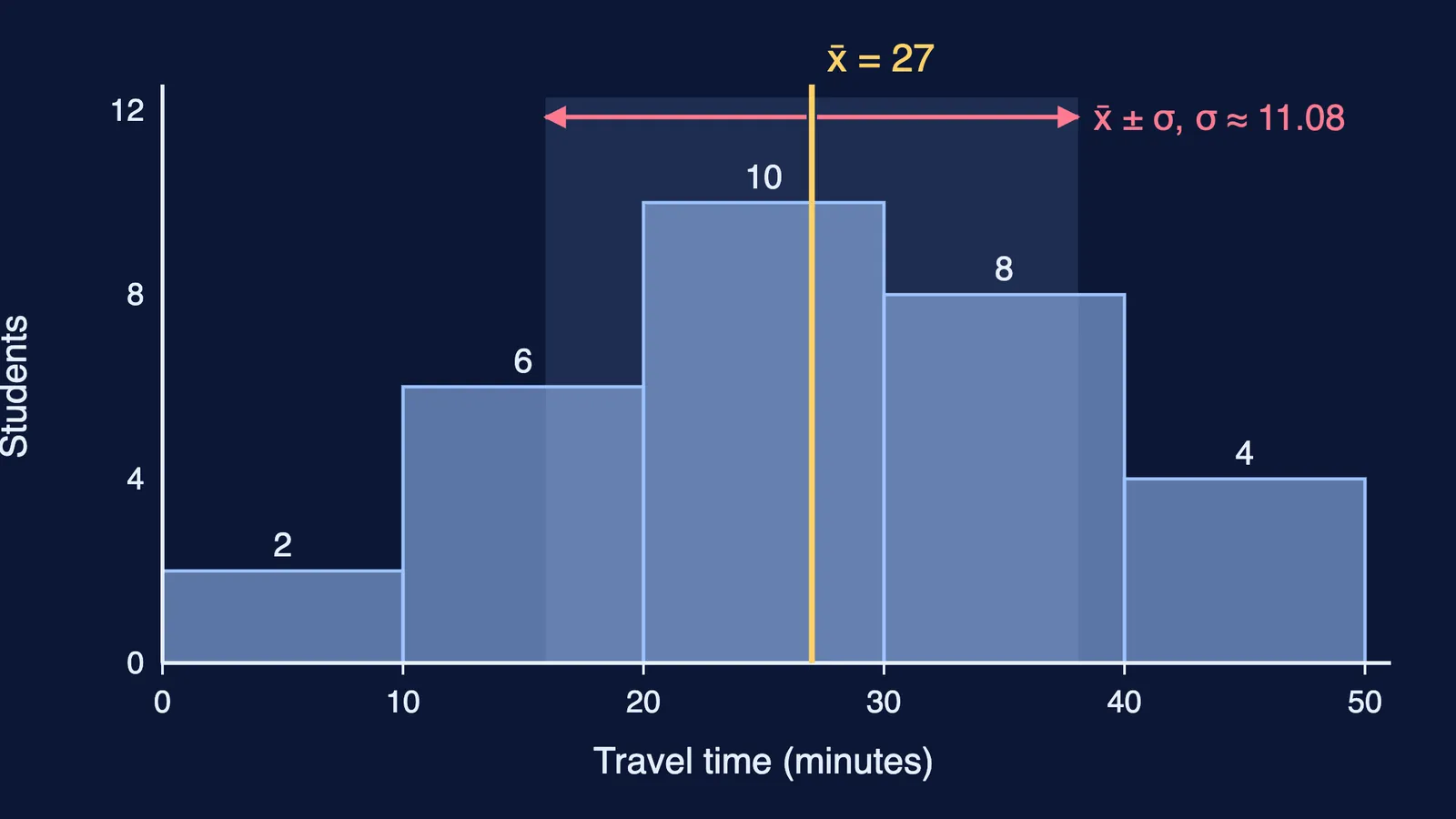
Example 2 (continuous, one worked table). Travel times of 30 students, in minutes. Take A = 25 and h = 10. Each row lists class, mid-point xᵢ, fᵢ, yᵢ, fᵢyᵢ, fᵢyᵢ²:
0–10: 5, 2, −2, −4, 8
10–20: 15, 6, −1, −6, 6
20–30: 25, 10, 0, 0, 0
30–40: 35, 8, 1, 8, 8
40–50: 45, 4, 2, 8, 16
Totals: N = 30, Σfᵢyᵢ = 6, Σfᵢyᵢ² = 38
Mean: x̄ = A + h(Σfᵢyᵢ/N) = 25 + 10 × 6/30 = 27 minutes.
Variance: σ² = (100/900)[30 × 38 − 6²] = (100/900) × 1104 ≈ 122.67 minutes².
Standard deviation: σ = √122.67 ≈ 11.08 minutes.
Mean deviation about the mean: |xᵢ − 27| = 22, 12, 2, 8, 18. Multiplying by fᵢ gives 44, 72, 20, 64, 72, sum 272, so M.D.(x̄) = 272/30 ≈ 9.07 minutes.
What practice questions should you try?
The mark labels below are our suggestion for the kind of question, not a CBSE allocation.
(1 mark) Find the range of 13, 7, 22, 9, 18.
(1 mark) A set of lengths has variance 0.0016 m². Find its standard deviation, with units.
(2 marks) Find the mean deviation about the mean of 3, 5, 7, 9, 11.
(3 marks) Find the variance and standard deviation of 1, 4, 5, 7, 8.
(3 marks) For x = 10, 20, 30 with f = 2, 5, 3, find the median and then the mean deviation about it.
(5 marks) Find the mean, variance and standard deviation of x = 4, 8, 12, 16, 20 with f = 1, 4, 6, 4, 1.
Answers: 1. 15. 2. 0.04 m. 3. 2.4. 4. σ² = 6, σ ≈ 2.45. 5. Median 20, M.D. = 5. 6. Mean 12, σ² = 16, σ = 4.
Which slips should you watch for?
Dropping the modulus in mean deviation, so the deviations cancel to zero.
Using class limits instead of mid-points.
Forgetting to multiply by h² in the shortcut variance, or by h for σ.
How should you revise this chapter?
Rework Example 2 without looking, then check each column. Then do one ungrouped and one grouped question a day for a week, alternating mean and median as the centre.
Stuck on a step? The Fermi Problem Library has worked problems with a step-by-step solver that explains the reasoning rather than printing an answer.