On this page
Morphology of Flowering Plants is Chapter 5 of NCERT Class 11 Biology and opens Unit II, Structural Organization in Plants and Animals. This guide is for your CBSE school exam and practical. For the entrance exam, read our separate guide to preparing Morphology of Flowering Plants for NEET.
How many marks is Morphology of Flowering Plants in Class 11?
The CBSE Class XI Biology curriculum for 2026-27 gives Unit II 10 marks out of 70 in the theory paper. That 10 is shared by three chapters: Morphology of Flowering Plants, Anatomy of Flowering Plants and Structural Organisation in Animals. CBSE prints no separate figure for Chapter 5.
The curriculum lists root, stem, leaf, inflorescence, flower, fruit and seed, plus a description of family Solanaceae. Nothing here is formative-only; in Class XI that note covers only Digestion and Absorption.
What does the 2026-27 NCERT chapter cover?
Work from the current NCERT chapter (Reprint 2026-27), which runs from 5.1 The Root to 5.9 Solanaceae.
Root: tap, fibrous and adventitious systems; root cap, then the meristematic, elongation and maturation regions.
Stem and leaf: nodes and internodes; leaf base, petiole and lamina; venation; simple and compound leaves; phyllotaxy.
Inflorescence: racemose and cymose, told apart by whether the main axis keeps growing.
Flower: symmetry, ovary position, aestivation, stamen attachment, apocarpous vs syncarpous, placentation.
Fruit and seed: the drupe, the dicot seed and the maize grain.
Description and family: the semi-technical description of a plant, then Solanaceae, the only family described.
Modifications of root, stem and leaf no longer get sections of their own. Only passing lines survive, such as the summary's note that some roots store food or give support.
How do the mustard and Solanaceae formulas compare?
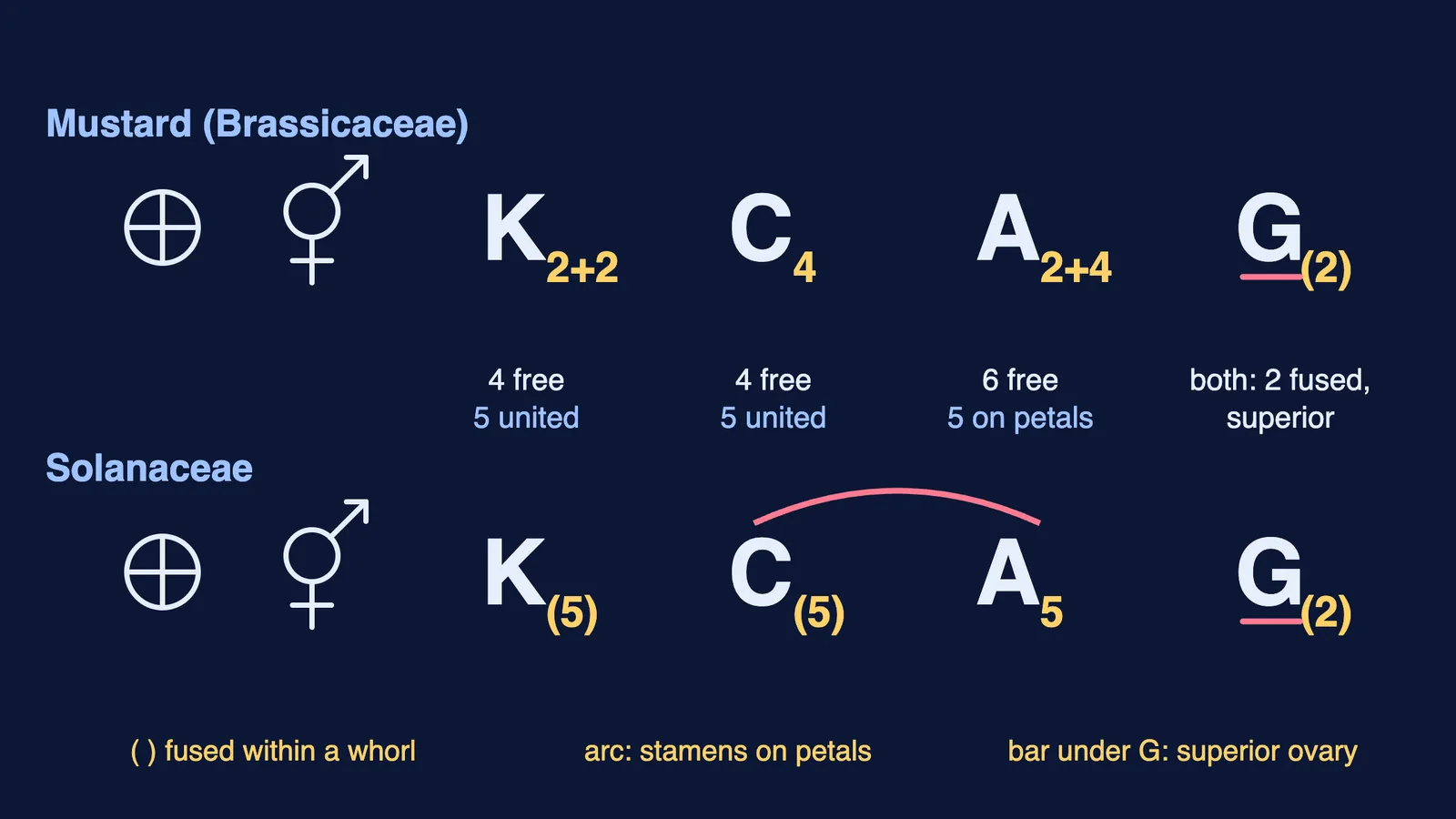
The chapter prints two floral formulas: mustard (Brassicaceae), ⊕ ⚥ K2+2 C4 A2+4 G(2), and Solanaceae, ⊕ ⚥ K(5) C(5) A5 G(2), each with a bar under G. For a mark-by-mark decoding, see our explainers on floral formula symbols and how to read a floral formula. Here we compare the two whorl by whorl, as in the diagram above.
Same: both flowers are actinomorphic and bisexual, and both have two fused carpels in a superior ovary.
Calyx: mustard has four free sepals in two pairs; Solanaceae has five united sepals.
Corolla: four free petals against five united petals.
Androecium: mustard has six free stamens in two groups, two and four; Solanaceae has five, each attached to a petal, shown by the arc over C and A.
What do you need for the practical exam?
The curriculum uses this chapter twice in the 30-mark practical.
Experiment 1: study a locally available Solanaceae plant (Poaceae, Asteraceae or Brassicaceae may be substituted where needed). Dissect and display the floral whorls, anther and ovary to show the number of chambers, give the floral formula and floral diagram, and record root type (tap or adventitious), stem type (herbaceous or woody) and leaf features. The major experiment, worth 5 marks, is set from Experiments 1, 3, 7 and 8.
Spotting: cymose and racemose inflorescences are on the spotting list. Spotting as a whole carries 7 marks.
Write the description in NCERT's order: habit, then root, stem and leaves, then inflorescence and flower, and finish with the floral diagram (mother axis as a dot at the top) and the formula.
Which questions should you practise?
These are our own questions; the marks in brackets are our suggestion, not CBSE's. The curriculum prints a question-paper design only for Class XII, so ask your teacher how your school sets the Class 11 paper.
Assertion: the brinjal flower is hypogynous. Reason: in a hypogynous flower the ovary is superior. Answer using the standard assertion-reason options. (1 mark)
A floral axis keeps growing and its youngest flowers are at the tip. Name the inflorescence type and the order of flowers. (2 marks)
A flower is actinomorphic and bisexual, with four free sepals, four free petals, eight free stamens and an inferior ovary of three fused carpels. Write its floral formula. (2 marks)
Mango and coconut are both drupes. State what they share and how their mesocarp differs. (2 marks)
In a maize grain, name the sheath over the plumule, the sheath over the radicle and the protein layer around the endosperm. (3 marks)
A student writes the Solanaceae formula as ⊕ ⚥ K5 C5 A5 G(2) with a bar above G. Find every error and correct it. (3 marks)
Check question 3: ⊕, the bisexual sign, K4 C4 A8, and G(3) with a bar above G for an inferior ovary. Check question 6: K and C need brackets (sepals and petals are united), C and A need the arc (epipetalous), and the bar goes under G (superior ovary).
Not sure where to start? Fermi's AI tutor works out what you already know and builds a plan for the session, so you start from the gap.