

On this page
Open the Morphology of Flowering Plants chapter in NCERT Class 11 Biology and you meet a line like ⊕ ⚥ K(5) C(5) A5 G(2). One row of letters describes a whole flower, once you know about a dozen symbols. Here they are, then the potato family's formula decoded mark by mark.
What do K, C, A, G and P stand for in a floral formula?
A floral formula is a short line of letters, numbers and signs that sums up a flower; NCERT presents it with the floral diagram at the end of a plant's description (NCERT Class 11 Biology, Chapter 5). The letters follow the whorls of the flower from the outside in:
K is the calyx, the outermost whorl, made of sepals.
C is the corolla, the whorl of petals.
P is the perianth, used when calyx and corolla are not distinct, as in lily.
A is the androecium, the stamens.
G is the gynoecium, the carpels.
Br means bracteate: the flower has a bract, a reduced leaf at the base of the pedicel.
The number after each letter counts the parts in that whorl. The same NCERT section lists ⊕ for actinomorphic (radially symmetric) flowers, % for zygomorphic (bilaterally symmetric) ones, ⚥ for bisexual, and ♂ and ♀ for male and female.
What do brackets, lines and the bar under G mean?
Brackets ( ) mean fusion within one whorl. K(5) is five united sepals (gamosepalous); K5 would be five free sepals.
A line or arc drawn above two symbols means adhesion, one whorl joined to another.
A bar under G means a superior ovary; a bar over G means an inferior ovary.
A plus sign separates whorls of the same organ, so K2+2 is two whorls of two sepals each (Wikipedia: Floral formula).
∞ is written when there are many parts, usually more than 10 to 12 (same source).
NCERT gives the same joining rule in its symbol key: fusion is shown by putting the number in brackets, and adhesion by a line drawn above the symbols of the floral parts (NCERT Class 11 Biology, Chapter 5).
A hook for the bar: think of it as the thalamus. In a hypogynous flower the ovary sits highest and is superior, so the line goes below G; in an epigynous flower the thalamus encloses the ovary, which is inferior, so the line goes above.
How do you read a floral formula step by step?
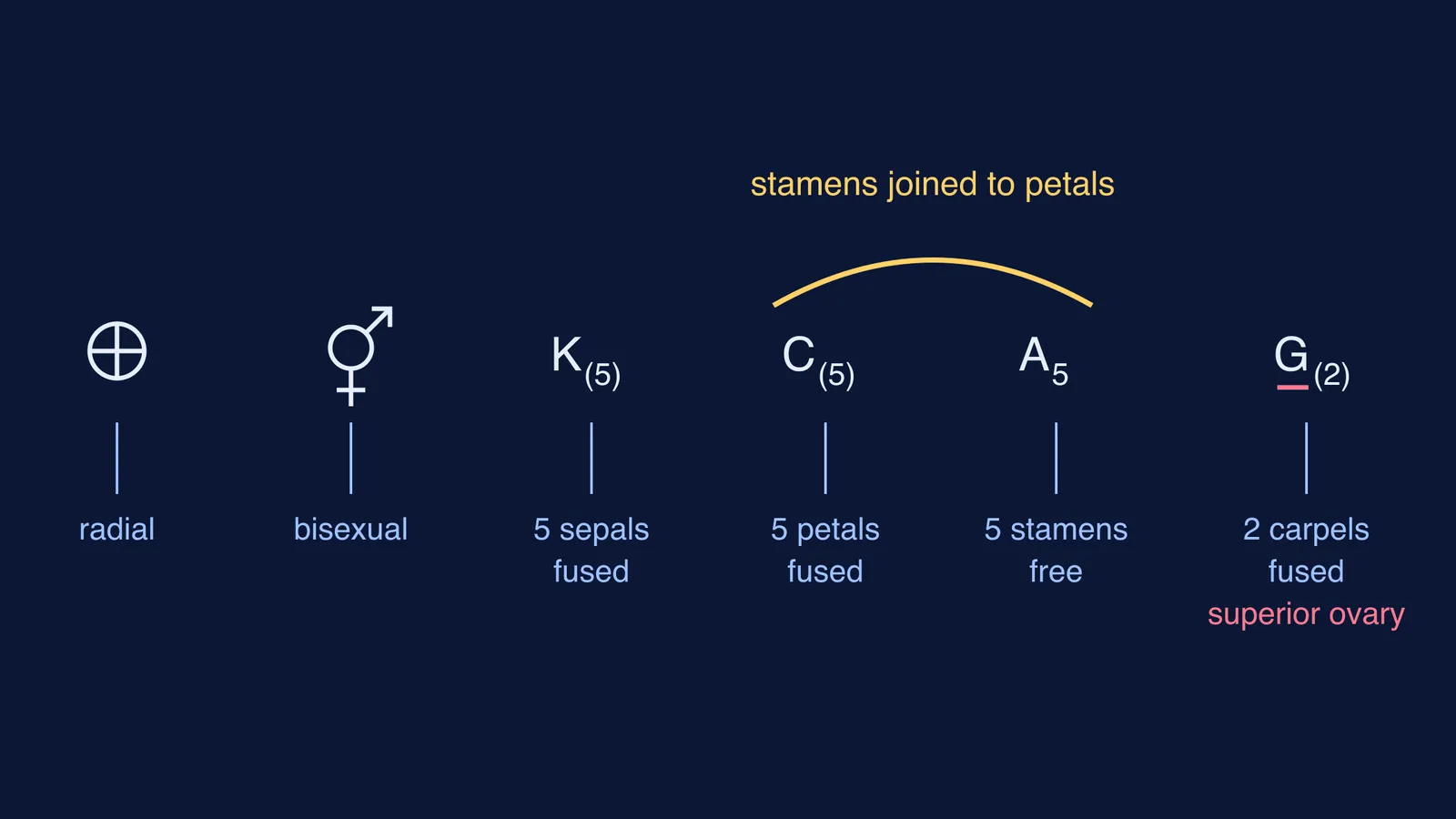
The current NCERT chapter describes the family Solanaceae in detail and prints its formula as ⊕ ⚥ K(5) C(5) A5 G(2), with a line over C(5) and A5 and a bar under G (NCERT Class 11 Biology, Chapter 5). Read it left to right:
⊕: actinomorphic; any cut through the centre gives equal halves.
⚥: bisexual; stamens and carpels in one flower.
K(5): five sepals, united.
C(5): five petals, united.
The line over C(5) and A5: stamens attached to the petals, which NCERT calls epipetalous.
A5: five stamens, free from each other (no bracket).
G(2) with a bar below: two carpels, fused, ovary superior.
The written description in the same section matches mark for mark: stamens five, epipetalous; bicarpellary, syncarpous, ovary superior.
Now try one yourself. NCERT illustrates the floral diagram with mustard (Brassicaceae), formula ⊕ K2+2 C4 A2+4 G(2), bar under G. Answer: radial, four free sepals in two whorls of two, four free petals, six free stamens in two whorls of two and four, two fused carpels, superior ovary.
Which floral formula symbols do students mix up?
Check these before you write a formula in a test:
Bar position: below G is superior, above G is inferior.
Bracket or arc: brackets join parts of one whorl; the arc joins two different whorls.
P or K and C: use P only when sepals and petals cannot be told apart.
⊕ or %: ⊕ is radial (mustard, chilli); % is bilateral (pea, gulmohur).
Count check: the numbers should match your floral diagram, whorl by whorl.
To practise, cover the formula and rebuild it from the description, then reverse. Pair this with our guide to drawing a floral diagram step by step and the list of commonly confused plant biology terms. If a chatbot decodes a formula for you, test it with this NCERT-based check for AI floral formula answers.
If the gap is a term behind a symbol, such as gamosepalous or epipetalous, the Fermi Concept Library has a lesson for each concept in biology, with its place in the map. For practice, the Fermi Problem Library has worked problems with a step-by-step solver that explains the reasoning rather than printing an answer.
Start with the Solanaceae line tonight: write it from memory, then check every mark against the Solanaceae section of the chapter.


