

On this page
A floral diagram is an idealized ground plan—a schematic cross-section of a flower bud—that depicts the number of floral organs, their arrangement in successive whorls, and their structural relationships. Standardized by German botanist August Wilhelm Eichler in his 1875 treatise *Blüthendiagramme* and formalized in modern systematics by Louis P. Ronse De Craene (2010), the diagram translates three-dimensional anatomy into a two-dimensional architectural map.
While reading a floral formula communicates symmetry, sexuality, and organ counts through compact letters and numbers, it cannot show physical spatial arrangements like petal overlap. As botanists Prenner, Bateman, and Rudall (2010) established in *Taxon*, floral diagrams and formulae serve complementary roles: the diagram provides the topological blueprint, while the formula records numerical and vertical details.
Where do you place the mother axis and floral whorls?
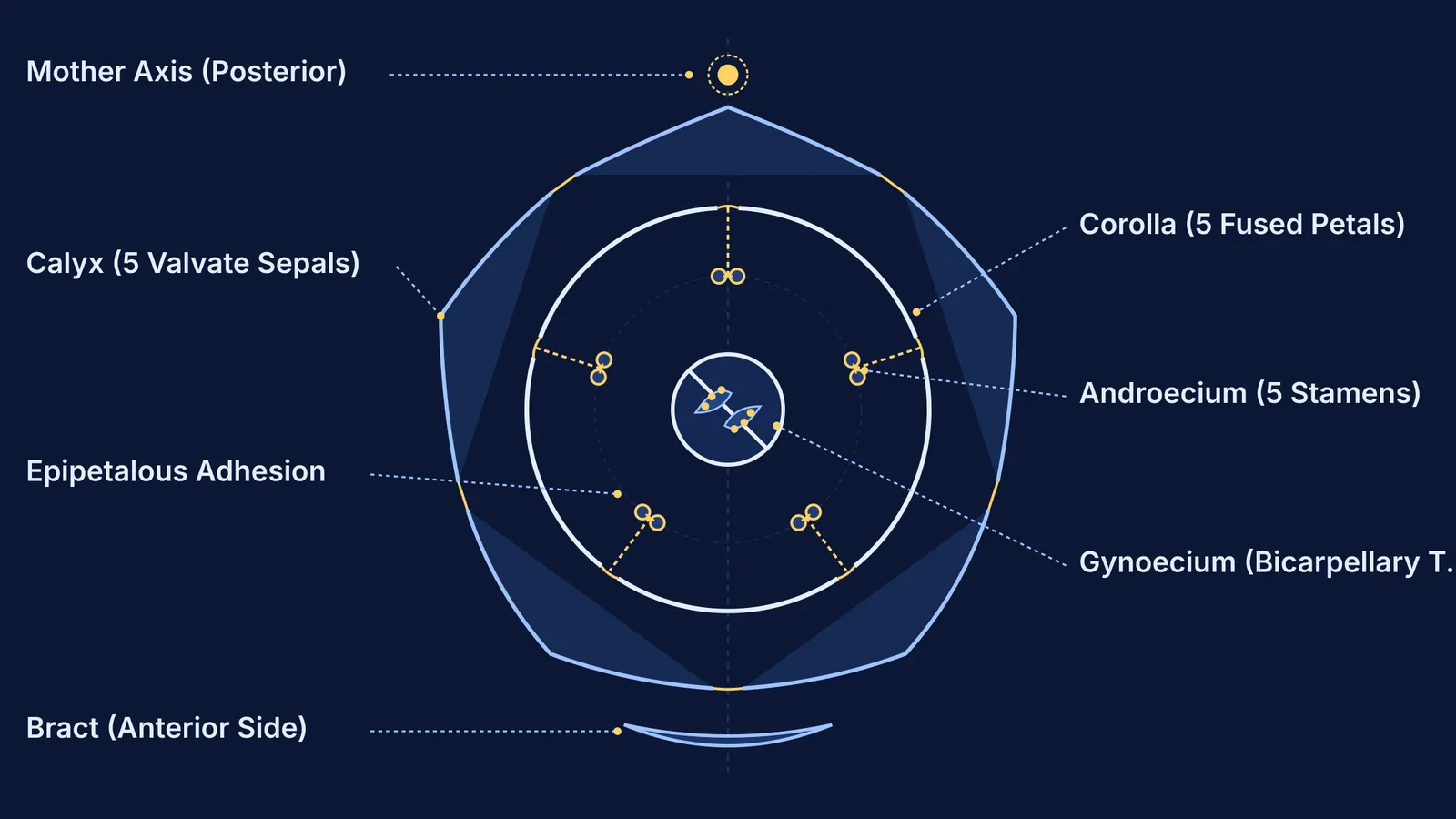
Every floral diagram begins with spatial orientation. Before sketching floral parts, locate the mother axis—the main stem or inflorescence branch supporting the flower. In NCERT Class 11 Biology conventions, the mother axis is drawn as a distinct solid dot (•) at the very top of the diagram.
This dot defines the posterior side (adaxial surface) of the flower, while the bottom corresponds to the anterior side (abaxial surface). If the flower possesses a bract, it is drawn as an arc at the bottom; lateral bracteoles appear on the flanks.
From the outside inward, construct four concentric whorls around a common centre:
Calyx: Outermost whorl of sepals, drawn as arcs with an outward-pointing ridge (keel) indicating the midrib.
Corolla: Second whorl of petals, drawn as smooth arcs alternating with the sepals.
Androecium: Third whorl of stamens, drawn as cross-sections of anthers. Dithecous anthers appear bilobed with four pollen sacs; monothecous anthers appear reniform.
Gynoecium: The central core showing a transverse section of the ovary, with carpel walls, septa, locules, and ovules.
How do you show aestivation, cohesion, and adhesion?
A floral diagram captures positional relationships through precise geometric conventions. The arrangement of sepals and petals in the bud—known as aestivation in floral whorls—is shown by how adjacent arcs meet:
Valvate: Arcs touch edge-to-edge without overlapping.
Twisted: One margin of each arc overlaps the next in a regular direction.
Imbricate: Margins overlap irregularly, with one organ fully external, one fully internal, and others overlapping at one margin.
Vexillary: Characteristic of pea flowers, featuring one large posterior standard petal overlapping two lateral wings, which enclose two anterior keels.
Fusion between floral organs follows two conventions:
Cohesion: Fusion within the same whorl. Gamosepalous calyces or gamopetalous corollas connect adjacent arc margins with solid lines. Syncarpous ovaries show fused carpellary walls.
Adhesion: Fusion between different whorls. In epipetalous flowers, a radial line connects each stamen to its corolla petal.
To bridge concept gaps across angiosperm families, the Fermi Concept Library maps every concept in biology, each with its own lesson and its place in the map.
What vital floral features does the diagram omit?
A frequent exam trap is assuming a floral diagram depicts the complete flower. Because it is strictly a two-dimensional horizontal cross-section, it omits several structural properties:
Ovary position: The diagram reveals locule numbers and ovary placentation types (marginal, axile, parietal, or free-central), but cannot show whether an ovary is superior (hypogynous) or inferior (epigynous). That vertical level is conveyed only in the floral formula by an underline (G with an underscore) or overline (G with an overscore).
Stamen length variations: Differences in filament height (such as tetradynamous 2 + 4 stamens in mustard) cannot show vertical elevation, though concentric rings indicate inner versus outer sets.
Colour and nectaries: Pigmentation and nectar glands are omitted unless special symbols are used.
How do you draw Brassica and Solanum step by step?
To master floral diagrams, practice the two benchmark families in NCERT Class 11:
Brassica campestris (Brassicaceae):
Place the mother axis dot at the top (actinomorphic).
Calyx (K 2+2): 4 polysepalous sepals in two whorls—two outer antero-posterior and two inner lateral.
Corolla (C 4): 4 polypetalous petals arranged in a diagonal cross (cruciform).
Androecium (A 2+4): 6 stamens in two rings—2 short outer lateral and 4 long inner in antero-posterior pairs.
Gynoecium (G superior, 2 fused): Bicarpellary syncarpous ovary with a false septum (replum) and parietal placentation.
Solanum nigrum (Solanaceae):
Place the mother axis dot at the top; the odd sepal is strictly posterior.
Calyx (K 5 fused): 5 sepals joined by marginal lines (gamosepalous, valvate).
Corolla (C 5 fused): 5 petals joined by marginal lines (gamopetalous, valvate).
Androecium (A 5): 5 stamens, each joined by a radial line to a petal (epipetalous).
Gynoecium (G superior, 2 fused): Bicarpellary syncarpous ovary with an obliquely tilted septum and a swollen axile placenta.
When testing whether an unknown diagram represents Solanaceae or Fabaceae, the Fermi Problem Library provides worked problems with a step-by-step solver that explains the reasoning rather than printing an answer.


