On this page
A floral formula packs a whole flower into one line of letters, numbers and brackets. An AI chatbot can decode it quickly, but it may also add families or examples your textbook never uses. So let the AI explain, then test yourself only on what NCERT prints.
What do the symbols in a floral formula mean?
NCERT Class 11 Biology, Chapter 5, Morphology of Flowering Plants (2026-27 reprint), lists the symbols as follows:
Br: bracteate (a bract, or reduced leaf, at the base of the pedicel)
K: calyx; C: corolla; P: perianth, when calyx and corolla are not distinct
A: androecium; G: gynoecium
G with a line below it: superior ovary; G with a line above it: inferior ovary
⊕: actinomorphic (radial symmetry); a sign like %: zygomorphic (bilateral symmetry)
♂: male; ♀: female; ⚥: bisexual
A number inside brackets: the parts are fused, so K(5) means five united sepals
A line drawn above two symbols: adhesion, where one whorl is joined to another
A floral diagram is the picture version. In it, a dot at the top marks the mother axis, and the whorls are drawn in succession, calyx outermost and gynoecium at the centre.
Worked example: how do you read the Solanaceae formula?
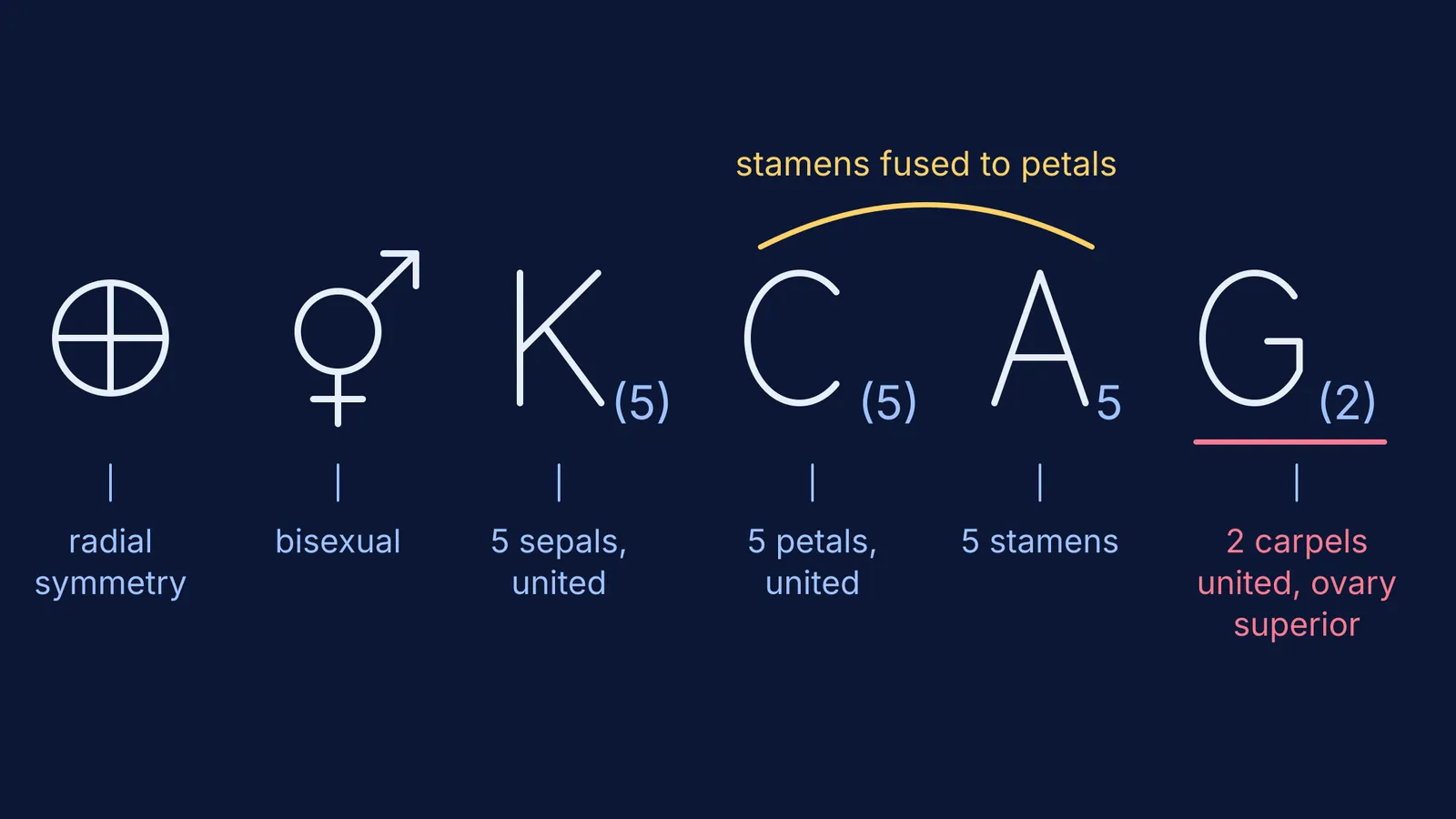
The chapter's family example is Solanaceae, the potato family. Its formula in the NCERT chapter is ⊕ ⚥ K(5) C(5) A5 G(2), with an arc over C and A and a line under G. Read it left to right:
⊕ ⚥: the flower is actinomorphic and bisexual.
K(5): five sepals, united.
C(5): five petals, united.
A5 under the arc: five stamens joined to the petals, which NCERT calls epipetalous.
G(2) with the line below: two fused carpels (bicarpellary, syncarpous) and a superior ovary.
The chapter's other worked formula is mustard (family Brassicaceae): ⊕ ⚥ K2+2 C4 A2+4 G(2), with G underlined. Decode it yourself before asking the AI. One honest note: the chapter does not define the plus sign, so ask the AI and confirm with your teacher. For A2+4, recall that the chapter says filament length varies within a mustard flower.
How is racemose different from cymose inflorescence?
Inflorescence is the arrangement of flowers on the floral axis, and NCERT splits it into two major types by what happens to the apex (NCERT Chapter 5):
Racemose: the main axis keeps growing, and flowers are borne laterally in acropetal succession, so the oldest flowers sit lowest.
Cymose: the main axis ends in a flower, so its growth is limited, and flowers are borne in basipetal order.
For Solanaceae, the chapter gives the inflorescence as solitary, axillary or cymose as in Solanum.
How should you ask an AI to decode a floral formula?
Type the formula exactly, then give the AI rules:
"Here is a floral formula from NCERT Class 11 Biology: [formula]. Explain each symbol one at a time, in one line each. Do not add families or examples that are not in this formula. If a symbol could mean two things, say so. Then ask me three questions about it, one at a time, and wait for my answer."
Then run three checks on the reply:
Match every meaning to the NCERT symbol list.
Strike out any family or example the AI adds that is not in the chapter.
Ask it to describe the floral diagram in words (outer ring, centre, the dot), then draw it yourself.
See also how to study NEET biology diagrams with an AI tutor and the cover-and-check method for textbook diagrams.
How do you test yourself on only the NCERT examples?
Testing yourself also helps you remember. In a 2006 Psychological Science paper, Henry Roediger and Jeffrey Karpicke had students study prose passages and then either take free-recall tests or restudy. On final tests 2 days and 1 week later, the students who had been tested remembered more, even though restudying made students more confident (Roediger and Karpicke, 2006). On a final test after 5 minutes, restudying did better, which may help explain why rereading can feel like it works.
Close the chat and the book, then answer from memory:
Write the Solanaceae formula from its description.
What does the arc over C and A show?
How many stamens does mustard have, and is its ovary superior?
Name NCERT's actinomorphic and zygomorphic examples.
What does the dot on a floral diagram mark?
Which whorl is outermost, and which central?
Differentiate racemose and cymose inflorescence (Exercise 4a).
Describe a Solanaceae flower and draw its floral diagram (Exercise 6).
Mark every answer against the chapter, not the AI. Retry the misses after two days and again after a week. If terms keep tripping you up, go through these commonly confused plant biology terms.
If you would rather work through it with a tutor, Fermi's AI tutor draws the figure and checks understanding as it goes, and the Fermi Concept Library gives every concept in biology its own lesson.
Start tonight with one formula: decode it with the AI, then test yourself on it with the book closed.