

On this page
Plant biology has a habit of naming different things with almost the same word. NCERT's Class 12 chapter Sexual Reproduction in Flowering Plants ends with an exercise that asks you to differentiate hypocotyl and epicotyl, coleoptile and coleorhiza, integument and testa, and perisperm and pericarp. When the textbook sets a pair as a drill, it is worth drilling before NEET-UG too. Below, each pair gets what the textbook says and a one-line fix.
Plastid or plasmid: which one is in a plant cell?
Plastids are found in all plant cells and in euglenoids, and NCERT sorts them into chloroplasts, chromoplasts and leucoplasts by the pigments they carry (NCERT Class 11, Cell: The Unit of Life).
A plasmid is an autonomously replicating, circular, extra-chromosomal DNA; Stanley Cohen and Herbert Boyer cut an antibiotic-resistance gene from a plasmid in 1972 on the way to the first recombinant DNA (NCERT Class 12, Biotechnology: Principles and Processes).
One-line fix: plas-T-id, T for tint, because most plastids carry pigment (leucoplasts are the colourless ones); plas-M-id, M for a mini ring of DNA.
For the three plastid types side by side, see how chloroplasts, chromoplasts and leucoplasts differ.
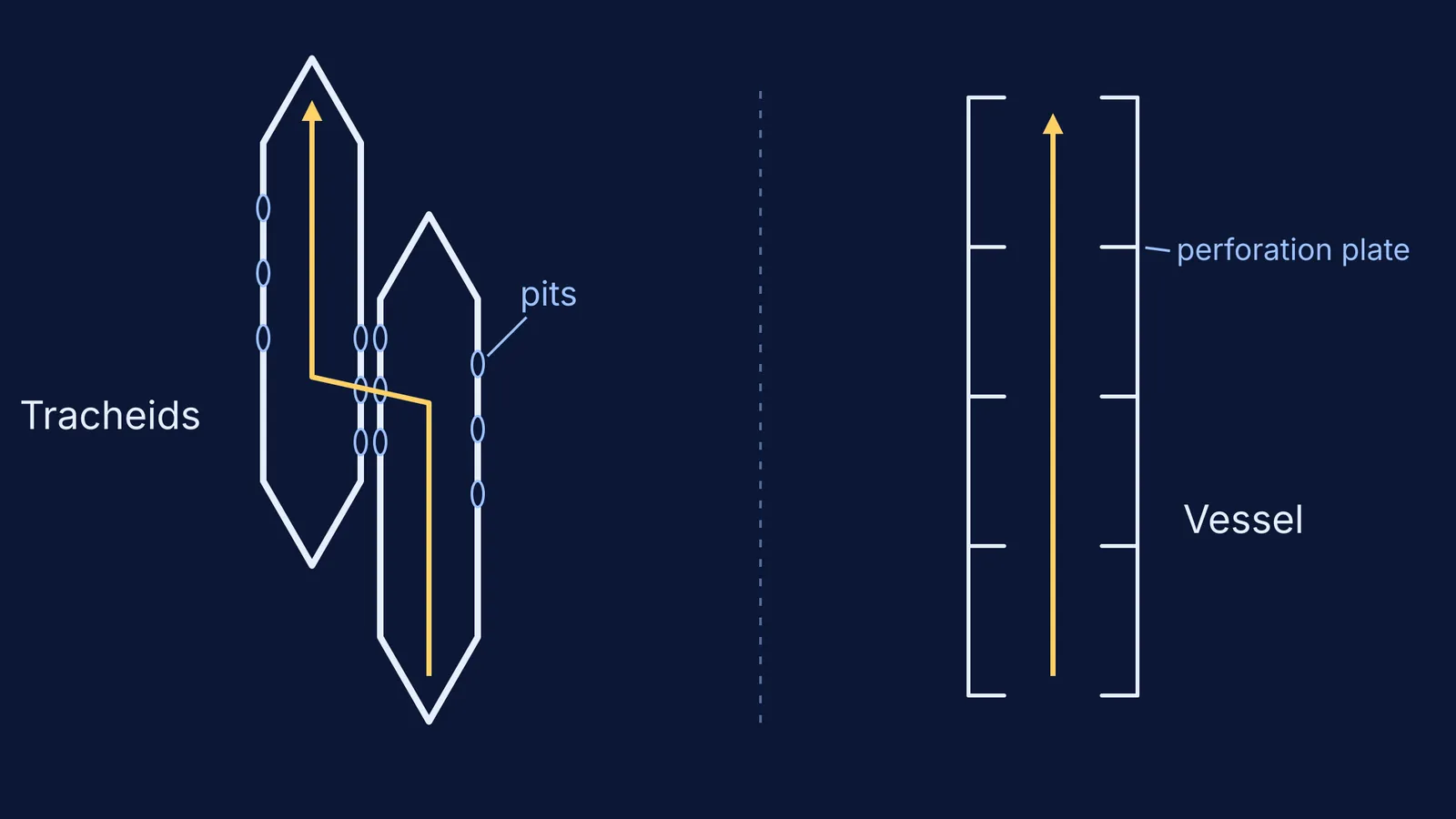
Tracheid or vessel: what is the difference?
Tracheids are xylem cells with thick, lignified secondary walls, and water passes from one tracheid to the next through pits in the side walls (OpenStax Biology 2e, Stems).
Vessel elements have thinner walls, are shorter than tracheids, and each one connects to the next through a perforation plate in its end wall, so a column of them works like a pipe (same source).
Conifer wood contains tracheids but no vessel elements, while gnetophytes have vessels as well as tracheids (OpenStax Biology 2e, Gymnosperms).
One-line fix: a tracheid is one long cell you leave by the side door (pits); a vessel is a vertical pipe of short cells with the end doors removed (perforations).
Pericarp or perisperm: which is in the fruit and which is in the seed?
The wall of the ovary develops into the wall of the fruit, called the pericarp (NCERT Class 12, Chapter 1).
In some seeds, such as black pepper and beet, remnants of the nucellus persist, and this residual, persistent nucellus is the perisperm (same chapter).
One-line fix: carp points to the fruit (think carpel, whose ovary becomes it), sperm points to the seed; pericarp comes from the ovary wall, perisperm from the nucellus.
A third peri- word, the pericycle, is a few layers of thick-walled parenchyma just inside the endodermis, where lateral roots begin (NCERT Class 11, Anatomy of Flowering Plants). Fix: cycle is a ring inside the root.
Perisperm sits close to endosperm, so pair this with albuminous and exalbuminous seeds.
How do you keep the seedling words straight?
All three pairs below come from the embryo and seed sections of the NCERT Class 12 chapter.
Epicotyl or hypocotyl: the epicotyl is the part of the embryonal axis above the cotyledons, ending in the plumule; the hypocotyl lies below, ending in the radicle. Fix: epi is above, hypo is below, as in hypodermic.
Coleoptile or coleorhiza: in a grass embryo the coleoptile is a hollow foliar structure around the shoot apex, and the coleorhiza is the sheath around the radicle and root cap. Fix: coleoPtile guards the Plumule, coleoRhiza guards the Root.
Integument or testa: integuments belong to the ovule and harden into tough protective seed coats as the seed matures. Fix: integument is the before (ovule), testa is the after (seed).
How should you revise confusable pairs before the exam?
Study the look-alikes mixed together, not one at a time. In experiments by Nate Kornell and Robert Bjork, people who saw paintings by different artists interleaved were better at naming the artist of new paintings than people who saw each artist's work in a block, even though participants rated blocking as more effective (Psychological Science, 2008).
A plan for one evening:
Write each pair on one card: both terms, where each sits, what each develops from, and the one-line fix.
Shuffle cards from different chapters so the order is unpredictable.
Say the difference aloud in one sentence, using the script below.
Draw a maize grain from memory, label pericarp, endosperm, scutellum, coleoptile and coleorhiza, and check against Figure 1.15 in the NCERT chapter.
Start the next session with the cards you got wrong.
Can you spot the swap?
Assertion: black pepper seeds contain perisperm. Reason: perisperm develops from the wall of the ovary. The assertion is true and the reason is false, because the ovary wall becomes the pericarp and the perisperm is persistent nucellus. That is exactly the swap the carp-and-sperm fix prevents.
If a pair stays shaky because the idea underneath is fuzzy (what the nucellus is, say), the Fermi Concept Library has a lesson for every biology concept, each with its place in the map. For mixed practice, the Fermi Problem Library has worked problems with a step-by-step solver that explains the reasoning rather than printing an answer.
Make tonight's first card plastid versus plasmid.


