

On this page
When you look at a plant cell under a light microscope, some of the most striking structures you will see are plastids. These organelles are found in all plant cells and in certain organisms like euglenoids (Wikipedia). In plants, they are surrounded by a double membrane. Because of their large size, they are easy to observe, making them a common topic in high school biology practicals.
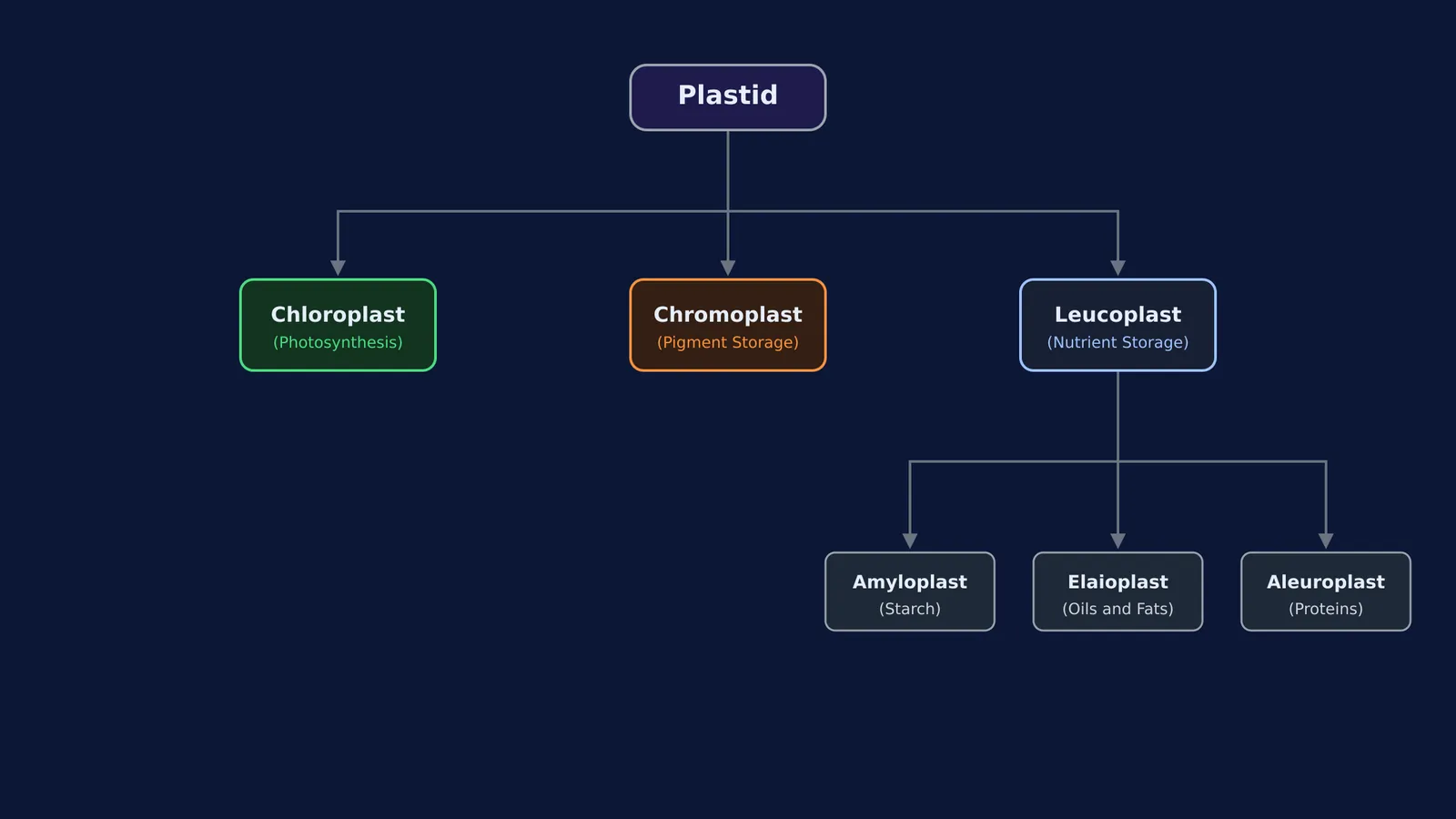
Plastids are factories and warehouses for the cell. They manufacture essential compounds and store nutrients that the plant needs to survive. Based on the pigments they contain, biologists divide plastids into three main categories: chloroplasts, chromoplasts and leucoplasts.
What are chloroplasts and chromoplasts?
If a plastid contains pigment, its job is usually related to interacting with light.
Chloroplasts are the most famous plastids. They contain the green pigment chlorophyll alongside carotenoids. These pigments trap the light energy required for photosynthesis, allowing the plant to make its own food. You will find them abundantly in the mesophyll cells of leaves. (For a closer look at how plants balance their energy during this process, read our guide on photorespiration: why RuBisCO wastes energy in C3 plants.)
Chromoplasts, on the other hand, contain fat-soluble carotenoid pigments like carotene and xanthophyll. These pigments give plant parts their vibrant yellow, orange or red colours. You see chromoplasts at work in the skin of a ripe tomato, the orange flesh of a carrot, and the bright petals of flowers. Their main function is to attract insects and animals for pollination and seed dispersal.
Plastids can change from one type to another depending on what the plant needs. For example, when a green fruit ripens, its chloroplasts often dismantle their photosynthetic machinery and turn into chromoplasts.
What do leucoplasts store?
Leucoplasts are colourless plastids. Since they lack pigment, they do not participate in photosynthesis or attract pollinators. Instead, they act as storage units for nutrients. They are typically found in non-photosynthetic tissues like roots, bulbs and seeds, far from the reach of sunlight.
Because plants need to store different types of food, leucoplasts differentiate into three specialised forms:
Amyloplasts store carbohydrates, specifically starch. A classic example is the potato tuber, which is packed with amyloplasts holding large starch granules.
Elaioplasts (also called oleoplasts) store oils and fats. They are common in the seeds of oil-yielding plants like mustard or sunflower.
Aleuroplasts (also known as proteinoplasts) store proteins. You will find these in the seeds of pulses and in the aleurone layer of maize grains.
If you are struggling to keep these names straight when revising meristems: apical, intercalary and lateral or cell organelles, the Fermi Concept Library can help you map out the relationships between different plant structures step by step.
How can you remember plastid types for exams?
In exams like NEET and Class 11 finals, questions often ask you to match the plastid to its function or stored nutrient. Here is a quick framework to help you remember:
Colour? Green = Chloroplast. Coloured (red/yellow/orange) = Chromoplast. Colourless = Leucoplast.
Storage? If the question mentions a colourless storage plastid, look at the root word:
*Amylo-* means starch (think of the enzyme amylase).
*Elaio-* means oil (from the Greek word for olive oil).
*Aleuro-* means flour or protein (like the aleurone layer in grains).
If you get stuck on a multiple-choice question about cell biology, the Fermi Problem Library provides a step-by-step solver that explains the reasoning behind each option instead of just printing the final answer.


