

On this page
When a seed forms, it receives a food supply to nourish the developing embryo until it can grow leaves and photosynthesise on its own. Depending on how this supply is managed, seeds are grouped into two main categories: albuminous and exalbuminous. Knowing how to classify them—and understanding the exceptions—is a staple of biology exams.
What are exalbuminous seeds?
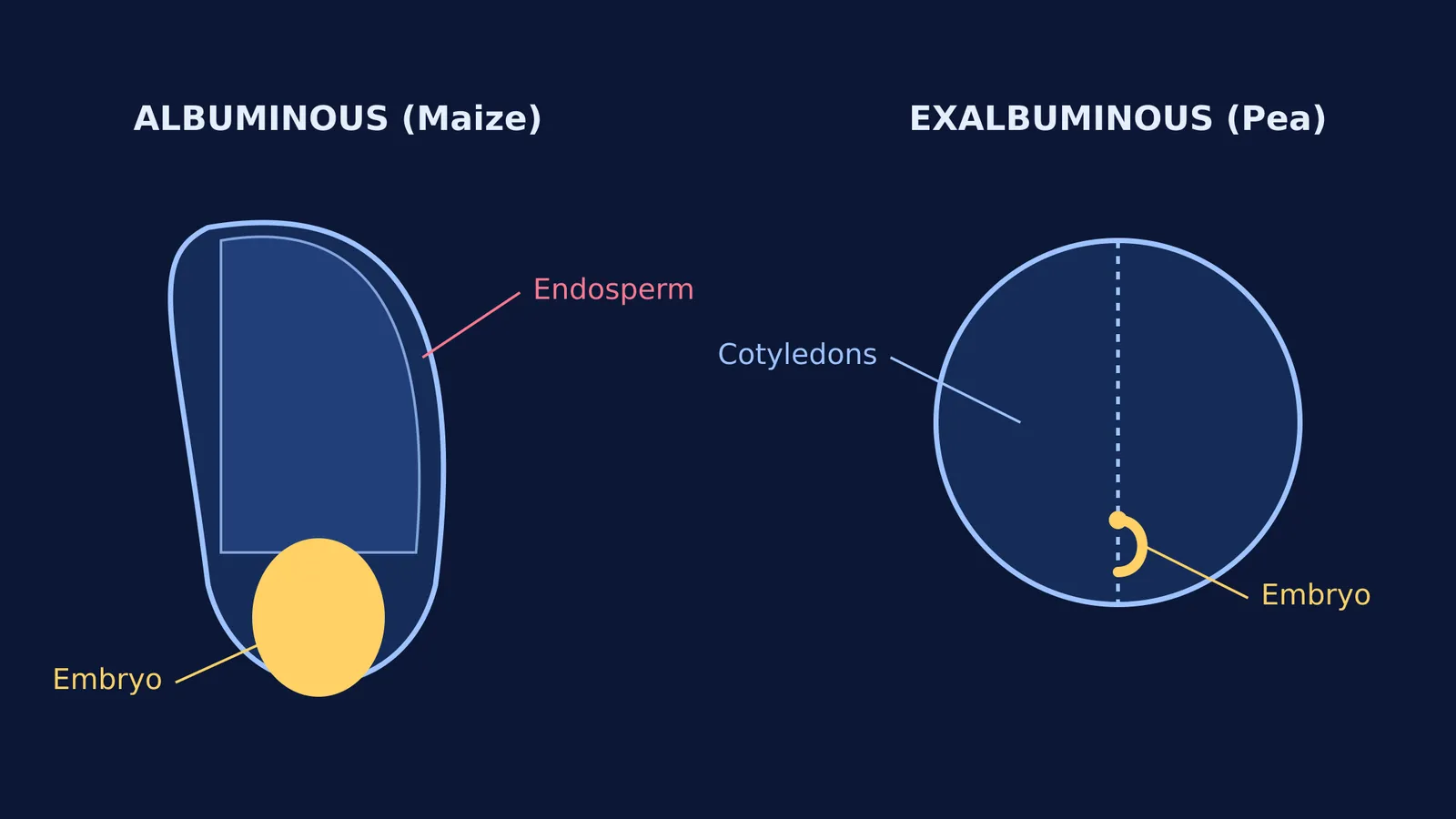
Exalbuminous (or non-endospermic) seeds do not retain any endosperm at maturity. Because the endosperm is entirely absorbed by the embryo during development, the seed must store its food reserves somewhere else. It packs this food into the cotyledons (seed leaves), which become thick and swollen.
Common examples include pea, groundnut, beans and gram. According to botanical classification, most exalbuminous seeds belong to dicotyledonous plants. When you split a pea or a peanut in half, the two large, fleshy halves you see are the cotyledons that have taken over the storage role. Because the endosperm is used up early, the mature seed consists almost entirely of the embryo and the seed coat.
What are albuminous seeds?
Albuminous (or endospermic) seeds retain a large amount of the endosperm because the embryo does not consume it all during its early growth. When the seed is planted and begins to germinate, it draws on this persistent endosperm for the energy it needs to push through the soil.
Examples include wheat, maize, barley and coconut. Most monocotyledons fall into this category. In a maize grain, for instance, the endosperm takes up the bulk of the internal space, storing starch and protein, while the embryo (which includes the scutellum) sits to one side. The endosperm remains distinct from the embryo until germination triggers its breakdown.
Why is castor an albuminous seed?
Castor is frequently tested because it breaks a simple rule of thumb. While most dicots are exalbuminous, castor is a dicot that retains a massive, oil-rich endosperm at maturity. The embryo sits as a thin structure alongside this large food reserve. This makes castor a classic example of an albuminous dicot seed.
When studying plant reproduction, you will often encounter other specialised structures and processes alongside seed types, such as the mechanisms behind apomixis and polyembryony or the distinction between true fruits, false fruits and parthenocarpy.
Where does the perisperm persist?
Before a seed develops, the ovule contains a central mass of maternal tissue called the nucellus. In most plants, the nucellus is completely used up as the seed forms and the embryo sac expands. Occasionally, however, remnants of the nucellus survive in the mature seed. This residual, persistent nucellus is known as the perisperm.
Black pepper and beet are the standard examples of seeds with a perisperm. The perisperm wraps around the embryo and the endosperm (if present), acting as an additional layer of storage tissue.
How can you remember seed types for exams?
Sorting seeds by their food-storage tissue can feel like a memory test. If you are preparing for exams, memorising isolated lists of examples often leads to confusion under pressure. When the facts blur together, the Fermi Concept Library gives you a clear path back to the underlying principles. Fermi works out what you already know, builds a plan for the session, and teaches through it, holding a line of reasoning until the core idea clicks.
To keep the examples straight, you can use this decision checklist:
Does it have thick, fleshy cotyledons? It is likely exalbuminous (pea, groundnut, beans, gram).
Is it a common cereal grain? It is albuminous (wheat, maize, barley).
Is it castor? Remember the exception: it is a dicot, but it is albuminous.
Is it black pepper or beet? These are the specific cases where the perisperm survives.
This structural approach to biology is what the Fermi Problem Library supports, offering worked problems with a step-by-step solver that explains the reasoning rather than printing an answer.


