

On this page
In the NEET-UG biology section, diagrams are not decorative illustrations. Several questions directly display an NCERT figure with labels replaced by letters, or ask about the physiological functions of specific structures shown in a diagram. Most aspirants revise these figures passively: they open their textbook, gaze at the nephron or the embryo sac for a few minutes, and turn the page convinced that they have memorized it.
Why does staring at NCERT diagrams fail during NEET?
When you look at a printed diagram with all its labels and arrows visible, your brain easily recognises every structure. Cognitive scientists call this the illusion of explanatory depth or the recognition heuristic. Because the diagram is sitting directly in front of you, the visual layout feels intuitive and fluent. But recognition is fundamentally different from memory retrieval. During the actual exam, when the labels are replaced by letters like A, B, and C, you must reconstruct the spatial layout and biological functions entirely from internal memory.
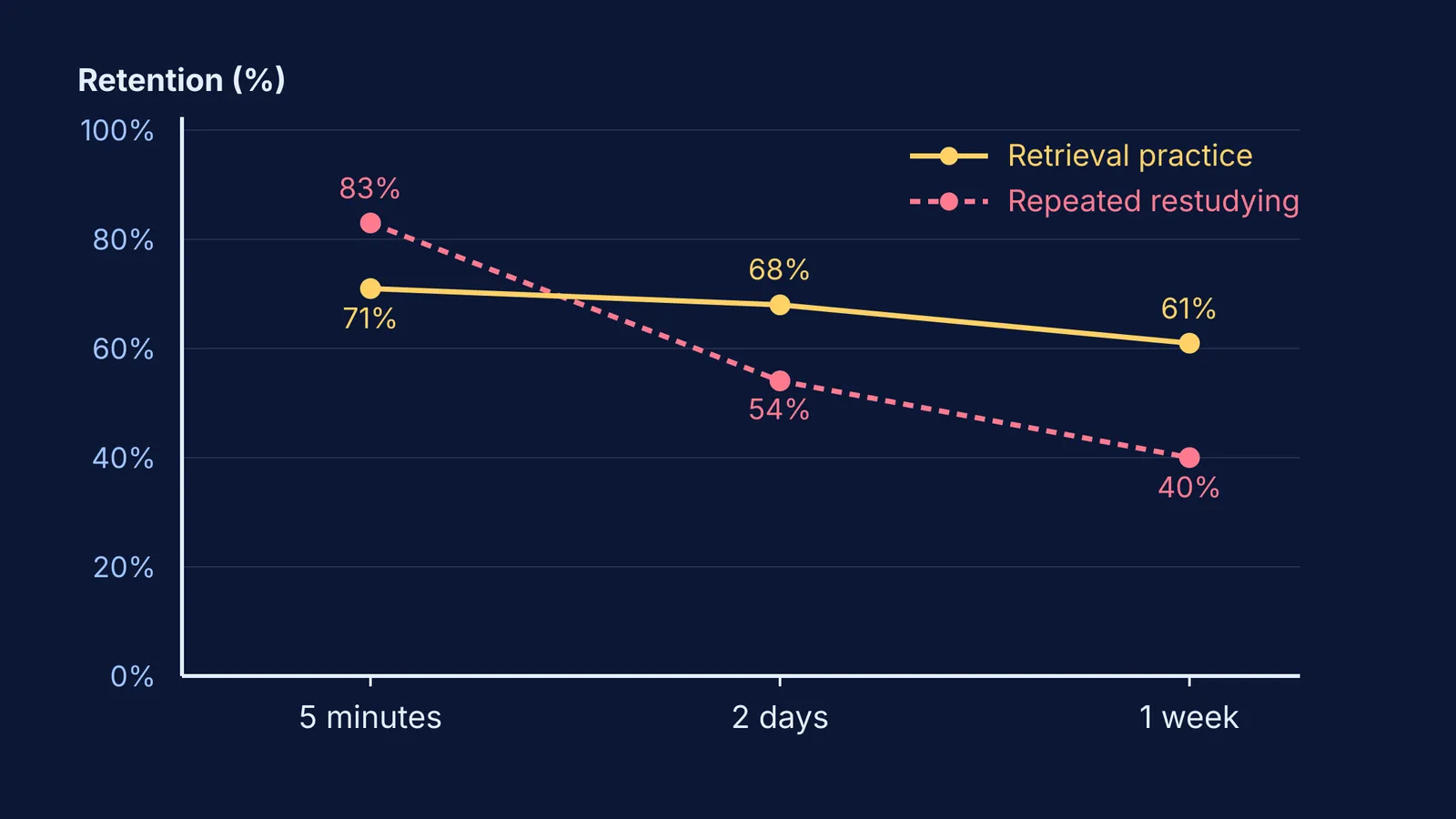
A classic 1989 study by John A. Glover in the *Journal of Educational Psychology* showed that taking an initial retrieval test on a diagram with labeled parts produced significantly higher delayed recall than simply restudying the diagram. In another landmark study, Henry L. Roediger and Jeffrey D. Karpicke (2006) found that while repeated studying produced higher scores on an immediate test after 5 minutes (83% versus 71%), the trend reversed dramatically after one week: students who engaged in repeated retrieval retained 61% of the material, whereas those who only restudied retained just 40%. Staring at a diagram gives you temporary fluency, but retrieval creates durable long-term retention. You can read more about effective visual revision in our guide to sketching and labelling diagrams for NEET biology.
Why does describing a diagram in words improve recall?
One of the most effective ways to force retrieval without looking at the book is to translate visual structures into spoken or written language. In a 2003 study in *Cognitive Science*, Shaaron Ainsworth and Andrea Thalia Loizou investigated how students learned the human circulatory system using text or diagrams. They found that students prompted to self-explain diagrams generated significantly more self-explanations, spent less total time learning, and scored significantly higher on post-tests than those learning from text alone.
When you describe a biological diagram in words, you engage in what learning scientists call dual coding. You force your brain to connect spatial coordinates (such as the outer cortex versus the inner medulla) with causal and biochemical mechanisms (such as osmolarity gradients and counter-current exchange). Furthermore, in a 2013 study published in *Advances in Physiology Education*, John L. Dobson found that students who completed brief retrieval quizzes retained 41% more anatomy and physiology material on their final semester evaluation compared to a control group.
Describing a diagram aloud or in text exposes invisible knowledge gaps. You might remember that the loop of Henle dips into the renal medulla, but you might forget whether the descending limb is permeable to water or electrolytes until you attempt to describe it from memory.
How can you use an AI tutor to test your diagram memory?
Instead of using an AI chatbot to generate passive summaries, you can turn it into an active testing partner. You describe the diagram entirely from memory, and instruct the AI to evaluate your spatial accuracy and quiz you on the details you omitted.
Here is an example prompt you can give an AI tutor:
"I am revising the NCERT diagram of the human nephron and Malpighian body for NEET biology. I will describe its parts and arrangement from memory. Please listen to my description, point out any structural labels or anatomical relationships I omitted or described incorrectly, and then ask me three follow-up questions testing the specific functions and physiological properties of those parts."
For instance, when you explain:
"The afferent arteriole brings blood into the glomerulus, a tuft of capillaries enclosed by Bowman's capsule. The efferent arteriole carries blood away. From Bowman's capsule, the filtrate passes into the proximal convoluted tubule, then down the descending loop of Henle, up the ascending limb, through the distal convoluted tubule, and finally into the collecting duct."
An AI tutor acting as a conversational quizzing partner can immediately identify what you left out:
You did not mention the relative diameters of the afferent and efferent arterioles, which create the high glomerular hydrostatic pressure required for ultrafiltration.
You omitted the podocytes with filtration slits in the visceral layer of Bowman's capsule.
You did not specify the location of the juxtaglomerular apparatus at the contact point between the afferent arteriole and the distal convoluted tubule.
The tutor can then quiz you: "Which of these structures is impermeable to water but allows active or passive transport of electrolytes?" This prompt forces you to retrieve the physiology of the ascending limb rather than just its visual name.
When revising complex physiological systems, Fermi's AI tutor teaches rather than merely printing an answer: it holds a line of reasoning across a session, notices where you are stuck, and decides whether to explain, ask, or show the concept. If you encounter related pathways that require deeper study, you can explore them in the Concept Library, which organizes every concept in physics, chemistry, biology, mathematics and computing, each with its own lesson and its place in the map.
How can you check your doubts against NCERT?
To make this practice reliable, always close the loop with the official textbook:
Close the book and describe: Spend three minutes describing an NCERT diagram from memory into the AI tutor—including structural layout, neighbouring tissues, and the direction of fluid or electrical flow.
Answer the AI's follow-up questions: Let the AI quiz you on the specific labels, permeability differences, or enzyme actions you skipped.
Open NCERT and cross-check: Compare your description and the AI's feedback directly with the textbook figure. Pay special attention to the figure caption and labels, similar to the care needed when checking NCERT exercise answers with AI.
Sketch the missed details once: On a blank sheet of paper, quickly draw the specific sub-structure you misidentified (such as the vasa recta or the layers of the filtration membrane) to fix the spatial relationship in memory.


