On this page
Structural Organisation in Animals is Chapter 7 of Class 11 NCERT Biology. Here are the 2026-27 syllabus, the frog as answer-ready points, and practice questions we wrote.
What does the 2026-27 syllabus include for this chapter?
The CBSE Biology curriculum for 2026-27 places it in Unit II, Structural Organization in Plants and Animals, which carries 10 marks of the 70-mark Class XI theory paper. Chapters 5, 6 and 7 share those 10 marks; CBSE gives no per-chapter figure.
Its Chapter 7 line asks for the frog's morphology and the anatomy and functions of its digestive, circulatory, respiratory, nervous and reproductive systems. Its formative-only list for Class XI names only Digestion and Absorption, so nothing in this chapter is set aside for formative-only assessment.
We followed the current NCERT chapter (Reprint 2026-27), which now has just two sections: 7.1 Organ and Organ System and 7.2 Frogs.
That list is in the NCERT rationalised content booklet for Class XI. The chapter still names the four tissue types, without their subtypes.
How do cells, tissues, organs and organ systems fit together?
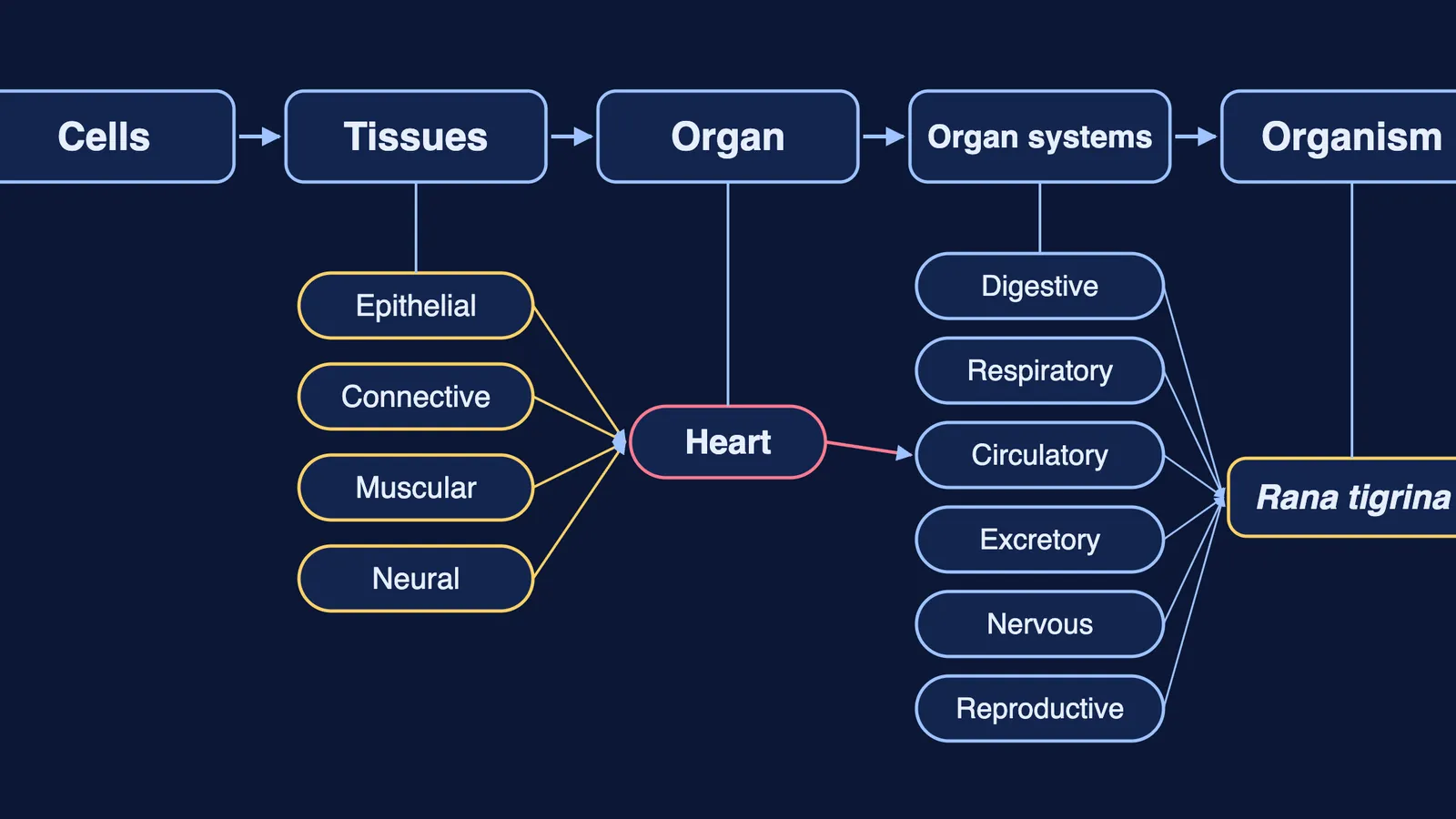
The NCERT chapter builds the ladder in the diagram above:
Tissue: similar cells, with intercellular substance, doing a specific function.
Four basic tissues: epithelial, connective, muscular and neural build every complex animal.
Organ: tissues arranged in a set proportion and pattern, such as the heart, which contains all four tissue types.
Organ system: two or more organs sharing a common function, such as digestion.
This split of work is division of labour. Morphology studies external form; anatomy studies internal organs.
What are the frog's key external features?
Frogs belong to class Amphibia, phylum Chordata; the common Indian species is Rana tigrina.
Cold-blooded (poikilotherms).
Change colour to hide; aestivate in summer and hibernate in winter in burrows.
Moist skin with mucus; it never drinks water but absorbs it through the skin.
Body has head and trunk only; no neck, no tail.
Nictitating membrane over the eyes; a tympanum receives sound.
Forelimbs have four digits, hind limbs five, with webbed feet.
Only males have vocal sacs for calling, and each male forelimb bears a copulatory pad on its first digit.
How do the frog's organ systems work?
Digestive: short gut (carnivore). A bilobed tongue catches food. Bile from the liver is stored in the gall bladder; bile and pancreatic juice reach the duodenum through a common bile duct.
Respiratory: skin in water (cutaneous); buccal cavity, skin and lungs (pulmonary) on land; only skin during aestivation and hibernation.
Circulatory: closed, with a lymphatic system as well. A pericardium wraps a three-chambered heart: two atria and one ventricle. The sinus venosus joins the right atrium; the conus arteriosus leaves the ventricle. Hepatic and renal portal systems are present. RBCs are nucleated.
Excretory: kidneys of uriniferous tubules (nephrons), ureters, urinary bladder, cloaca. It excretes urea: ureotelic.
Control and coordination: central (brain and spinal cord), peripheral (ten pairs of cranial nerves, plus spinal nerves) and autonomic systems. Forebrain: olfactory lobes, cerebral hemispheres, diencephalon. Midbrain: optic lobes. Hindbrain: cerebellum, medulla oblongata.
Reproductive: males have testes, 10 to 12 vasa efferentia, Bidder's canal and a urinogenital duct. Female oviducts open separately into the cloaca. One spawning releases 2500 to 3000 ova; fertilisation happens outside the body, in water, and tadpoles metamorphose into adults.
What practice questions should you try?
The mark labels are our suggestion, not a CBSE allocation; formats follow the Class XII Biology sample paper for 2026-27, as no Class XI paper is published.
(1 mark) Name the membrane that covers the frog's heart.
(1 mark) How many pairs of cranial nerves arise from the frog's brain?
(2 marks) Trace bile from where it is made to where it acts, and state its job.
(2 marks) A frog spends winter in a deep burrow. Which organ exchanges gases then, and by what process?
(3 marks) Compare the routes by which sperm and ova reach the cloaca.
(3 marks) Name the three regions of the frog's brain with one structure in each.
(5 marks) Draw a labelled outline of the frog's heart showing four named parts, and describe the path of blood in and out of it.
Answers: 1. Pericardium. 2. Ten. 3. Liver, gall bladder, common bile duct, duodenum; emulsifies fat. 4. Skin; diffusion. 5. Testes, vasa efferentia, kidney, Bidder's canal, urinogenital duct, cloaca; ovaries, oviducts, cloaca. 6. Forebrain (cerebral hemispheres), midbrain (optic lobes), hindbrain (cerebellum). 7. Sinus venosus, two atria, ventricle, conus arteriosus; vena cava, sinus venosus, right atrium; ventricle, conus arteriosus, arteries.
How should you revise this chapter?
Redraw the ladder from memory and give two facts per frog system. Pair this with Animal Kingdom for Class 11, where Amphibia first appears, and Cell: The Unit of Life for Class 11, the next chapter. Preparing for NEET too? Read tissues and the frog for NEET.
Not sure where to start? Fermi's AI tutor works out what you already know and builds a plan for the session, so you start from the gap.