On this page
Class 11 Probability teaches you to write events as sets and give them probabilities that obey three rules. Here is what the 2026-27 exam keeps, with worked examples.
What is in Class 11 Probability for 2026-27?
In the CBSE Mathematics curriculum for 2026-27, Probability sits in Unit V, Statistics and Probability, which carries 12 of the 80 theory marks. That 12 is shared with Statistics; there is no separate figure for Probability. The exam list covers events, exhaustive and mutually exclusive events, axiomatic (set theoretic) probability and the probability of 'not', 'and' and 'or' events. The table adds: "No chapter/unit-wise weightage. Care to be taken to cover all the chapters."
One part is not examined. For Class XI, the same curriculum says: "The following topics are included in the syllabus but will be assessed only formatively to reinforce understanding without adding to summative assessments." Its Probability entry reads: "Random experiments; outcomes, sample space (set representation)." The sections below leave it out, though you still use sample spaces as a tool.
Study Chapter 14 of the NCERT Class 11 Mathematics textbook (Reprint 2026-27): 14.1 Event and 14.2 Axiomatic Approach to Probability. Conditional probability and Bayes' theorem wait for Class 12; see our Class 12 Probability board exam guide, or probability for JEE Main for the entrance-exam angle.
How do you write events as sets?
In NCERT's Chapter 14, an event is simply a subset E of the sample space S. Event words become set operations:
Impossible event: φ. Sure event: S.
'not A': A′ = S − A.
'A or B': A ∪ B. 'A and B': A ∩ B. 'A but not B': A − B.
Mutually exclusive: A ∩ B = φ.
Exhaustive: E1 ∪ E2 ∪ ... ∪ En = S.
What is the axiomatic approach to probability?
NCERT defines probability P by three axioms:
P(E) ≥ 0 for any event E.
P(S) = 1.
If E and F are mutually exclusive, P(E ∪ F) = P(E) + P(F).
Each outcome gets a number from 0 to 1, these add to 1, and P(A) sums the outcomes in A. With n(S) equally likely outcomes, P(E) = n(E)/n(S). It follows that P(φ) = 0, P(not A) = 1 − P(A) and P(A ∪ B) = P(A) + P(B) − P(A ∩ B).
Worked examples: how do you use the rules?
Example 1: is the assignment valid? A weighted four-sided die has P(1) = 0.1, P(2) = 0.25, P(3) = 0.3, P(4) = 0.35. Each value lies in [0, 1] and they add to 1, so it is valid. Let A = 'odd' = {1, 3} and B = 'at least 3' = {3, 4}.
P(A) = 0.4, P(B) = 0.65, and P(A and B) = P(3) = 0.3.
P(A or B) = 0.4 + 0.65 − 0.3 = 0.75. Check: P({1, 3, 4}) = 0.75.
P(not B) = 0.35, and P(A and not B) = P(1) = 0.1.
Values 0.4, 0.5, 0.3 and −0.2 also add to 1, but −0.2 breaks the first axiom, so that assignment is invalid.
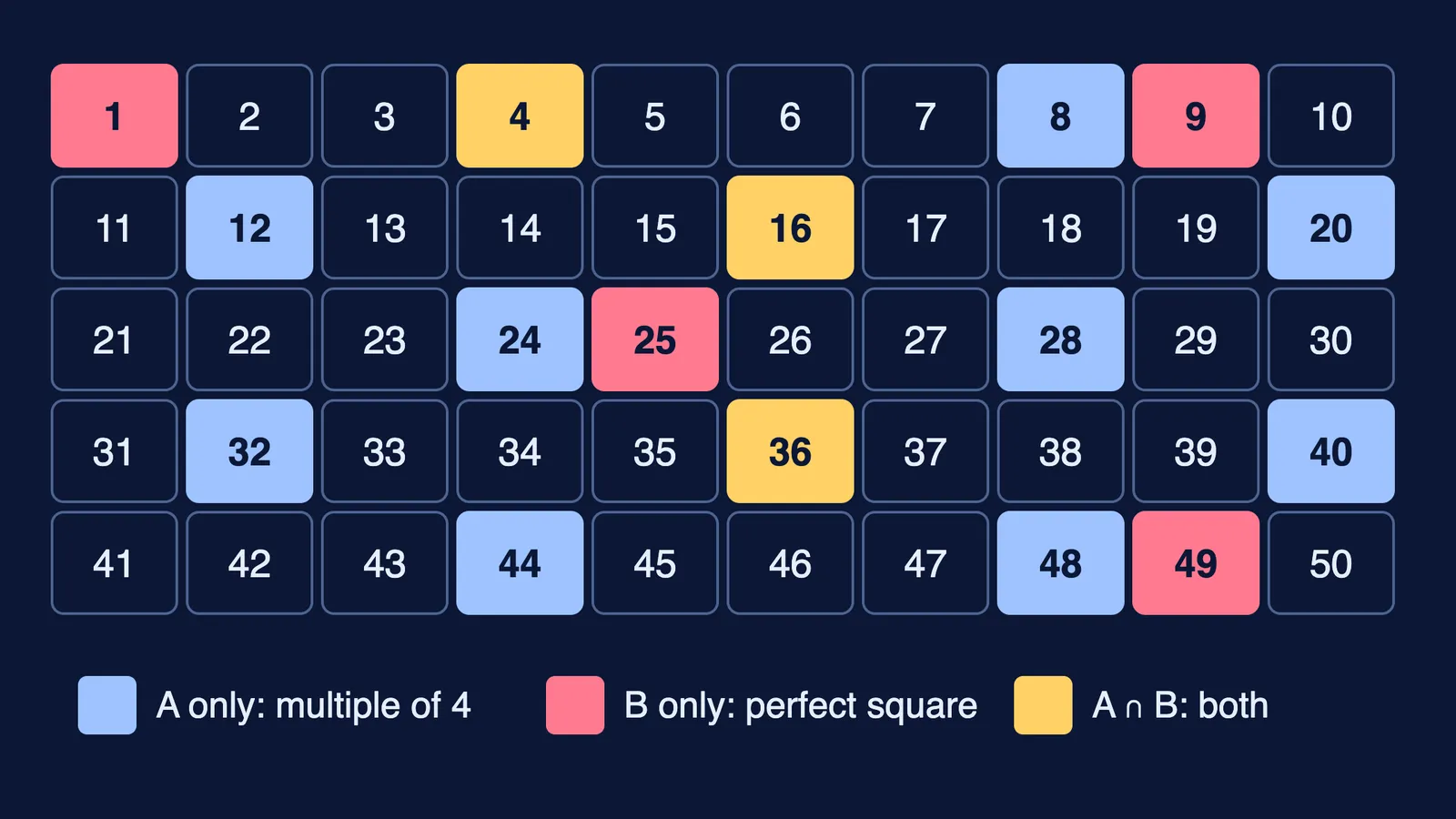
Example 2: the 'or' rule by counting. A number is chosen at random from 1 to 50. Let A = 'multiple of 4' and B = 'perfect square', as in the diagram above.
n(A) = 12, and B = {1, 4, 9, 16, 25, 36, 49}, so n(B) = 7.
A ∩ B is the even squares, {4, 16, 36}, so n(A ∩ B) = 3.
P(A or B) = 12/50 + 7/50 − 3/50 = 16/50 = 8/25.
P(neither) = 1 − 8/25 = 17/25.
What practice questions should you try?
These are our own questions; the mark labels are our suggestion, not CBSE's.
(1 mark) If P(A) = 0.37, find P(not A).
(2 marks) A and B are mutually exclusive, P(A) = 0.35, P(B) = 0.45. Find P(A or B) and P(neither).
(2 marks) Can mutually exclusive events have P(A) = 0.6 and P(B) = 0.7? Give a reason.
(3 marks) P(A) = 0.55, P(B) = 0.3, P(A ∪ B) = 0.65. Find P(A ∩ B), P(A and not B) and P(not A and not B).
(3 marks) Outcomes ω1 to ω5 have probabilities 0.15, 0.2, 0.3, 0.25 and k. Find k, and P(E) for E = {ω1, ω4, ω5}.
Answers: (1) 0.63. (2) 0.8 and 0.2. (3) No: P(A ∪ B) would be 1.3. (4) 0.2, 0.35 and 0.35. (5) k = 0.1, P(E) = 0.5. All answers were checked by hand and in Python.
Which mistakes cost marks?
Adding P(A) and P(B) when the events overlap.
Taking 'not A and not B' as 1 − P(A ∩ B). It is 1 − P(A ∪ B).
Accepting an assignment that adds to 1 without checking each value is between 0 and 1.
Skipping the overlap in Example 2 gives 19/50, counting 4, 16 and 36 twice.
Not sure where to begin? Fermi's AI tutor works out what you already know and builds a plan for the session.