On this page
Probability rewards careful reading more than long calculation. Once the events are named correctly, most questions take a few lines. This guide covers what the official syllabus lists, works one original example per rule, and ends with a two-week plan.
What does the JEE Main 2027 syllabus include in probability?
Probability sits in Unit 13, "Statistics and Probability", of the NTA's Syllabus for JEE (Main) - 2027, linked as "Syllabus" from the JEE Main website. The probability part lists exactly four things:
probability of an event
addition and multiplication theorems of probability
Bayes' theorem
probability distribution of a random variable
The binomial distribution is not named, so we leave it out. Conditional probability, independence and total probability are not listed separately, but the multiplication theorem and Bayes' theorem depend on them.
Which NCERT chapters cover it?
Two chapters in the NCERT 2026-27 reprints:
Class 11, Chapter 14 Probability: events, mutually exclusive events, the axiomatic approach and P(A or B) (NCERT Class 11 Chapter 14).
Class 12, Chapter 13 Probability: conditional probability, the multiplication theorem, independent events, total probability and Bayes' theorem (NCERT Class 12 Chapter 13).
One gap: the Class 12 reprint stops at section 13.5 and defines a random variable only in a short remark, though the syllabus lists probability distributions. Our guide to probability distributions and their mean and variance works through them. If counting still feels slow, revise permutations and combinations for JEE Main first.
How do you use each rule? Five worked examples
1. Addition rule. Pick a number at random from 1 to 30. Find P(multiple of 3 or of 5). There are 10 multiples of 3, 6 multiples of 5, and 2 numbers (15 and 30) counted in both. So P = 10/30 + 6/30 − 2/30 = 14/30 = 7/15. Forgetting the overlap gives 16/30.
2. Conditional probability. Same numbers. Find P(multiple of 3, given even). The sample space shrinks to 15 even numbers, of which 5 (6, 12, 18, 24, 30) are multiples of 3. So P = 5/15 = 1/3.
3. Independent is not mutually exclusive. Roll a fair die. Let A = even {2, 4, 6} and B = {1, 2}. Then P(A) = 1/2, P(B) = 1/3 and P(A and B) = P({2}) = 1/6 = P(A) × P(B), so A and B are independent, yet they overlap. Now take C = {1, 3}. A and C are mutually exclusive, so P(A and C) = 0, not 1/2 × 1/3: they are dependent.
4. Multiplication theorem. Bag I holds 3 red and 5 blue balls. Draw two without replacement. P(both red) = 3/8 × 2/7 = 6/56 = 3/28. The 2/7 is conditional: after one red ball, 2 red remain among 7.
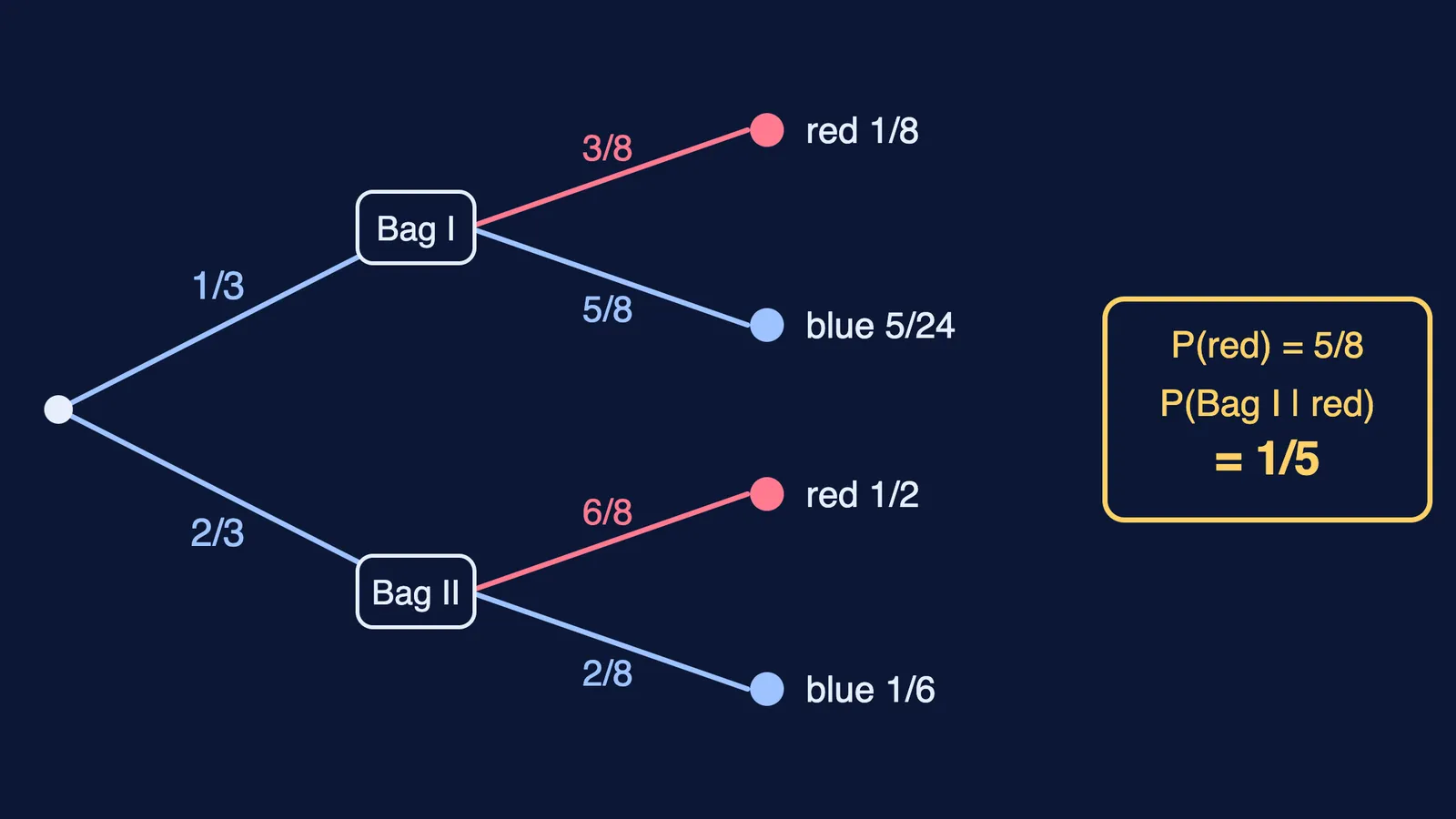
5. Total probability, then Bayes. Roll a die. On 1 or 2, draw a ball from Bag I (3 red, 5 blue); otherwise draw from Bag II (6 red, 2 blue). So P(I) = 1/3 and P(II) = 2/3.
Total probability: P(red) = 1/3 × 3/8 + 2/3 × 6/8 = 1/8 + 1/2 = 5/8.
Bayes: P(Bag I given red) = (1/8) ÷ (5/8) = 1/5, so P(Bag II given red) = 4/5.
Draw the tree first, as in the diagram at the top of this post. Each branch product is one term of the total; Bayes divides one branch by the sum of all branches ending in red. For the same idea with a medical test, read Bayes' theorem and a positive test result.
A probability distribution. Let X be the number of red balls in two draws from Bag I without replacement. P(X = 0) = 5/8 × 4/7 = 5/14, P(X = 1) = 2 × 3/8 × 5/7 = 15/28 and P(X = 2) = 3/28. These add to 10/28 + 15/28 + 3/28 = 1, a check worth doing every time. We verified every answer here with exact fractions and by listing all outcomes in Python.
What traps cost marks most often?
Reversing the condition. P(red given Bag I) is 3/8; P(Bag I given red) is 1/5.
Replacement. Underline "with" or "without" before you start.
Missing branches. First-stage probabilities in a tree must add to 1.
If one step keeps going wrong, the Fermi Problem Library has worked problems with a step-by-step solver that explains the reasoning rather than printing an answer.
How should you plan two weeks of probability practice?
Days 1-3: Class 11 Chapter 14. List the sample space before using the addition formula.
Days 4-6: conditional probability, the multiplication theorem and independence. For each pair of events, write whether they are independent, mutually exclusive or neither.
Days 7-9: total probability and Bayes, with a tree for every question.
Days 10-11: probability distributions; check each table sums to 1.
Days 12-14: mixed timed sets from past JEE Main papers. Log each error as wrong event, wrong rule or arithmetic.