On this page
You have probably met this question in the NCERT Class 12 Mathematics probability chapter, Exercise 13.3, Question 5. A test catches 99% of cases, you test positive, so you must be 99% likely to be ill. That feels right, and it is wrong by a factor of about six. Below, you solve it with the formula, then check by counting.
What does the NCERT question actually say?
In Exercise 13.3 of the NCERT chapter, a laboratory blood test is 99% effective in detecting a disease when it is present. The same test gives a false positive for 0.5% of healthy people tested. Only 0.1% of the population has the disease. You are asked for the probability that a person has the disease, given that their test is positive.
Name the events before touching any numbers. Let D be "the person has the disease" and T be "the test is positive". Then:
P(D) = 0.001, the base rate (NCERT calls this the "priori probability")
P(D') = 0.999
P(T | D) = 0.99, the chance a sick person tests positive
P(T | D') = 0.005, the false positive rate
The question wants P(D | T). The 99% in the question is P(T | D), the reverse conditional. Mixing up these two is the whole trap.
How do you find the probability of disease given a positive test?
The NCERT chapter states Bayes' theorem for a partition E1, ..., En as P(Ei | A) = P(Ei) P(A | Ei) divided by the sum of P(Ej) P(A | Ej) over all j, and proves it from the theorem of total probability (NCERT, section 13.5).
Numerator: P(D) × P(T | D) = 0.001 × 0.99 = 0.00099.
False-alarm term: P(D') × P(T | D') = 0.999 × 0.005 = 0.004995.
Denominator, the total chance of a positive: P(T) = 0.00099 + 0.004995 = 0.005985.
Answer: P(D | T) = 0.00099 / 0.005985 = 990/5985 = 22/133, which is about 0.165.
So a positive result raises the chance of disease from 0.1% to about 16.5%: a big jump, but nowhere near 99%.
For more examples of the method, see our guide to conditional probability and Bayes' theorem in three steps.
Why does a 99% accurate test give mostly false alarms?
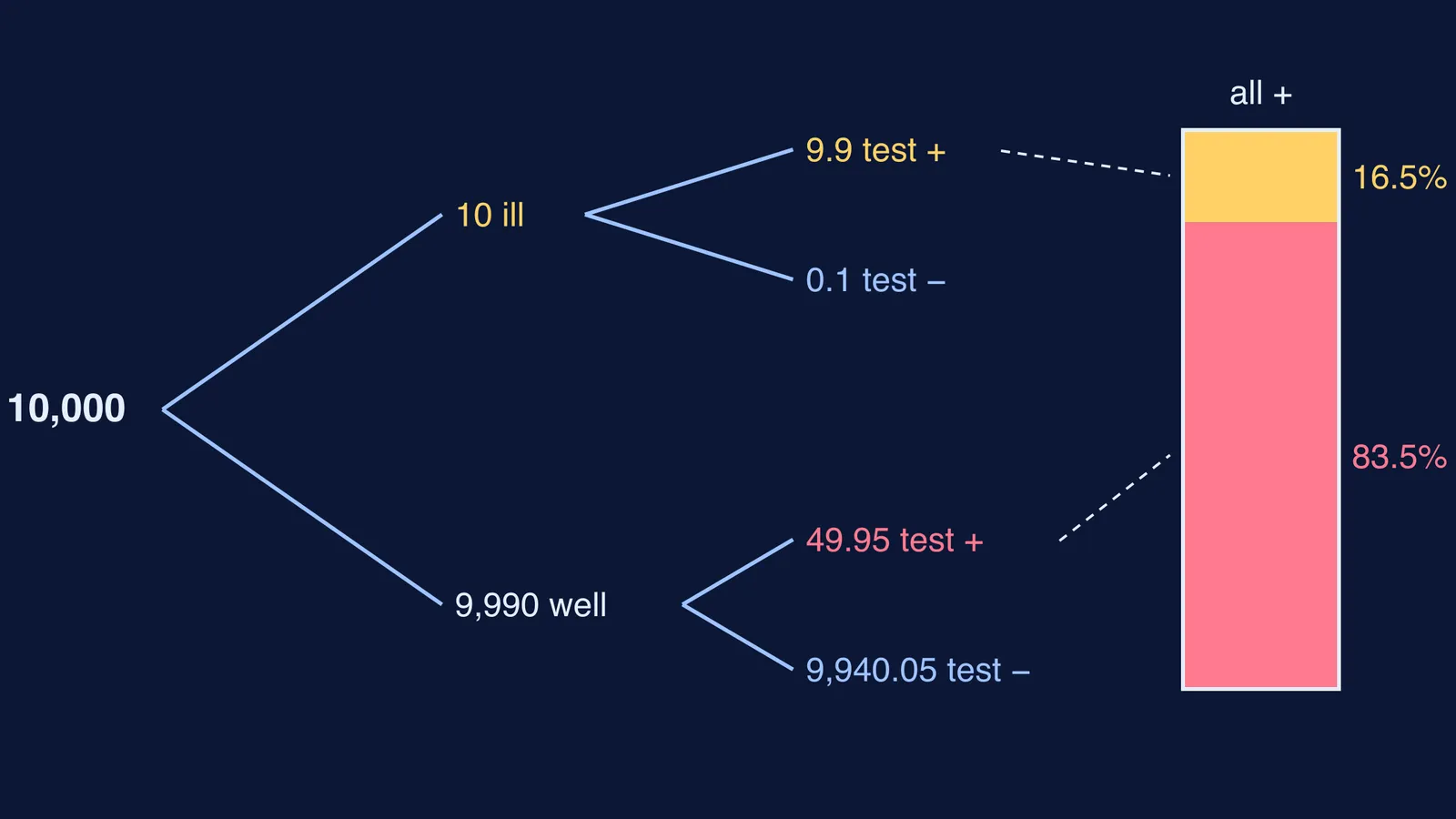
Count people instead of probabilities. Picture 10,000 people taking the test, using the rates from the NCERT question:
0.1% of 10,000 have the disease: 10 people. The other 9,990 are healthy.
99% of the 10 sick people test positive: 9.9 people.
0.5% of the 9,990 healthy people also test positive: 49.95 people.
Total positives: 9.9 + 49.95 = 59.85, about 60.
Sick among the positives: 9.9 out of 59.85, which is 0.165 again.
These are expected counts, so decimals appear; roughly 10 true positives sit beside 50 false ones.
NCERT's own worked example makes the same point. In Example 18 of the chapter, an HIV test catches 90% of cases and wrongly flags 1% of people without HIV, in a population where 0.1% have HIV. The probability that a person who tests positive actually has HIV comes out at about 0.083. A two-way table of counts is the same tool; see two-way table conditional probability, worked step by step.
Why is counting easier than the formula?
Psychologists Gerd Gigerenzer and Ulrich Hoffrage studied this kind of problem in a 1995 paper in Psychological Review. They showed that Bayesian algorithms are computationally simpler when the information is given in frequency formats (counts such as "10 out of 10,000") than in probability formats. According to the paper's abstract, when problems were presented that way, statistically naive participants derived up to 50% of all inferences by Bayesian algorithms.
So turn a slippery Bayes question into a crowd of people first; the formula then gives the exact fraction.
How should you write a Bayes answer in the board exam?
Use this checklist on every "given that" question:
Define each event in words, for example "D: the person has the disease".
Write the prior P(D), and its complement P(D').
Write both likelihoods: P(T | D) and P(T | D').
Check which conditional the question asks for. "Given the test is positive" means T comes after the bar.
Write the full denominator using total probability; the false-alarm term is the one students drop.
Simplify to a fraction such as 22/133, then sanity-check with 10,000 people.
If you get stuck on a step, the Fermi Problem Library has worked problems with a step-by-step solver that explains the reasoning rather than printing an answer. To revisit the ideas underneath, the Fermi Concept Library gives each concept, such as conditional probability, its own lesson.
This is a textbook model, not a guide to real results; a doctor can explain what a real positive test means.
For a picture of the same idea, see why a positive on a 99% accurate test may be a false alarm.