On this page
Permutations and Combinations is a short unit with a long reach: its counting habits carry into probability and the binomial theorem. The usual mistakes are counting something twice or missing a case. Here is what the syllabus asks, six worked examples and a two-week plan.
What does the JEE Main syllabus include in Permutations and Combinations?
The official Syllabus for JEE (Main) - 2027, linked as "Syllabus" on the NTA JEE Main website, lists Mathematics Unit 4 as: the fundamental principle of counting, permutations and combinations, the meaning of P(n, r) and C(n, r), and simple applications.
That maps onto Chapter 6 of the NCERT Class 11 Mathematics textbook (Reprint 2026-27): the fundamental principle of counting, factorial notation, nPr = n!/(n − r)!, permutations of objects that are not all distinct, and nCr = n!/(r!(n − r)!). Circular arrangements appear in neither document.
If nC0 = 1 puzzles you, start with why 0! is defined as 1.
How do you solve P&C problems step by step?
We checked every answer below twice: by formula and by listing every case in a short Python script.
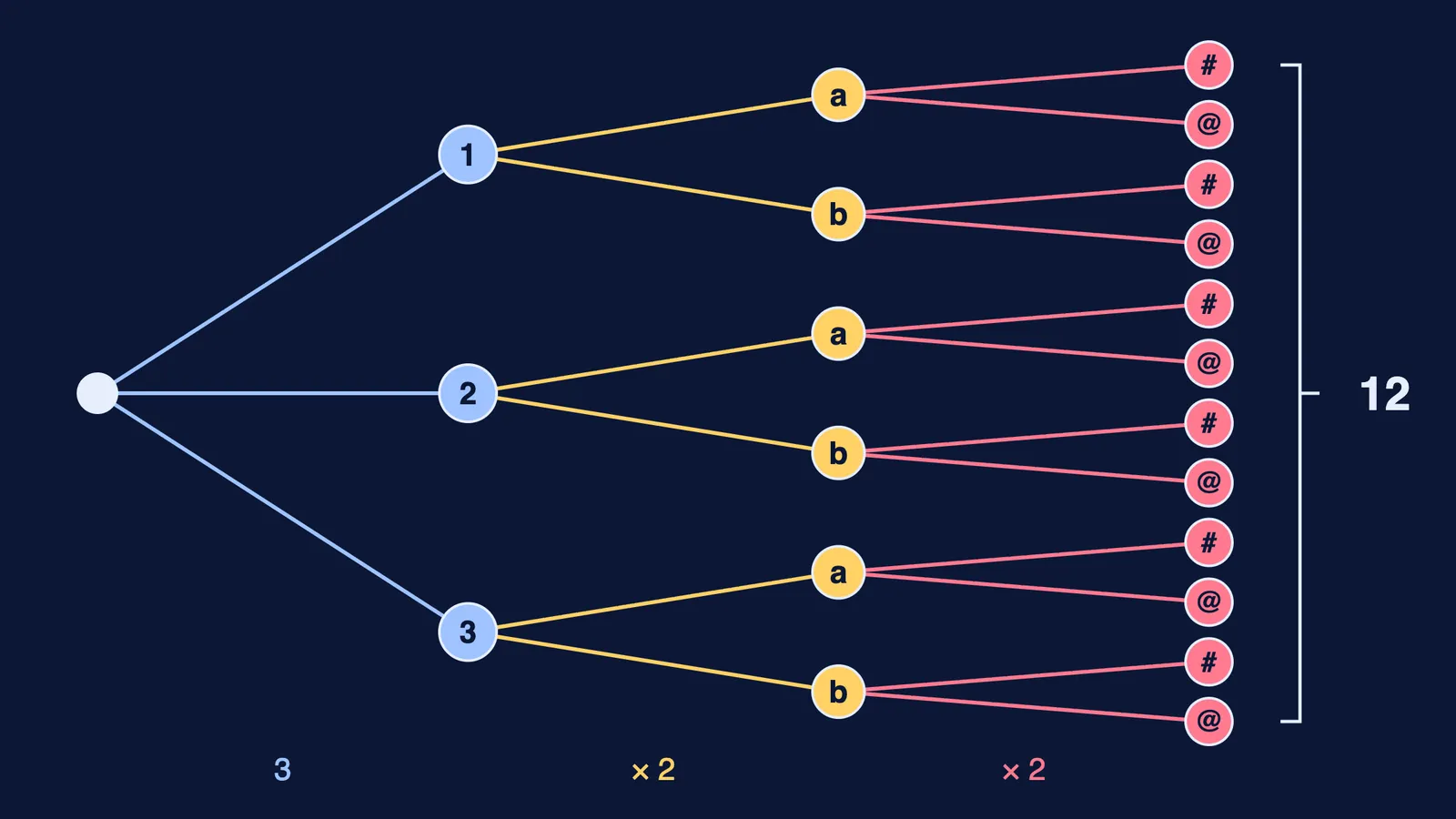
1. Multiplication principle. A code is one digit from {1, 2, 3}, then a letter a or b, then a symbol # or @. Each first choice leads to the same next choices, so multiply: 3 × 2 × 2 = 12. The decision tree in the image above has exactly 12 leaves.
2. nPr versus nCr. From 9 students, pick a captain, vice-captain and treasurer: order matters, so 9P3 = 9 × 8 × 7 = 504. Pick a 3-member group instead: order does not matter, and each group was counted 3! = 6 times in the 504, so 9C3 = 504 ÷ 6 = 84.
3. Repeated letters. TOFFEE has 6 letters with F twice and E twice. Swapping the two Fs or the two Es changes nothing, so 6! ÷ (2! × 2!) = 720 ÷ 4 = 180. For the "at least one repeat" twist, see words with a repeated letter.
4. Restrictions in a row. Six friends A to F stand in a line (6! = 720 ways).
A and B together: glue them into one block, arrange 5 units in 5! ways, times 2 orders inside the block: 240.
A and B never together: 720 − 240 = 480. Check by the gap method: arrange the other four in 4! = 24 ways, which leaves 5 gaps, and place A and B in two different gaps in 5P2 = 20 ways: 24 × 20 = 480.
A at either end: 2 × 5! = 240. A at the left end and B at the right end: the middle four fill in 4! = 24 ways.
5. At least one, and a committee rule. Choosing at least one of 5 different books: each is in or out, so 2⁵ − 1 = 31 (minus the empty choice). From 5 girls and 6 boys, form a committee of 4 with at least 2 girls. Split by cases: 5C2 × 6C2 + 5C3 × 6C1 + 5C4 = 150 + 60 + 5 = 215. Check by complement: 11C4 = 330, minus no girls (6C4 = 15) and exactly one girl (5 × 6C3 = 100), gives 215.
Why do students overcount in Permutations and Combinations?
6. The overcounting trap. For the same committee, a tempting shortcut is "pick 2 girls, then any 2 of the other 9": 5C2 × 9C2 = 10 × 36 = 360. It is wrong. A committee with 3 girls gets counted 3 times, once for each pair you could have called "the first two", and a committee with 4 girls gets counted 6 times. Indeed 150 + 3 × 60 + 6 × 5 = 360, while the true answer is 215.
Other traps:
Using nCr when roles differ (captain, vice-captain), or nPr when they do not.
Forgetting the internal order of a glued block.
Adding when you should multiply: "and then" multiplies, "either-or" with no overlap adds.
How should you practise Permutations and Combinations for JEE Main?
A two-week plan, 45 minutes a day:
Days 1-3: multiplication and addition principles. Draw a tree for small problems until you can predict the leaf count.
Days 4-6: nPr, nCr and repeated letters. Say whether order matters before writing a formula.
Days 7-9: restrictions and committees. Solve each one two ways, by cases and by complement, until both agree.
Days 10-12: mixed sets from previous JEE Main papers, timed. Tag each error: wrong formula, missed case or double count.
Days 13-14: redo only the logged errors, then a fresh timed set.
For small cases, listing every outcome by hand or in a few lines of code is the most reliable check you have.
When an answer will not match, the Fermi Problem Library has worked problems with a step-by-step solver that explains the reasoning rather than printing an answer, so you can see which case you missed.