On this page
"How many words have at least one letter repeated?" looks like a question with a dozen cases. One letter twice, two pairs, one letter three times, all four the same. Count those cases one by one and you will almost certainly miss one or count one twice. There is a two-line method that avoids all of it.
How do you count words with at least one repeated letter?
Every word either has all its letters different, or it has at least one letter repeated. It cannot be both, and it cannot be neither. So the two groups together make up all the words, and you can find the hard group by subtraction:
Words with at least one repeat = all words − words with all letters different.
Both counts on the right come from the multiplication principle, which NCERT's Class 11 Mathematics textbook, Chapter 6 states as: "If an event can occur in m different ways, following which another event can occur in n different ways, then the total number of occurrence of the events in the given order is m×n."
For words of length r made from n different letters:
With repetition allowed, each of the r places has n choices, so there are n^r words.
With no repetition, the choices shrink by one each time: n × (n − 1) × … × (n − r + 1), written nPr.
With at least one letter repeated, there are n^r − nPr words.
"Words" here means any arrangement of letters, with or without meaning, which is how NCERT phrases these questions.
Worked example: four-letter words from ROSE
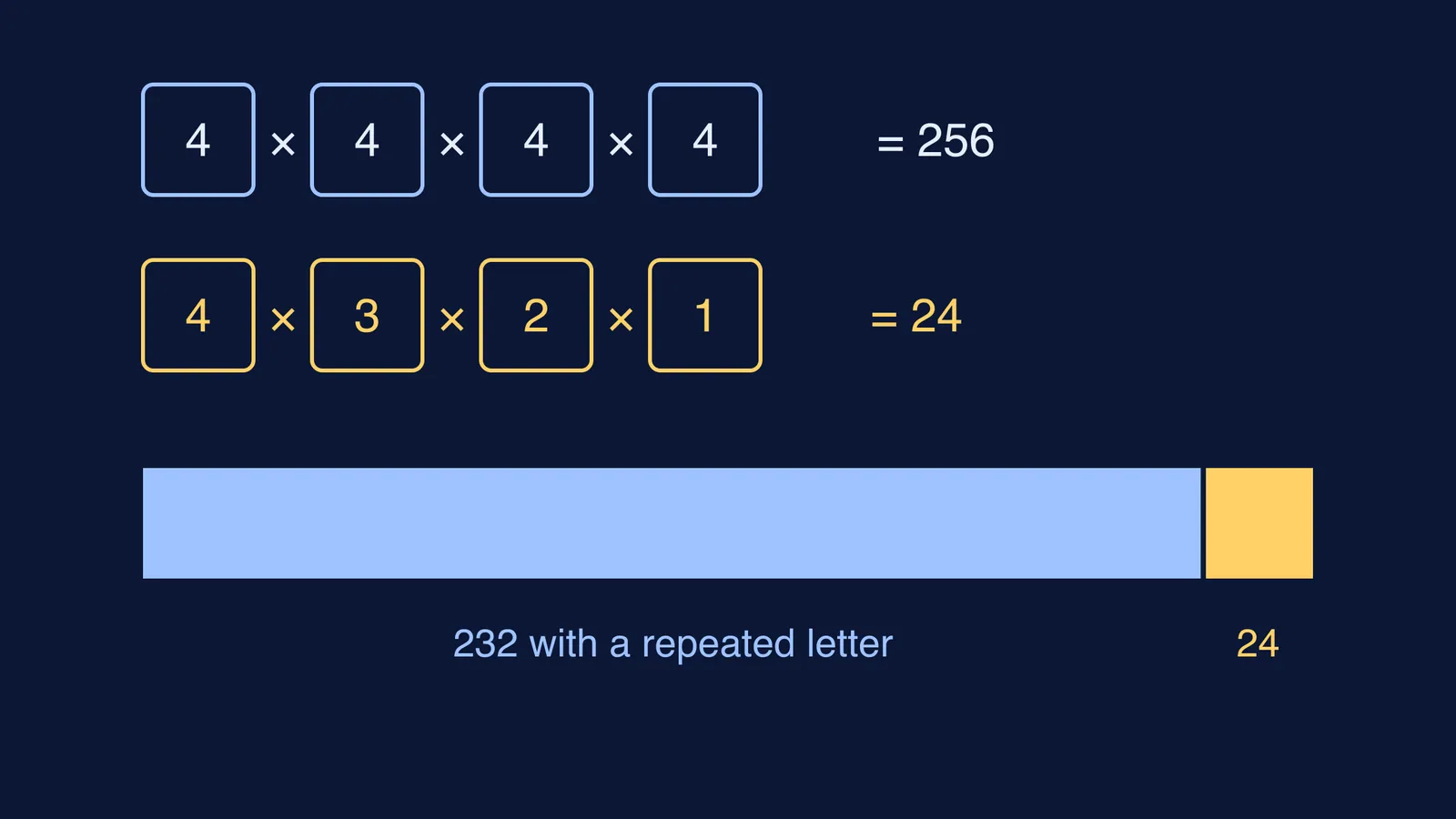
NCERT's Example 1 counts the 4-letter words that can be made from R, O, S and E without repeating a letter: 4 × 3 × 2 × 1 = 24. The note right after it asks what happens if repetition is allowed: each of the 4 places can be filled in 4 ways, so 4 × 4 × 4 × 4 = 256 words.
Now subtract. 256 − 24 = 232 four-letter words from ROSE have at least one letter repeated. ROOS, EEEE and RSRS are all in that 232; ROSE and SORE are among the 24.
The same chapter counts 3-letter words from the letters of NUMBER: 6 × 6 × 6 = 216 with repetition and 6 × 5 × 4 = 120 without. So 216 − 120 = 96 of them repeat a letter.
If you want to see why subtraction is safe, try the smallest case by hand. Two-letter words from A and B: AA, AB, BA, BB. That is 2 × 2 = 4 in all, 2 × 1 = 2 with different letters (AB, BA), and 4 − 2 = 2 with a repeat (AA, BB). The formula and the list agree.
What about longer words from the whole alphabet?
The method does not change when the numbers get big; it is the same multiplication principle from the NCERT chapter. For 5-letter words from the 26 letters of the English alphabet:
All words: 26^5 = 11,881,376.
All letters different: 26 × 25 × 24 × 23 × 22 = 7,893,600.
At least one letter repeated: 11,881,376 − 7,893,600 = 3,987,776.
That is roughly one five-letter string in three.
Which mistakes cost marks in these questions?
Splitting into cases (exactly one pair, two pairs, a triple) and missing one. Subtraction makes the cases unnecessary.
Using nCr instead of nPr for the all-different count. In a word, ROSE and SORE are different, so order matters. If you are unsure which to use, our post on the does-order-matter test for permutations and combinations walks through it.
Subtracting the wrong group. The opposite of "at least one letter repeated" is "all letters different", not "exactly one letter repeated".
Counting letters instead of different letters. When repetition is allowed and you build words from the letters of LETTER, you are choosing among L, E, T and R, so n is 4, not 6.
The same "count the opposite" idea runs through probability: the chance something happens at least once is 1 minus the chance it never happens, as in our post on why the probability of not happening is 1 minus P(E).
How should you practise this?
For any short word, find three numbers: the total with repetition, the total without, and the difference. Do it for a 2-letter word first, list everything to check, then move to 4 and 5 letters. When a question adds a condition, such as "must start with a vowel", apply the condition to both counts before you subtract.
If you get stuck on a variation, the Fermi Problem Library has worked problems with a step-by-step solver that explains the reasoning rather than printing an answer. For the definitions behind nPr and the multiplication principle, the Fermi Concept Library gives each concept its own lesson.