On this page
You throw two dice and need the chance of at least one six. You could list every outcome with a six in it, or count the outcomes with no six at all and subtract from 1. This post shows why that subtraction always works and how to spot the board questions where it saves time.
Why does P(E) + P(not E) = 1?
The event "not E", written Ē or E′, is every outcome in the sample space that is not in E. NCERT's Class 10 maths textbook calls Ē the complement of E and states the rule: P(Ē) = 1 − P(E) (NCERT Class 10 Mathematics, Chapter 14).
The Class 11 textbook gives the reason (NCERT Class 11 Mathematics, Chapter 14). Two facts do the work:
E and not E cannot happen together, so they are mutually exclusive.
Every outcome is in one or the other, so together they make up the whole sample space S.
The chapter's axioms say P(S) = 1 and that the probabilities of mutually exclusive events add, so P(E) + P(not E) = P(S) = 1. The argument never uses dice or cards, so the rule holds whether or not the outcomes are equally likely.
For the vocabulary (sample space, mutually exclusive, exhaustive), see our explainer on sample space and types of events in Class 11 probability.
When should you use 1 − P(E) in a board question?
Use the complement when "not E" is quicker to count than E. Look for these clues in the wording:
"At least one": the complement is "none", which is often a single case.
"Not", "neither" or "fails to": the question already asks for a complement, so find the plain event and subtract.
"More than 1" or "less than 6", when the event covers most of the sample space.
An earlier part already gave you P(E). In NCERT's card examples, P(not an ace) follows straight from P(ace).
What is the probability of at least one six with two dice?
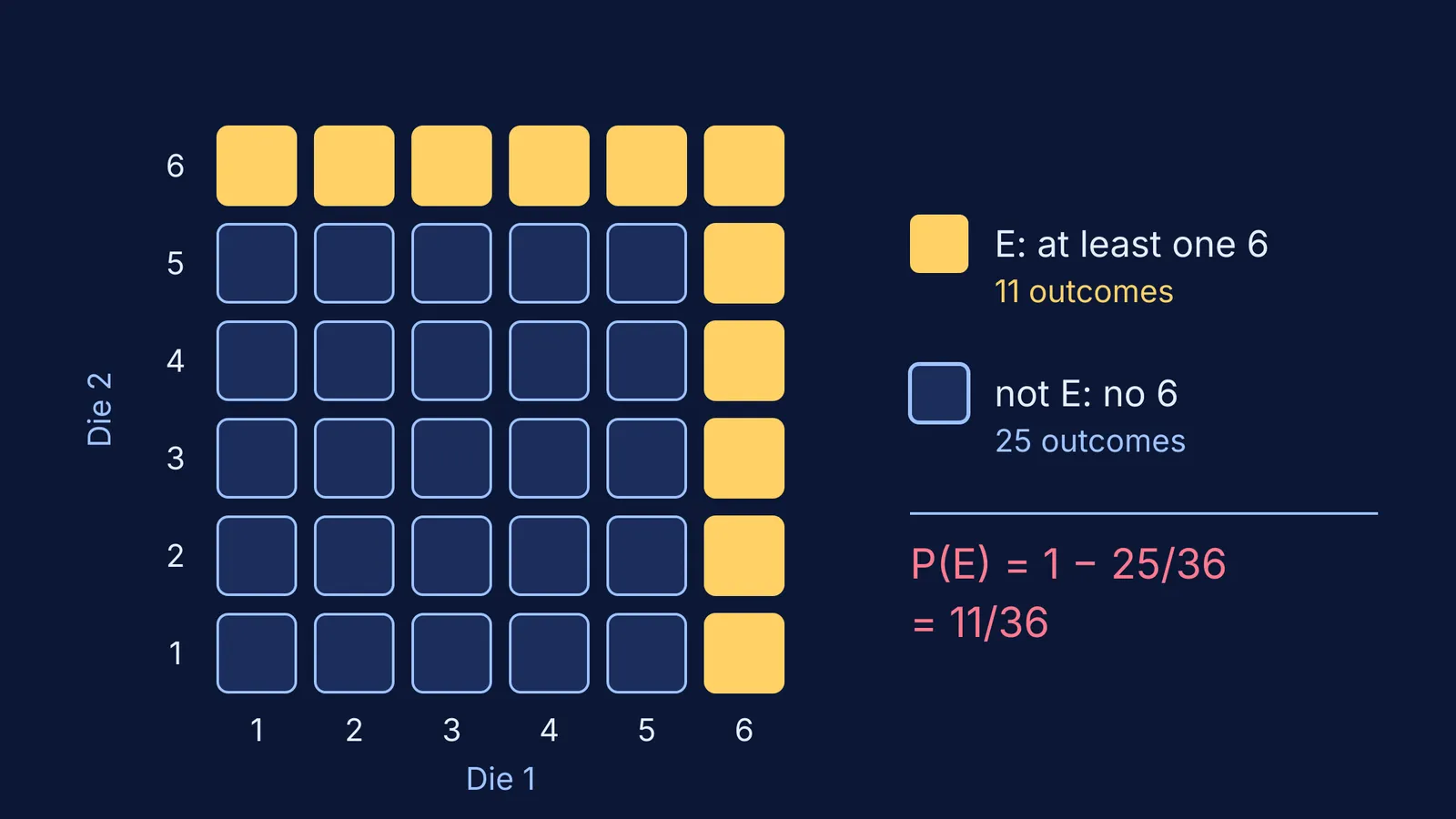
The direct way: the sample space has 6 × 6 = 36 equally likely outcomes. Those with at least one six are (6,1) to (6,6), which is 6, plus (1,6) to (5,6), 5 more, so 11. A common slip is 6 + 6 = 12, which counts (6,6) twice.
The complement way:
Name the event: E = at least one six.
Write the complement in words: not E = no six on either die.
Count it: each die has 5 faces that are not a six, so 5 × 5 = 25 outcomes.
Subtract: P(E) = 1 − 25/36 = 11/36.
Same answer, no list and no double counting. The diagram above shows all 36 outcomes.
The saving grows with each extra die. With three dice, "no six" is 5 × 5 × 5 = 125 of 216 outcomes, so P(at least one six) = 1 − 125/216 = 91/216. Our post on how many coin tosses make a head almost certain takes the same idea to n trials.
NCERT Class 11 (Example 7) has a harder case: P(Anil qualifies) = 0.05, P(Ashima qualifies) = 0.10 and P(both qualify) = 0.02 (NCERT Class 11 Mathematics, Chapter 14). "Neither qualifies" is the complement of "at least one qualifies", so the textbook finds P(E ∪ F) = 0.05 + 0.10 − 0.02 = 0.13 and answers 1 − 0.13 = 0.87.
What mistakes do students make with "not E"?
The wrong complement for "at least one". It is "none", not "exactly one" and not "all".
The wrong complement for "at most". In three coin tosses, "at most 2 heads" has the complement "3 heads".
Confusing complementary with mutually exclusive. Getting a 1 and getting a 2 on a die are mutually exclusive, but their probabilities do not add to 1, because together they do not cover the sample space.
Skipping the check. Every probability lies between 0 and 1 (NCERT Class 10 Mathematics, Chapter 14). If your P(E) and P(not E) do not add to 1, one of the counts is wrong.
How should you practise the complement rule?
Take five "at least one" NCERT questions and solve each twice, once directly and once with 1 − P(E). Then add questions where the direct count is shorter, so you practise choosing a method, not just subtracting. For questions with several stages, probability tree diagrams, step by step show how the "none" branch gives you the complement in one multiplication.
If you keep going wrong at the "which event is the complement?" step, the Fermi Problem Library has worked problems with a step-by-step solver that explains the reasoning rather than printing an answer. To revise the definitions behind the rule, the Fermi Concept Library gives each concept its own lesson.
Next time a question says "at least one", write "not E" first and count that side.