

On this page
Probability problems that ask for "at least one" success are a staple in school board exams and competitive engineering tests like JEE Main. Calculating the chances of getting exactly one, two, or three heads, and then adding them all up, takes far too long in an exam setting. Instead, you can find the answer quickly by looking at the only outcome you do not want: getting no heads at all.
What is the probability of getting at least one head?
When an event has only two possible outcomes—such as flipping a fair coin where the probability of heads is p = 0.5 and tails is q = 0.5—it is known as a Bernoulli trial. The binomial distribution models the number of successes in a fixed sequence of independent experiments.
In a set of n coin tosses, the total possible outcomes range from zero heads to n heads. Because these cover every single possibility, the sum of the probabilities for all these outcomes is exactly 1.
If you want the probability of getting *at least one* head, you are looking for the combined probability of getting one, two, three, and so on, all the way up to n heads. The only outcome left out of that list is getting zero heads (which is the same as getting all tails). Therefore, you can subtract the probability of zero heads from the total probability of 1.
Probability(at least one head) = 1 − Probability(no heads)
Since each coin toss is independent of the others, you multiply the probability of a tail (1/2) for each toss. The probability of getting no heads in n tosses is (1/2)ⁿ.
Probability(at least one head) = 1 − (1/2)ⁿ
How many times must a fair coin be tossed?
The problem asks for the smallest number of tosses (n) so that the probability of getting at least one head is at least 0.99. We can set up an inequality using the formula we just built.
1 − (1/2)ⁿ ≥ 0.99
To solve for n, move the terms around to isolate the fraction with the exponent.
1 − 0.99 ≥ (1/2)ⁿ
0.01 ≥ (1/2)ⁿ
Next, write 0.01 as a standard fraction to make it easier to compare.
1/100 ≥ 1/2ⁿ
When you take the reciprocal of both fractions (flipping them upside down), you must also flip the inequality sign.
100 ≤ 2ⁿ
Now, you just need to find the smallest power of 2 that is 100 or greater. Counting up the powers of 2 gives you:
2¹ = 2
2² = 4
2³ = 8
2⁴ = 16
2⁵ = 32
2⁶ = 64
2⁷ = 128
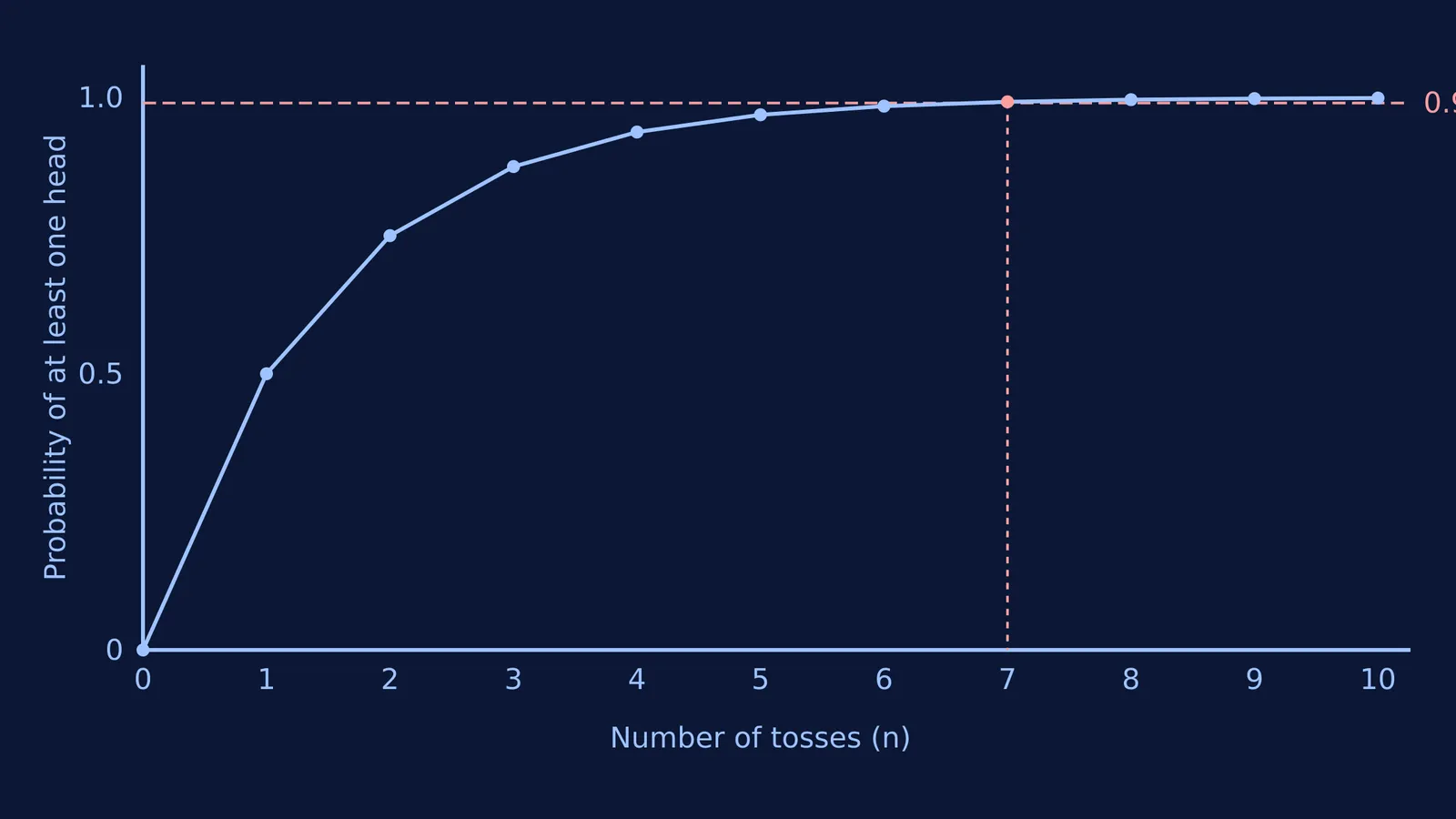
Since 64 is less than 100, six tosses are not enough. With six tosses, the probability of at least one head is 63/64, which is approximately 0.984. The first power of two to exceed 100 is 2⁷ = 128.
Therefore, a fair coin must be tossed at least seven times to reach a probability of 0.99 of getting at least one head.
What if the target probability changes?
Examiners often test if you understand the concept by changing the target number. If a question asks for a target of 0.999 instead of 0.99, the setup remains exactly the same.
This shows how quickly powers of 2 grow. Adding just three more coin tosses pushes the probability from 0.99 to 0.999.
Where do students go wrong in inequalities?
The final algebraic steps of this problem catch many students out. When moving terms across the inequality symbol, it is easy to forget that multiplying or dividing by a negative number reverses the sign. Similarly, taking the reciprocal of both sides flips the inequality from "greater than" to "less than".
If you regularly drop signs or get stuck on the arithmetic, the Fermi Problem Library has worked problems with a step-by-step solver that explains the reasoning rather than printing an answer. The AI tutor notices where a student is stuck, and decides whether to explain, ask, or show, checking understanding as it goes.
Once you are comfortable with the complement rule, you can apply it to other areas of mathematics. For more practice, you can explore Odds in favour and odds against: converting them to probability, read about Probability distributions for JEE: mean and variance worked out, or look at how probabilities change in With and without replacement: probability problems compared.


