

On this page
When you toss a coin or roll a die, you cannot predict the exact outcome, but you know all the possibilities. In Class 11 mathematics, this idea is formalised using the concepts of random experiments, sample spaces, and events. By viewing probability through the lens of set theory, the math becomes clear and exact.
Here is a breakdown of how to construct a sample space and identify the different types of events you will encounter in the NCERT Class 11 mathematics syllabus.
What is a random experiment?
An experiment is considered a random experiment if it meets two conditions: it has more than one possible outcome, and it is impossible to predict the result in advance.
For example, tossing a coin is a random experiment because the outcome can be a head (H) or a tail (T), and neither is guaranteed. Similarly, rolling a six-sided die yields one of six unpredictable numbers.
How do you write a sample space?
The set of all possible outcomes of a random experiment is called the sample space, usually denoted by the symbol S. Each individual outcome is a sample point.
If you toss a single coin, the sample space is S = {H, T}. If you roll a die, S = {1, 2, 3, 4, 5, 6}.
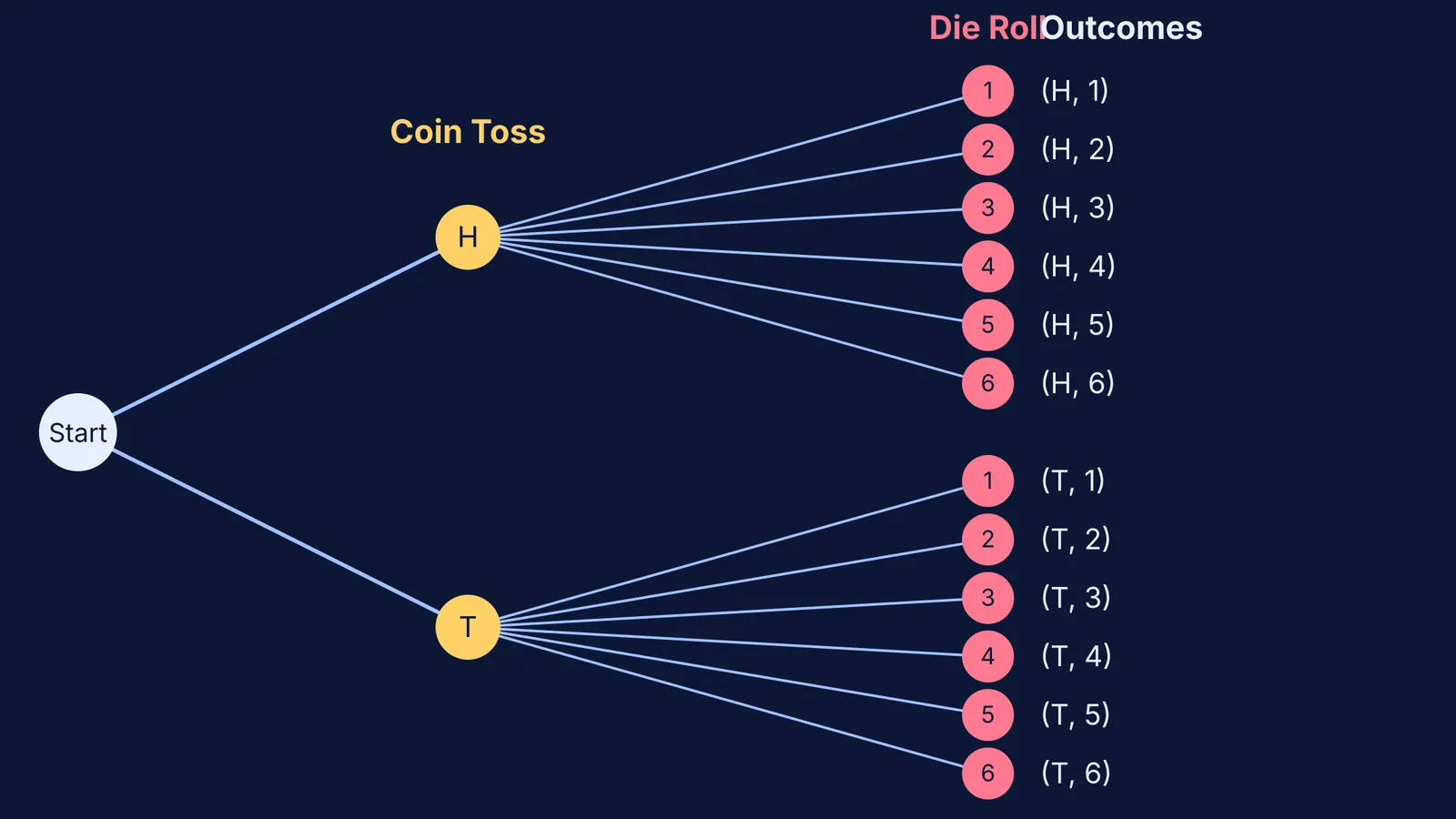
When experiments are combined, the sample space grows. Consider a common exam problem: tossing a coin and then rolling a die. The coin gives 2 outcomes, and the die gives 6. The combined sample space S contains 12 outcomes:
S = {(H, 1), (H, 2), (H, 3), (H, 4), (H, 5), (H, 6), (T, 1), (T, 2), (T, 3), (T, 4), (T, 5), (T, 6)}
Writing out the full sample space prevents you from missing hidden outcomes when calculating probabilities. If you have concept gaps about combination problems, the Fermi Concept Library has a lesson for every concept in probability and its place in the map.
What are simple and compound events?
An event is defined mathematically as any subset of the sample space. Depending on how many sample points an event contains, it falls into one of two categories:
Simple event: An event that contains exactly one sample point. For instance, in the coin-and-die experiment, the event "getting a head and a 4" is E = {(H, 4)}. Because there is only one outcome in the set, it is a simple (or elementary) event.
Compound event: An event that contains more than one sample point. If you define the event "getting a tail and an even number", the subset is E = {(T, 2), (T, 4), (T, 6)}. Since it contains three outcomes, it is a compound event.
Sure and impossible events
Probability ranges from 0 to 1, representing the two extremes of certainty. In set language, these extremes are mapped to the empty set and the full sample space.
Impossible event (∅): An event that contains no sample points and can never occur. If you roll a standard six-sided die, the event "getting a 7" is impossible. Its subset is empty: E = ∅, and its probability is 0.
Sure event (S): An event that contains all sample points and is certain to occur. When rolling a die, the event "getting a number less than 7" covers every possible outcome. Its subset is the entire sample space: E = {1, 2, 3, 4, 5, 6} = S, making its probability 1.
You can combine these basic events using words like "and", "or", and "not" to form new subsets. For a deeper look at the algebra of these combinations, see our guide on translating events into set language.
Mutually exclusive and exhaustive events
Besides categorising events by the number of outcomes, Class 11 probability introduces relationships between multiple events.
Mutually exclusive events: Two events are mutually exclusive if they cannot happen at the same time. In set language, their intersection is the empty set (A ∩ B = ∅). For example, when rolling a die, event A = "getting an odd number" {1, 3, 5} and event B = "getting an even number" {2, 4, 6} share no sample points.
Exhaustive events: A set of events is exhaustive if their union forms the entire sample space. Taking the same die example, the union of event A (odd numbers) and event B (even numbers) is {1, 2, 3, 4, 5, 6}, which is exactly S. Because one of these events must occur, they are exhaustive.
A worked example: two coins
To see these definitions in action, let's write out the events for the random experiment of tossing two coins. The sample space is S = {HH, HT, TH, TT}.
Simple event: Let E₁ be the event of getting exactly two heads. E₁ = {HH}.
Compound event: Let E₂ be the event of getting at least one tail. E₂ = {HT, TH, TT}.
Impossible event: Let E₃ be the event of getting three heads. E₃ = ∅.
Sure event: Let E₄ be the event of getting heads or tails. E₄ = {HH, HT, TH, TT} = S.
This structured approach—identifying the experiment, writing the full sample space S, and defining events as subsets—prevents errors when calculating probabilities later. When working on advanced problems, the Fermi Problem Library provides a step-by-step solver that explains the reasoning for categorising these events rather than just printing the final answer.


