

On this page
Word problems in probability often use everyday English, but mathematical formulas require strict notation. A common stumbling block is translating conversational phrases like "but not", "neither", and "at least one" into operations on sets.
Before applying an addition or multiplication theorem, you must write down exactly what the question asks. Here is a guide to translating four common probability conditions into set notation, alongside examples of how the formulas work.
How do you write "A but not B" in set notation?
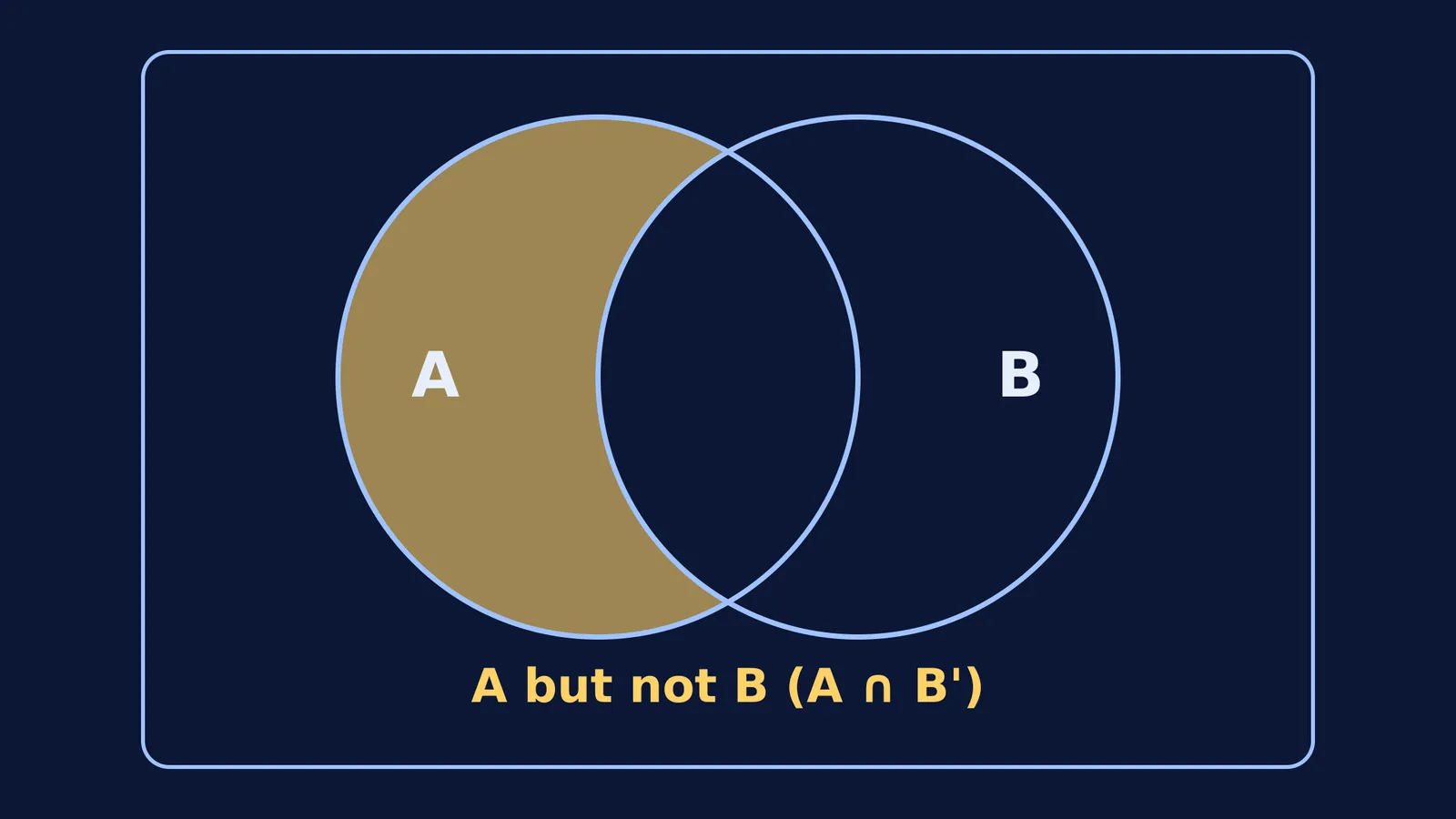
The phrase "A but not B" means you are looking for outcomes where event A occurs, but event B definitely does not. According to the OpenStax *Introductory Statistics* textbook, the complement of an event B (written as B′) consists of all outcomes that are not in B (OpenStax).
To find "A but not B", take the intersection of A and this complement, written as A ∩ B′. Sometimes this is written as a set difference, A − B.
To calculate its probability, subtract only the overlapping part:
P(A ∩ B′) = P(A) − P(A ∩ B)
Consider rolling a six-sided die. Let event A be rolling an even number (2, 4, 6), and event B be rolling a multiple of 3 (3, 6). "A but not B" means rolling an even number that is not a multiple of 3. The only outcomes are 2 and 4.
Using the formula, the probability of A is 3/6, and the probability of their intersection (rolling a 6) is 1/6. Subtracting the intersection from A gives 2/6 (or 1/3), matching the manual count.
What is the set notation for "neither A nor B"?
"Neither A nor B" means both events fail to happen. Because both fail simultaneously, this is an intersection of two complements: A′ ∩ B′.
If you have gaps in your understanding of basic set theory, the Fermi Concept Library has every concept in physics, chemistry, biology, mathematics and computing, each with its own lesson and its place in the map.
Thanks to De Morgan's laws, A′ ∩ B′ is identical to (A ∪ B)′. This provides a simpler way to calculate the probability of "neither". Find the probability of "at least one" and subtract it from 1:
P(A′ ∩ B′) = 1 − P(A ∪ B)
For background on these transformations, look at Augustus De Morgan and his laws for sets.
Rolling the die again, let event A be rolling a number greater than 4 (5, 6), and B be rolling an odd number (1, 3, 5). "Neither A nor B" means the number is not greater than 4 and is not odd, leaving only 2 and 4. The union of A and B contains 1, 3, 5, and 6. The probability of this union is 4/6. Subtracting this from 1 gives 2/6.
How do you represent "at least one" of two events?
The phrase "at least one" is a union, written as A ∪ B. Event A happens, event B happens, or both happen simultaneously.
The formula is the standard addition theorem of probability:
P(A ∪ B) = P(A) + P(B) − P(A ∩ B)
Take drawing a card from a standard deck of 52 cards. Let A be drawing a heart (13 cards), and B be drawing a face card (12 cards). "At least one" means drawing a heart, a face card, or both.
The probability of a heart is 13/52, and a face card is 12/52. Since three face cards are also hearts, the intersection is 3/52. Adding the probabilities of A and B gives 25/52, but subtracting the intersection prevents double-counting those three cards. The final probability is 22/52.
If you are staring at a word problem and struggling to convert the English into set operations, the Fermi Problem Library has worked problems with a step-by-step solver that explains the reasoning rather than printing an answer. It helps break down text into mathematical statements.
How do you express "exactly one" of A or B?
"Exactly one" is stricter than a union. One event happens while the other does not. In set theory, this is the symmetric difference, denoted by A Δ B.
In standard intersection and union notation, you combine two mutually exclusive scenarios: "A but not B" OR "B but not A".
(A ∩ B′) ∪ (A′ ∩ B)
To calculate this probability, take the probability of the union (at least one) and subtract the probability of the intersection (both):
P(Exactly one) = P(A ∪ B) − P(A ∩ B)
Returning to the deck of cards, "exactly one" means drawing a heart that is not a face card (10 cards) or a face card that is not a heart (9 cards), totalling 19 cards. Using the formula, you take the union (22/52) and subtract the intersection (3/52). The result is 19/52.
This logic scales when you add a third event. To map out three events, read our guide on three-set Venn problems.


