

On this page
In a counting problem, the formulas are rarely the hard part; the first decision is. Here is one test, ten examples to practise on, and problems that need both methods.
What is the difference between a permutation and a combination?
A permutation is "an arrangement in a definite order of a number of objects taken some or all at a time", according to NCERT Class 11 Mathematics, Chapter 6. In a combination, the same chapter says, "the order is not important": you are only selecting.
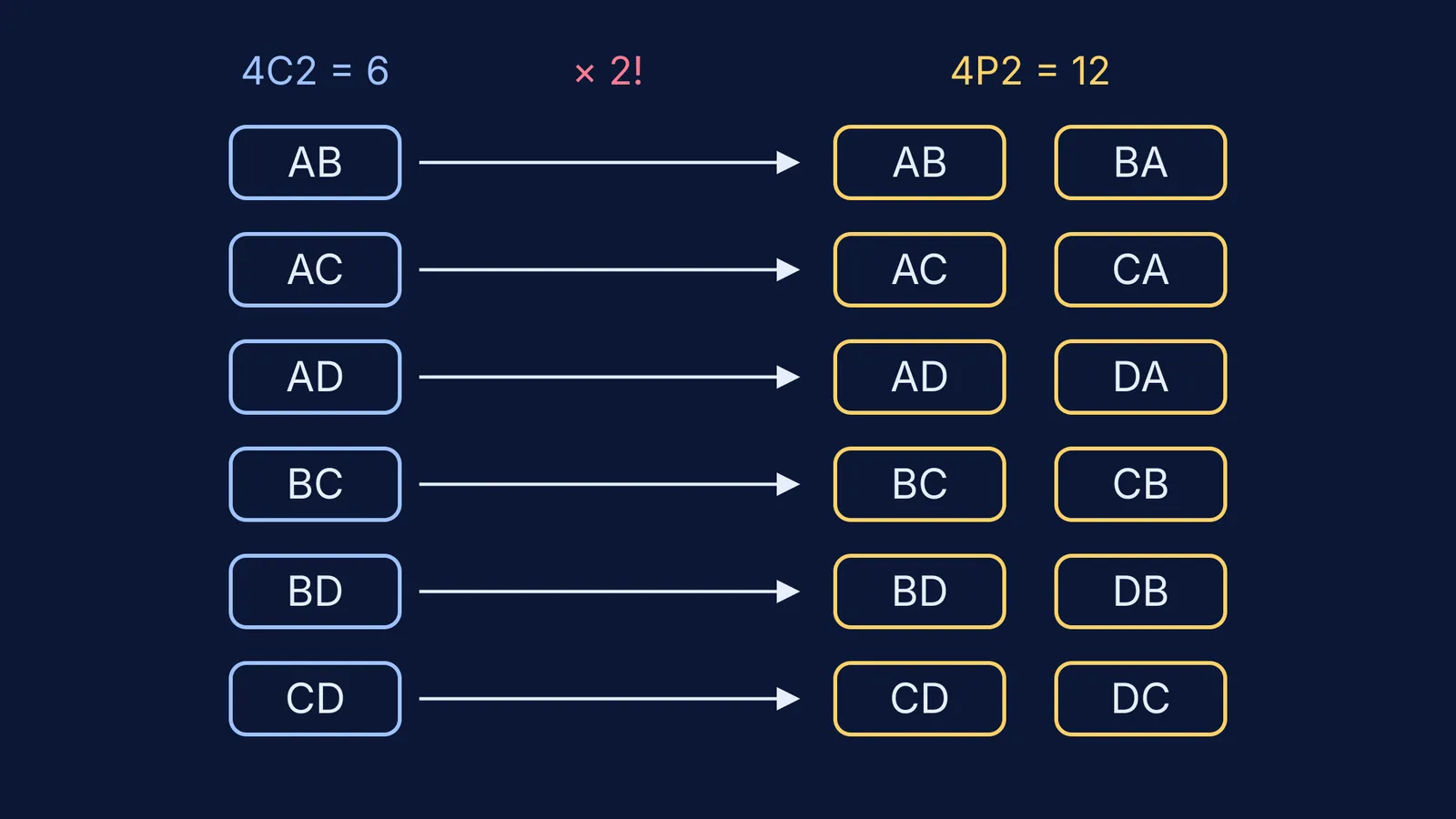
The two formulas are nPr = n!/(n − r)! for arrangements and nCr = n!/(r!(n − r)!) for selections. NCERT's Theorem 5 links them: nPr = nCr × r!, because each selection of r objects can be rearranged in r! ways.
How do you decide whether order matters?
Use the swap test.
Write down one possible answer, for example (Asha, Ravi).
Swap two of the items: (Ravi, Asha).
Does the question treat this as a different outcome? Yes: count permutations. No: count combinations.
Roles, ranks, positions and digits in a number usually mean order matters. Teams, committees, handshakes and hands of cards usually mean it does not.
Ten mixed examples: does order matter?
Examples 1 to 7, 9 and 10 are taken from or based on NCERT's Chapter 6, which works six of them in full. Cover each answer and run the swap test.
A chairman and a vice-chairman are chosen from 12 people. Swap them and different people hold each post. Order matters: 12P2 = 132.
Twelve people each shake hands with all the others. Asha–Ravi is the same handshake as Ravi–Asha. Order does not matter: 12C2 = 66.
Chords join pairs of 7 points on a circle. Chord PQ is chord QP. Combination: 7C2 = 21.
Four-digit numbers use digits 1 to 9, no repeats. 1234 and 1324 are different numbers. Permutation: 9P4 = 3,024.
A committee of 3 is formed from 5 people. The same three people make the same committee. Combination: 5C3 = 10.
A signal hangs 2 of 4 coloured flags one below the other. Red over blue is not blue over red. Permutation: 4P2 = 12.
Four cards are dealt from a 52-card pack. A hand is the same whichever card came first. Combination: 52C4 = 270,725.
Gold, silver and bronze go to 3 of 8 finalists. Swapping gold and silver changes the result. Permutation: 8P3 = 336.
A student picks 5 of 9 courses, 2 of them compulsory. The real choice is 3 of the other 7, in any order. Combination: 7C3 = 35.
The letters of ALLAHABAD are arranged in a row. Different orders give different words, but the four A's and two L's are identical. Permutation with repeats: 9!/(4! × 2!) = 7,560.
Which problems need both permutations and combinations?
Many exam problems ask you to select objects and then arrange them. The usual pattern: combinations for the selecting, a permutation for the arranging, and the multiplication principle to join them. If you are unsure when to multiply and when to add, read when to add and when to multiply in counting problems.
Here is NCERT's Example 20 from the same chapter: how many words, with or without meaning, with 3 vowels and 2 consonants can be formed from the letters of INVOLUTE? The word has 4 vowels (I, O, U, E) and 4 consonants (N, V, L, T).
Select the vowels: 4C3 = 4 ways. Order does not matter yet.
Select the consonants: 4C2 = 6 ways.
Arrange the 5 chosen letters: 5! = 120 ways. Now order matters.
Multiply: 4 × 6 × 120 = 2,880 words.
A second pattern: a committee of 3 with one chairperson, chosen from 8 people. Select the 3 members (8C3 = 56), then the chair from those 3: 56 × 3 = 168. Check by picking the chair first (8 ways), then 2 members from the other 7 (7C2 = 21): 8 × 21 = 168. More variations: how to choose a committee with a chairperson.
What should you do when you keep picking the wrong formula?
Try this routine on your next counting questions:
Before any formula, write one sample answer and swap two items in it.
Number the choosing and arranging steps separately.
Check the final count by a second route, or by listing a small case by hand.
If the mistake keeps coming back, the Fermi Problem Library has worked problems with a step-by-step solver that explains the reasoning rather than printing an answer, so you can follow the reasoning one step at a time. If the formulas feel shaky, the Fermi Concept Library covers every concept in mathematics, each with its own lesson and its place in the map.
For a picture of nPr = nCr × r!, see permutations vs combinations visualised with 3 of 5 books.


