

On this page
When you first encounter combinatorics in mathematics, the most confusing step is often knowing when to care about order. If you have five different books on a shelf and you want to pick three of them to take on a trip, how many ways can you do it? And does it matter which book you pack first?
The answer depends on whether you are dealing with a combination or a permutation. To see the difference, it helps to walk through a concrete example and watch how the numbers change.
What is the difference between permutations and combinations?
In mathematics, a combination is a selection of items from a set that has distinct members, such that the order of selection does not matter. If you choose *Dune*, *Foundation*, and *Neuromancer*, it is the exact same combination whether you grabbed *Dune* first or last.
A permutation is an ordered arrangement of a set of objects. If you are deciding the order in which to read those three books over the summer, reading *Dune* first and *Foundation* second is a completely different permutation from reading *Foundation* first and *Dune* second.
How do you calculate combinations?
If you want to pack three out of your five books, you are making a selection where order is ignored.
According to the combination formula, the number of ways to choose r objects from n distinct objects is written as nCr, and is calculated as n! / (r!(n - r)!).
For our 5 books taken 3 at a time, 5C3 gives: 5! / (3! × 2!) = 120 / (6 × 2) = 10.
There are exactly 10 ways to pick a trio of books from your shelf.
How do you calculate permutations?
Now imagine you want to pick three of the five books, but you also want to decide which one you read first, second, and third. This means you are making an ordered arrangement.
The permutation formula for arranging r objects chosen from n distinct objects is written as nPr, and is calculated as n! / (n - r)!.
For arranging 3 out of 5 books, 5P3 gives: 5! / 2! = 120 / 2 = 60.
There are 60 different ways to pick and order three books.
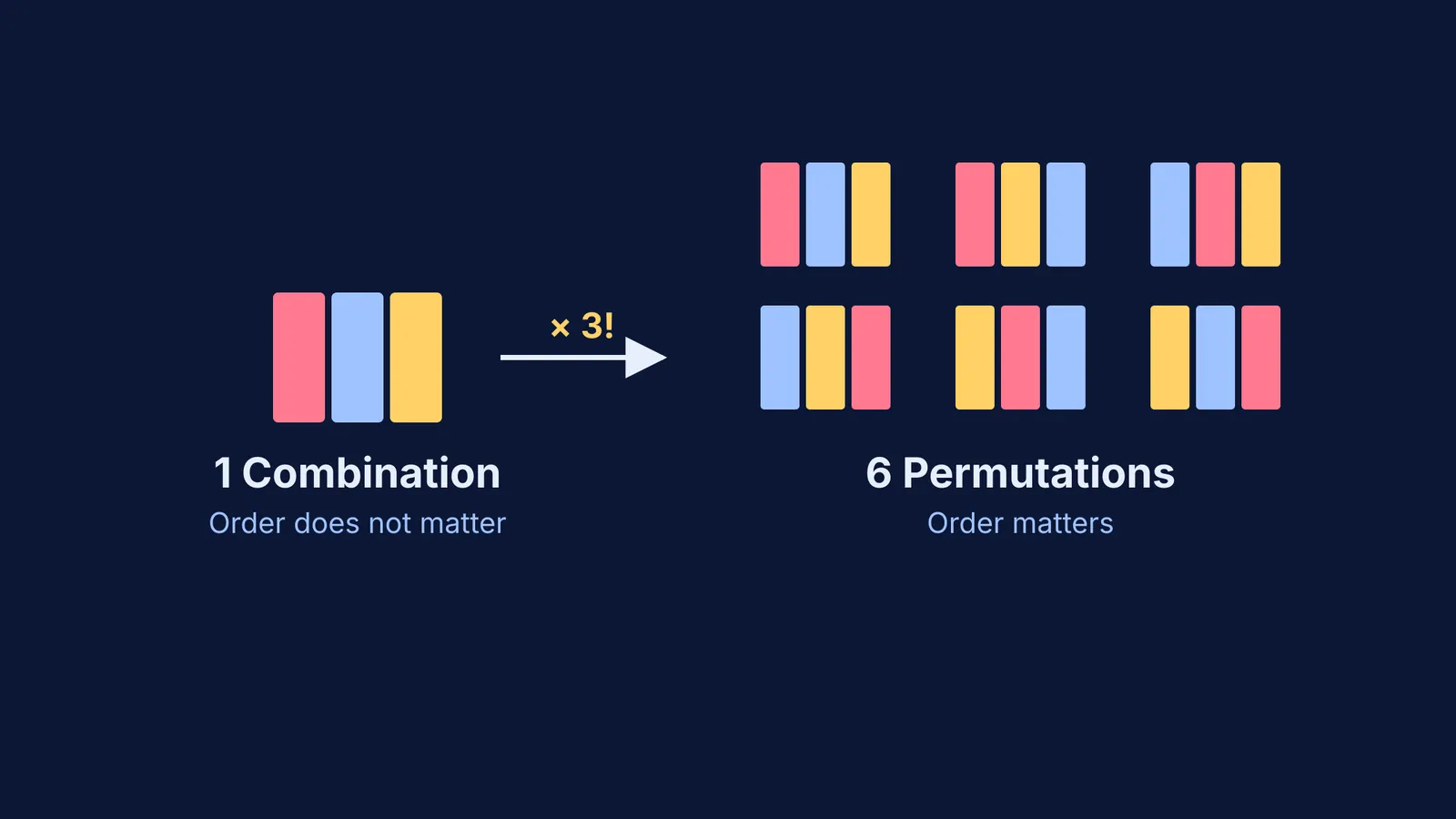
How do you visualise the 3! factor?
Why did the number jump from 10 combinations to 60 permutations? The secret lies in the factorial of the chosen number of items.
Take just one of your 10 combinations—say, the red book, the blue book, and the yellow book. How many ways can you arrange these three specific books?
Red, Blue, Yellow
Red, Yellow, Blue
Blue, Red, Yellow
Blue, Yellow, Red
Yellow, Red, Blue
Yellow, Blue, Red
That is exactly 3! = 3 × 2 × 1 = 6 arrangements.
Because every single one of your 10 combinations can be arranged in 6 different ways, the total number of permutations is 10 × 6 = 60. The general rule connecting the two concepts is simple: nPr = nCr × r!.
If you are struggling to picture why these formulas work or want to experiment with different values, the Fermi Simulation Lab provides interactive simulations for the ideas that are easier to see than to read.
When do you use permutations vs combinations in real life?
Mathematics is not just about exam questions. Recognizing the difference between ordering and grouping helps you understand everyday scenarios.
Passwords and PINs: When you set a 4-digit PIN on your phone, the code 1234 is not the same as 4321. Because the sequence is critical to unlocking the device, a PIN relies on permutations.
Lottery tickets: If a lottery requires you to pick winning numbers out of a pool, drawing the numbers in any sequence wins the jackpot. Because you only care about the final group of numbers drawn, lotteries rely on combinations.
Forming a committee: Choosing a president, a vice-president, and a treasurer from a club is a permutation because each person gets a distinct, ordered role. Simply choosing three general members to represent the club is a combination.
By testing every scenario with the order rule, you can confidently decide which mathematical tool to apply.
How do you spot them in exam problems?
When you sit down to an exam like the JEE Main, a word problem will rarely tell you whether to use permutations or combinations. Use this framework to decode the question:
Spot the verbs. Look for action words. "Select", "choose", "form a committee", or "pick a hand of cards" almost always mean combinations.
Look for arrangement clues. Words like "arrange", "seat in a row", "form a word", or "create a password" signal that order matters. Use permutations.
Watch out for mixed conditions. Sometimes a problem asks you to select items first, and then arrange them. For example, if you must group items using the bundle method or handle constraints like selecting items with combinations, always split the selection step from the arrangement step to stop double counting.
If you are unsure where to start a complex word problem, Fermi's AI tutor works out what you already know and builds a plan for the session, writing on a board to show you exactly how the counting works step by step.
Next time you look at a shelf of books, remember that choosing what to read and deciding the order are two very different mathematical problems.


