

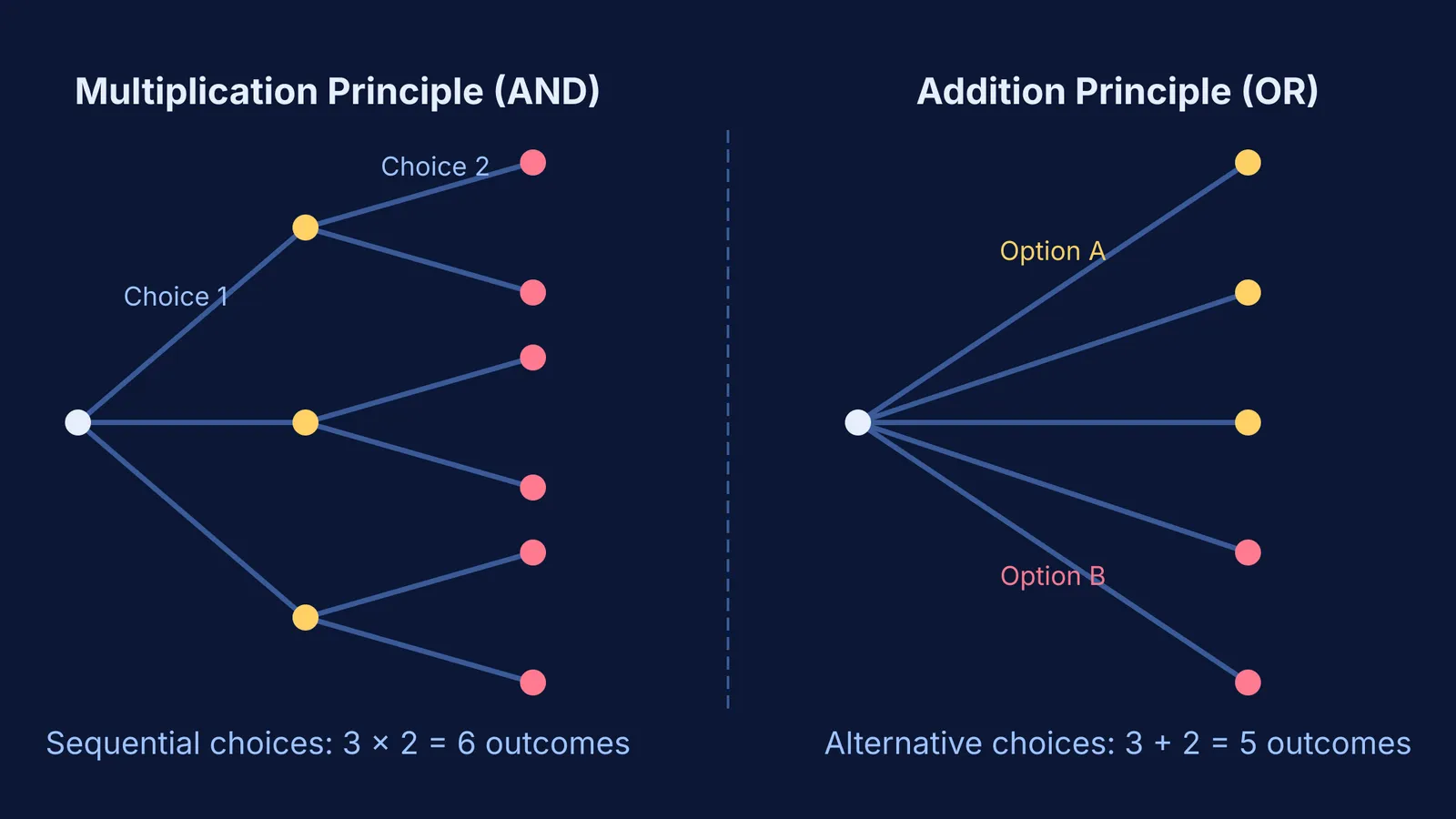
Start with the problem: you stare at a combinatorics question and wonder if the answer is 5 × 4 or 5 + 4. It is a frequent hurdle in probability and counting. A 2013 study of combinatorial thinking in the *Journal of Mathematical Behavior* found that errors occur when students apply formulas without picturing the actual sets of outcomes (Lockwood, 2013). The fix is to connect the arithmetic back to the physical choices you are making.
The rule of thumb relies on the English words AND and OR:
The Multiplication Principle (AND): Use this when a task is broken into sequential stages. If a process requires you to make one choice AND then make another choice, you multiply the options. For example, if you are packing for a trip and must choose one of 3 shirts AND one of 2 pairs of trousers, you multiply the options. For each of the 3 shirts, there are 2 trousers you could pair it with. That creates a grid of 3 × 2 = 6 possible outfits.
The Addition Principle (OR): Use this when you are choosing between mutually exclusive alternatives. If you want to eat exactly one piece of fruit, and your kitchen has 3 apples OR 2 oranges, you add the options. You are making a single choice from two separate pools. You have 3 + 2 = 5 choices.
If you are stuck, draw a quick tree diagram. If the branches extend from previous branches (stages), you multiply. If they all originate from the same starting point as separate options, you add.
How do you spot hidden cases in word problems?
Sometimes, the words AND and OR are completely absent from the problem description. A classic example asks: "How many 3-digit even numbers can be formed using the digits 1, 2, 3, 4, and 5 without repetition?"
The condition "even" means the last digit must be 2 or 4. If you try to fill the three slots left-to-right in a single sequence (AND), you hit a wall. The number of choices for the first digit depends entirely on which even digit you eventually place at the end. The single multiplication sequence breaks down because the stages are not independent.
This breakdown is your signal that you need to split the problem into cases (OR). You calculate the outcomes for each case separately using multiplication, and then add the results together:
Case 1: The number ends in 2. You have 1 choice for the last digit. Because you cannot repeat digits, you have 4 remaining choices for the first digit, and 3 for the middle digit. That gives 4 × 3 × 1 = 12 possible numbers.
Case 2: The number ends in 4. By the exact same logic, placing a 4 at the end leaves 4 choices for the first digit and 3 for the middle. There are 4 × 3 × 1 = 12 possible numbers here.
Since a valid number ends in 2 OR 4, you add the results: 12 + 12 = 24 even numbers. Recognizing when a straightforward multiplication sequence fails is the key to identifying hidden cases. If you get stuck on complex arrangements, the Fermi Problem Library has worked problems with a step-by-step solver that explains the reasoning behind these splits rather than just printing an answer.
How do you check if your cases are set up correctly?
When a problem forces you to resort to addition, you must ensure your cases are set up correctly. A flawed case split is a primary source of wrong answers in exams like JEE Main and NEET. Run your cases through this three-point checklist:
Are the cases mutually exclusive (disjoint)? You cannot simply add cases if they overlap. If a problem asks for numbers between 1 and 100 that are even OR multiples of 5, a number like 10 fits both conditions. If you add the even numbers to the multiples of 5, you have counted 10 twice. You must subtract the overlap. (Read more on three-set Venn problems: counting with inclusion-exclusion).
Do the cases cover every possibility? Did you miss a valid scenario? Consider counting the ways to draw a hand of five cards that contains "at least one King". The distinct cases are exactly one King, two Kings, three Kings, or four Kings. If you forget to calculate the four Kings case, your final sum will be short.
Are you avoiding double counting? Ensure the internal structure of your cases does not accidentally count the same outcome twice. This often happens when you group items together and then arrange the groups, only to realize the arrangement created identical layouts. (For deeper strategies, see our guide on permutations and combinations: how to stop double counting).


