

On this page
Combinatorics often feels like a maze of formulas. But many of its most daunting equations are just stories about groups of people. If you want to prove a combination identity without pages of factorial algebra, try building a story around it.
One of the best examples is finding the ways to choose a committee with a chairperson.
What are the ways to choose a committee with a chairperson?
Imagine you have a group of 5 students: Alice, Bob, Charlie, David and Eve. You need to form a 3-person committee, and exactly one of those three members will be the chairperson. How many ways can you build this group?
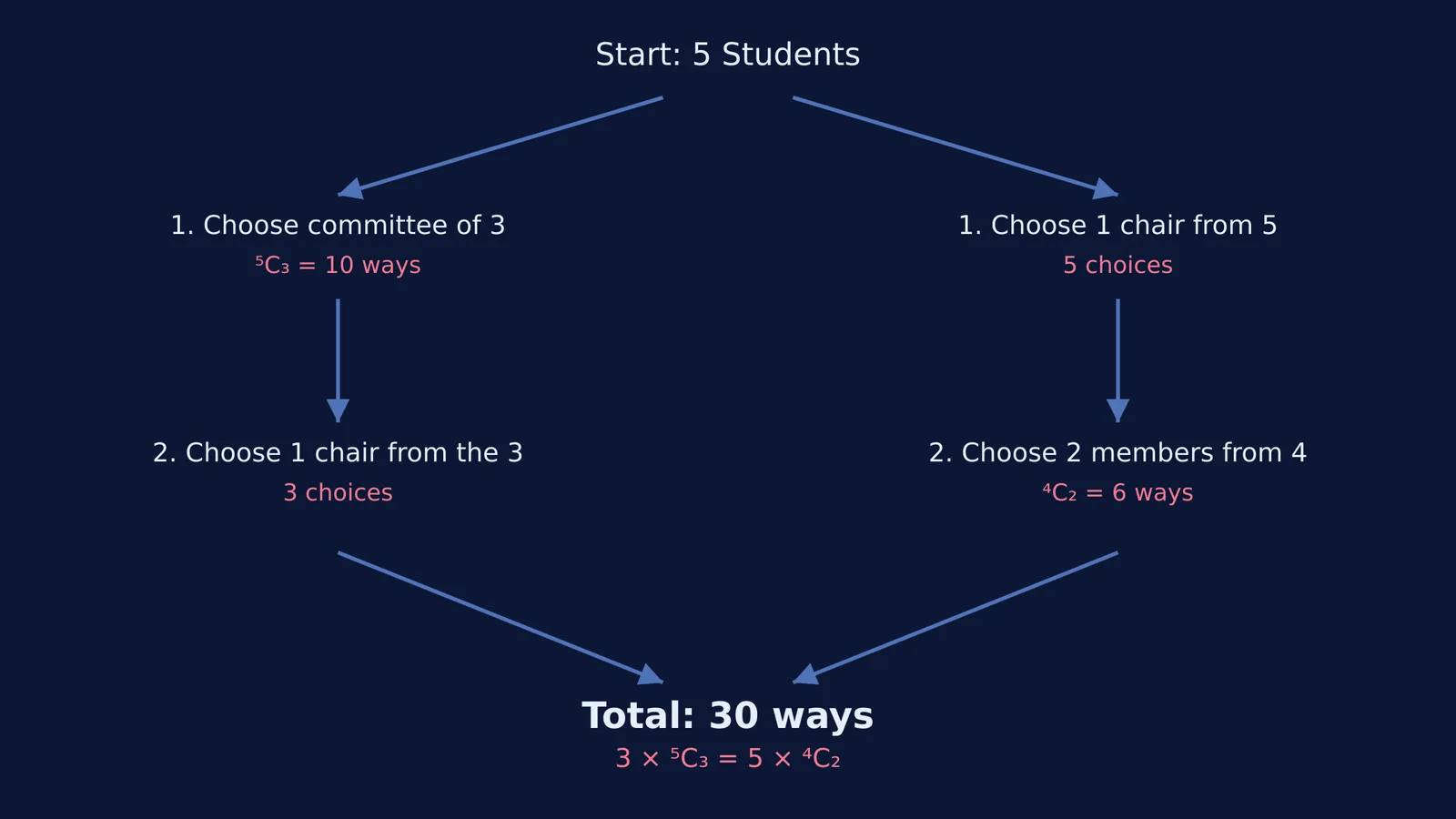
There are two perfectly logical ways to solve this, depending on who you pick first.
Method 1: Choose the committee first
First, select your 3 committee members from the pool of 5 students. The number of ways to do this is calculated using combinations, specifically 5C3. If we list them out, one such combination might be Alice, Bob and Charlie. There are exactly 10 possible groups like this.
Next, look at the 3 students standing in front of you. You need to appoint one of them as the chair. You could choose Alice, you could choose Bob, or you could choose Charlie. There are 3 choices for any group you formed.
To find the total number of combinations, you multiply the initial 10 groups by the 3 chair choices for each group: 10 × 3 = 30 unique outcomes.
In general algebra, if you have n people and need a committee of r people:
Pick the committee: ⁿCᵣ ways.
Pick the chair from the committee: r ways.
Total: r · ⁿCᵣ.
Method 2: Choose the chair first
Let us restart and try a different approach. This time, pick the chairperson immediately from the whole group of 5 students before doing anything else. You might pick David. There are 5 possible choices for this first step.
Now you have a chair, but you still need 2 more regular members to complete the 3-person committee. Because David is already chosen, you have 4 students left in the room (Alice, Bob, Charlie and Eve). You need to select 2 of them to join David. Selecting 2 from the remaining 4 students gives ⁴C₂ ways, which evaluates to 6 groups.
Multiply these steps: 5 initial choices for the chair × 6 ways to fill the rest of the committee = 30 unique outcomes.
In general algebra, for n people and a committee of r:
Pick the chair from everyone: n ways.
Pick the remaining r − 1 members from the n − 1 people left: ⁿ⁻¹Cᵣ₋₁ ways.
Total: n · ⁿ⁻¹Cᵣ₋₁.
Why do factorial proofs fall short?
If you tried to prove r · ⁿCᵣ = n · ⁿ⁻¹Cᵣ₋₁ using standard algebra, you would have to expand both sides into factorials. You would write ⁿCᵣ as n! / [r! (n − r)!] and then multiply it by r. You would then need to expand the right side, carefully cancel terms, and manipulate the fractions until both sides matched.
While this algebraic method works, it hides the meaning behind the mathematics. Factorial proofs treat combinations as abstract symbols rather than selections of real objects. By using a story—like choosing a committee and a chair—you create a combinatorial proof. This tells you not just that the formula is true, but why it is true in the physical world.
Why do we count the same thing twice?
Both methods solve the exact same problem: finding the ways to choose a committee with a chairperson. Since they count the identical set of outcomes, their algebraic results must be equal.
This proves our identity without a single factorial expansion:
r · ⁿCᵣ = n · ⁿ⁻¹Cᵣ₋₁
This technique is called double counting. Mathematicians J. H. van Lint and R. M. Wilson discuss double counting in their 2001 text *A Course in Combinatorics*. By describing a single finite set from two different perspectives, you naturally generate two mathematical expressions that must equal each other.
If you want to review the topics behind this proof, the Fermi Concept Library holds every concept in physics, chemistry, biology, mathematics and computing, each with its own lesson and its place in the map. When you are stuck on a tricky combination problem, Fermi's AI tutor teaches rather than answers: it holds a line of reasoning across a session, working out what you already know and teaching you the next step rather than printing a final answer.
How does this help in JEE maths?
Combinatorics questions in exams like JEE Main and Advanced rarely ask for direct formula substitutions. Instead, they test if you can manipulate large binomial sums, such as problems involving sums of binomial coefficients.
The "committee with a chair" identity is your shortcut for pulling an r or an n out of a summation. When you face an expression like Σ (r · ⁿCᵣ), applying r · ⁿCᵣ = n · ⁿ⁻¹Cᵣ₋₁ allows you to move the constant n outside the sum. This transforms a complex series into a standard binomial expansion that resolves easily.
You can apply the same story logic to other selection problems, whether you are dealing with constraints like at least one, at most two or ordering items using the bundle method. Once you see the people behind the variables, combinatorics becomes a logic puzzle rather than a memory test.


