

On this page
Most students meet 0! = 1 as a line in a formula box, with no reason given, so it feels like a trick. It is not. Three separate checks, each one you can do in a minute, land on the same answer.
Why does 0 factorial equal 1?
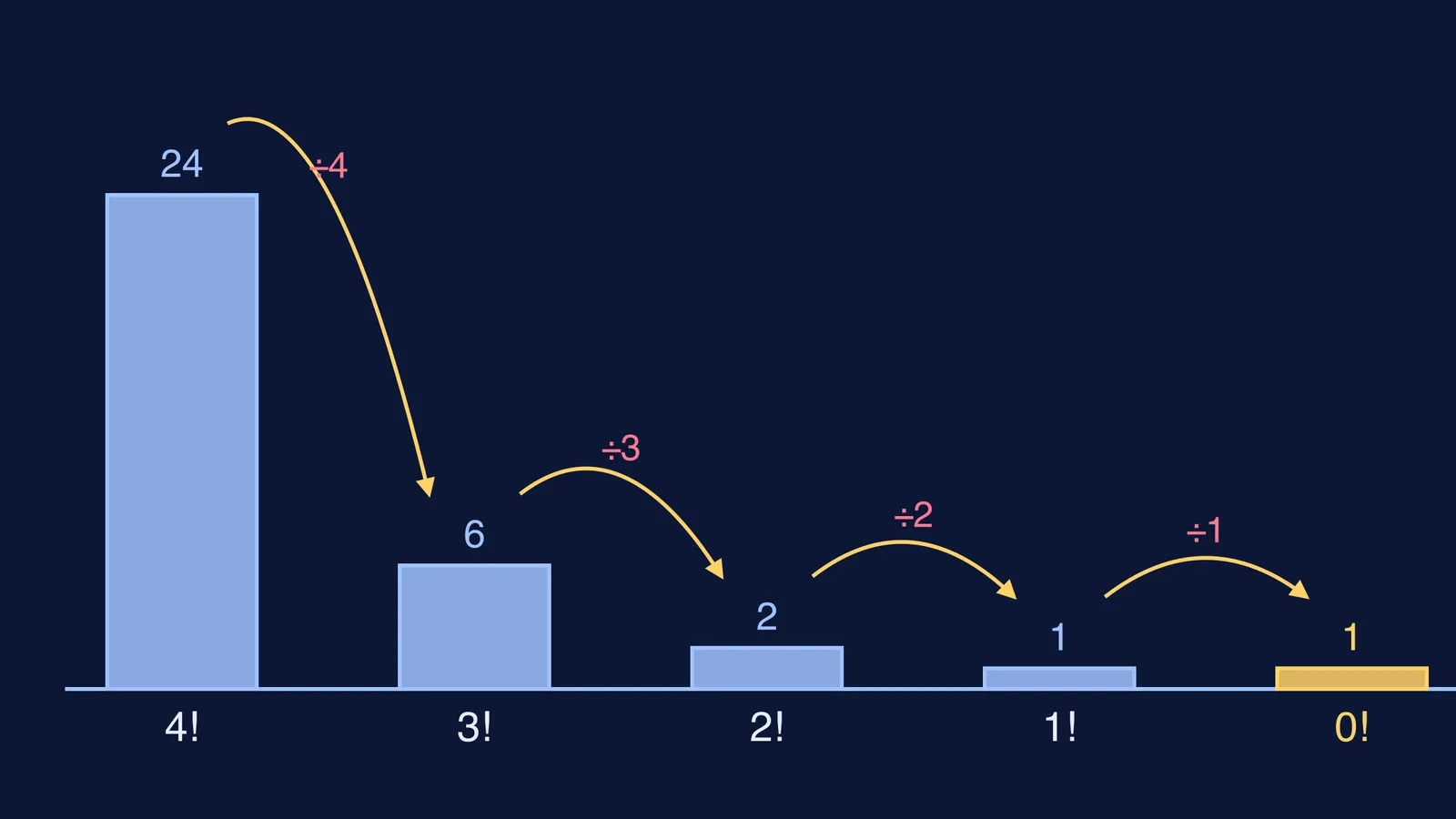
Start with what you already trust. 4! = 4 × 3 × 2 × 1 = 24. Every factorial is the one before it, multiplied by the next number: n! = n × (n − 1)!. Read the other way, you get each factorial by dividing the one above it, a pattern The Math Doctors use to explain this exact question.
3! = 4! ÷ 4 = 24 ÷ 4 = 6
2! = 3! ÷ 3 = 6 ÷ 3 = 2
1! = 2! ÷ 2 = 2 ÷ 2 = 1
0! = 1! ÷ 1 = 1 ÷ 1 = 1
The last step uses nothing new. That is why factorials can be defined by two rules, 0! = 1 and n! = n × (n − 1)! for n > 0, as The Math Doctors set out, so zero is the starting point rather than an exception.
Try one more step and the pattern breaks: (−1)! would be 0! ÷ 0, and you cannot divide by zero. So the pattern explains both why 0! exists and why ordinary factorials stop there.
How many ways can you arrange nothing?
n! counts the ways to put n different objects in a row. Three books on a shelf can stand in 3! = 6 orders. Two books, 2 orders. One book, 1 order.
Now take the books away. Is there still an arrangement? Yes, exactly one: the empty shelf. Wikipedia's article on the factorial puts it plainly: "There is exactly one permutation of zero objects: with nothing to permute, the only rearrangement is to do nothing."
The same idea appears in arithmetic. A product with no factors at all is called the empty product, and it equals 1, the number that changes nothing when you multiply by it (factorial article). It is the partner of a sum with nothing in it, which equals 0, a comparison The Math Doctors also make.
Why do nC0 and nCn need 0! = 1?
Here is the check that matters most in exams. The number of ways to choose r things from n is nCr = n! ÷ (r! × (n − r)!).
Worked example: a class of 5 students must send all 5 to a quiz. How many ways? Obviously one. The formula says 5C5 = 5! ÷ (5! × 0!) = 120 ÷ (120 × 0!). That equals 1 only if 0! = 1. Choosing nobody, 5C0, gives the same expression and the same single way: send no one.
The same goes for arrangements. nPr = n! ÷ (n − r)!, so arranging all 5 students in a row gives 5P5 = 120 ÷ 0!. There are 120 orders, so again 0! must be 1. Setting 0! = 1 is what keeps nCn = n! ÷ (n! × 0!) = 1 true, the example the factorial article uses. If you want the rest of the nCr identities that rely on this, our guide to nCr = nC(n−r) and Pascal's rule builds on it, and the does-order-matter test helps you pick nPr or nCr in the first place.
Is 0! = 1 just a convention?
It is a definition, but the only one that keeps the recurrence, the counting meaning and the nCr formula all true at once. Advanced maths agrees: the NIST Digital Library of Mathematical Functions lists Γ(1) = 1 and n! = Γ(n + 1) for the gamma function (DLMF 5.4.1), which gives 0! = Γ(1) = 1. The standard list of factorial numbers in the OEIS (A000142) begins at n = 0 with the terms 1, 1, 2, 6, 24, 120.
The symbol itself has a history. Christian Kramp was the first to use the notation n!, and he explained it in his 1808 book Éléments d'arithmétique universelle, according to the MacTutor biography of Kramp.
A 60-second check for permutation and combination questions
Use this whenever a 0! appears, or should appear, in your working:
Edge cases: when r = 0 or r = n, write the 0! explicitly, then replace it with 1.
Sanity values: nC0 = 1, nCn = 1, nP0 = 1, nPn = n!. If your answer breaks one of these, recheck the formula.
Cancelling: in n! ÷ (n − r)!, cancel only after you have checked whether n − r is 0. Our walkthrough on simplifying factorial expressions like n! / (n−2)! has more practice.
Explain it back: tell a friend or parent the divide-down pattern from 4! to 0! without notes. If you can say why, you will not write 0! = 0 under pressure.
If an nCr or nPr question still goes wrong at the edges, the Fermi Problem Library has worked problems with a step-by-step solver that explains the reasoning rather than printing an answer. To revise the idea itself, the Fermi Concept Library gives each mathematics concept its own lesson.


