

On this page
When you first encounter an equation like (n + 1)! = 12(n - 1)!, it looks like an impossible arithmetic problem. Because factorials grow astronomically fast, trying to plug in numbers or guess the answer quickly becomes unmanageable.
The difficulty comes from how we are taught to read the exclamation mark. A 2017 study in the International Journal of Mathematical Education in Science and Technology of 198 undergraduate students found that many initially view factorials primarily as a computational procedure rather than a mathematical object. If you only see 5! as an instruction to calculate 120, you will get stuck when the expression involves variables like n.
When a student is caught in this arithmetic trap, Fermi's AI tutor works out what they already know, builds a plan for the session, and teaches through it — writing on a board and checking understanding as it goes.
Why do factorial fractions look confusing?
The recursive definition of a factorial is n! = n × (n - 1)!. This mathematical rule is the key to simplifying any factorial fraction.
A common mistake is to treat the factorial symbol like a standard algebraic variable and try to divide the arguments directly. For instance, a student might assume that 4! / 2! simplifies to 2!. This is mathematically false: 4! is 24 and 2! is 2, so the actual answer is 12 (which is not 2!).
Instead of dividing the numbers inside the factorial, you have to write out the multiplication. You will quickly notice that the smaller factorial is completely contained inside the larger one.
How to simplify factorial expressions like n! / (n-2)!?
To simplify a fraction with factorials, you never calculate the full number. Instead, you peel off terms from the larger factorial until you reach the smaller one.
Identify the larger factorial: Look at the numerator and denominator. Since n is two steps larger than n - 2, the numerator n! is the larger term.
Expand the larger factorial: Write out the first few terms of n! descending by one each time: n × (n - 1) × (n - 2).
Stop at the smaller factorial: Cap the expansion with a factorial sign once it matches the denominator: n! = n × (n - 1) × (n - 2)!.
Cancel the matching terms: Substitute this back into the fraction. The (n - 2)! terms in the numerator and denominator cancel out entirely, leaving just n(n - 1).
This exact technique of cancelling out terms is similar to what you do when recovering aₙ from a formula for Sₙ or finding Aⁿ for a matrix by spotting the pattern.
How do you solve (n+1)! = 12(n-1)!?
We can apply the peeling technique to solve algebraic equations involving factorials.
Step 1: Gather the factorials Divide both sides by (n - 1)! to get the factorials into a single fraction on the left side: (n + 1)! / (n - 1)! = 12
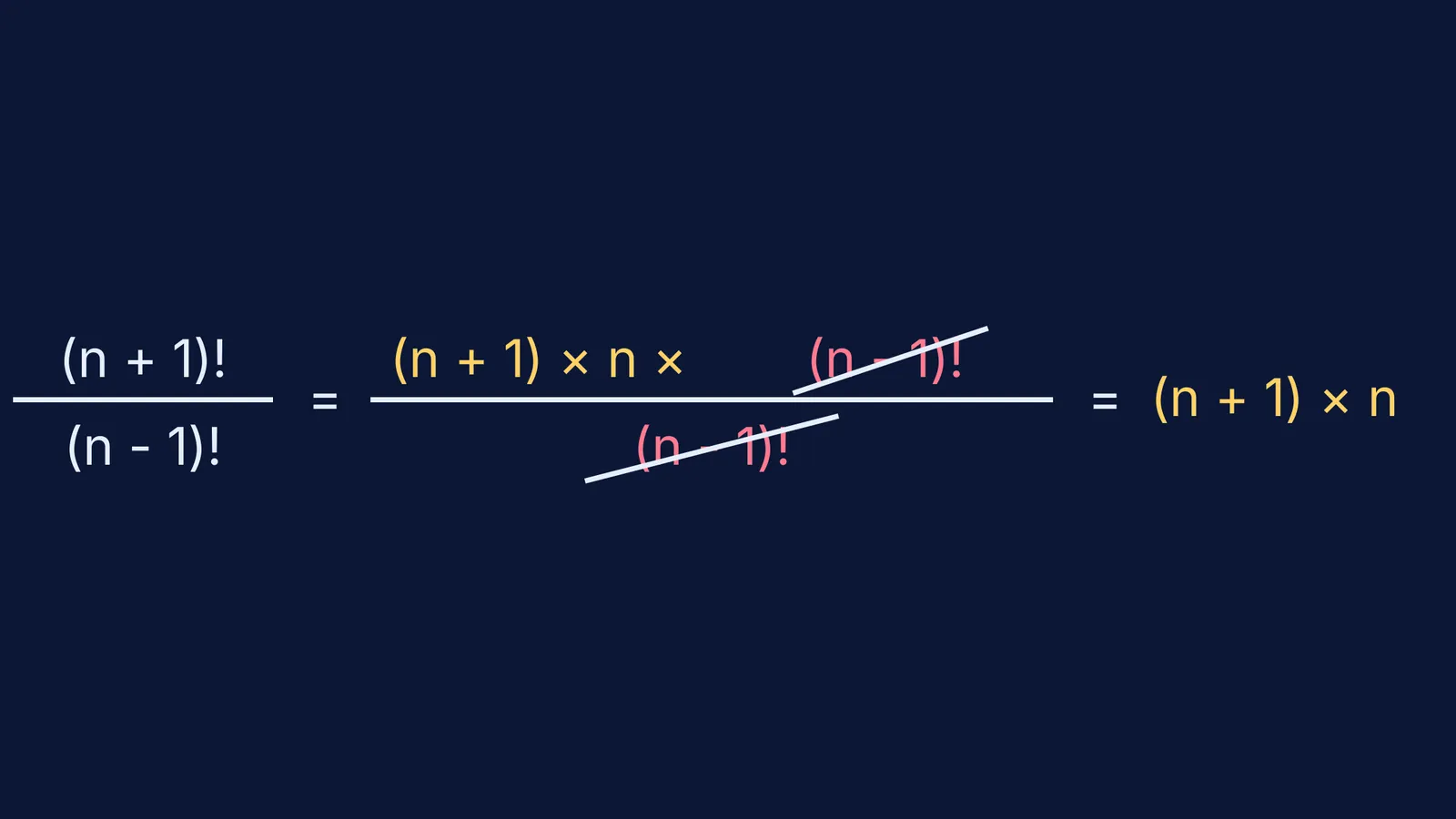
Step 2: Expand the larger factorial The numerator (n + 1)! is larger. Expand it downwards until it hits (n - 1)!: (n + 1)! = (n + 1) × n × (n - 1)!
Step 3: Cancel and simplify Substitute the expanded form into the fraction: (n + 1) × n × (n - 1)! / (n - 1)! = 12
The (n - 1)! terms cancel out, leaving a standard algebraic equation: (n + 1)n = 12
If you get stuck on the algebra at this stage, the Concept Library can help you review quadratics, while the Problem Library has worked problems with a step-by-step solver that explains the reasoning rather than printing an answer.
Step 4: Solve the quadratic equation Expand the brackets to get n² + n = 12. Bring everything to one side to form a quadratic: n² + n - 12 = 0
Factorise the quadratic: (n + 4)(n - 3) = 0
This gives two possible mathematical roots: n = -4 or n = 3. (To learn more about finding valid solutions, see our guide on nature and location of roots).
Step 5: Check the domain The factorial function n! is only defined for non-negative integers (n ≥ 0). If n = -4, the original equation would require evaluating (-3)!, which is undefined. Therefore, we discard -4.
The only valid solution is n = 3.
Once you stop seeing the exclamation mark as an instruction to calculate a massive number, factorial equations become ordinary algebra problems. By finding the larger factorial and expanding it downwards, you can cancel the complexity and solve what remains.


