

On this page
If you are revising permutations and combinations for CBSE Class 11 or JEE Main, four results do most of the work: symmetry, Pascal's rule, the nCa = nCb rule and the ratio of neighbouring terms. All of them come from one formula, and the NCERT Class 11 Mathematics chapter on permutations and combinations proves the first three in a few lines.
What does nCr = nC(n−r) mean?
The starting point is the formula nCr = n! / (r!(n − r)!) for 0 ≤ r ≤ n, as given in the NCERT chapter and in section 26.3 of the NIST Digital Library of Mathematical Functions.
Symmetry: nCr = nC(n−r). Swap r and n − r in the formula and the denominator does not change, so neither does the value. NCERT's plain-language reading is that selecting r objects out of n is the same as rejecting (n − r) objects. Pick a cricket XI from 15 players and you have also picked the 4 who sit out, so 15C11 = 15C4.
Use it to shrink calculations:
100C98 = 100C2 = (100 × 99) / 2 = 4950
20C17 = 20C3 = (20 × 19 × 18) / 6 = 1140
How do you find r if nCa = nCb?
The NCERT chapter states it directly: if nCa = nCb, then either a = b or a + b = n.
Worked example: if 15C(3r) = 15C(r+3), find r.
Case a = b: 3r = r + 3, so r = 1.5. Reject it, because r must be a whole number.
Case a + b = n: 3r + (r + 3) = 15, so 4r = 12 and r = 3.
Check: 15C9 = 15C6, since 9 + 6 = 15.
The same idea answers "if nC12 = nC8, find nC17": 12 + 8 = n, so n = 20, and 20C17 = 20C3 = 1140.
What is Pascal's rule nCr + nC(r−1) = (n+1)Cr?
Pascal's rule, nCr + nC(r−1) = (n+1)Cr, is Theorem 6 in the NCERT chapter and, written with n + 1 in place of n, the recurrence 26.3.5 in the NIST DLMF.
Why it is true: to choose r people from n + 1, watch one person, say Asha. Either Asha is in and you choose the other r − 1 from the remaining n, in nC(r−1) ways, or Asha is out and you choose all r from those n, in nCr ways. The cases never overlap, so they add up to (n+1)Cr.
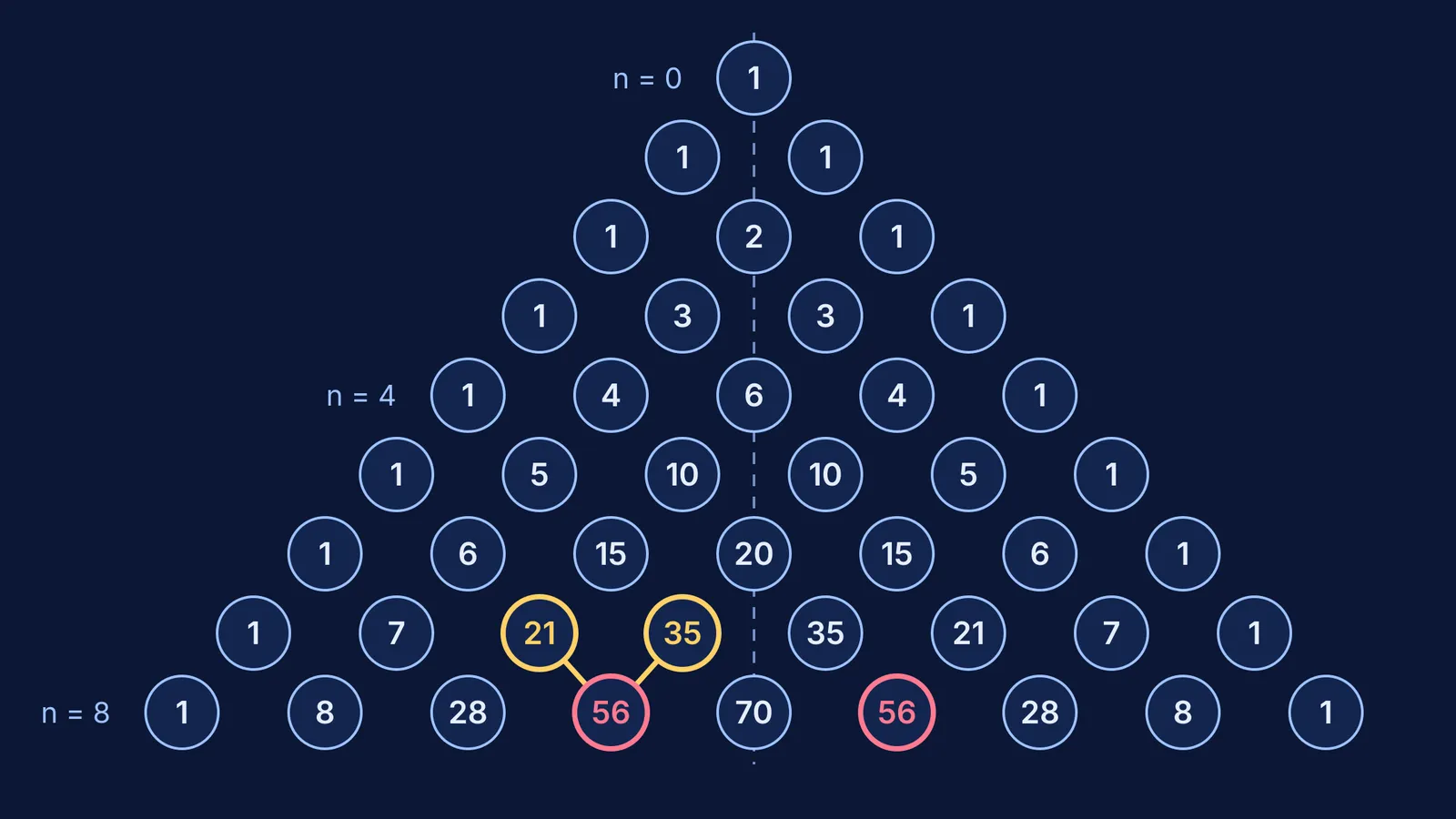
This is also the rule that builds Pascal's triangle: each number is the sum of the two above it. In the diagram at the top, 21 + 35 = 56, which is 7C2 + 7C3 = 8C3.
Use it to collapse sums:
10C4 + 10C3 = 11C4 = 330
8C3 + 8C4 + 9C5 = 9C4 + 9C5 = 10C5 = 252
Pascal's rule applies only when the two n values match and the two r values differ by 1.
How do you simplify a ratio of combinations?
For neighbouring terms in the same row, the factorials cancel to a short ratio, which is also equation 26.3.6 in the NIST DLMF:
nC(r) / nC(r−1) = (n − r + 1) / r
Write nCr / nC(r−1) = [n! / (r!(n − r)!)] × [(r − 1)!(n − r + 1)! / n!]. The n! cancels, (r − 1)! / r! leaves 1/r, and (n − r + 1)! / (n − r)! leaves n − r + 1.
Worked example: three consecutive values nC(r−1), nCr and nC(r+1) are 36, 84 and 126. Find n and r.
First ratio: 84/36 = 7/3 = (n − r + 1)/r, so 3n + 3 = 10r.
Second ratio, with r + 1 in place of r: 126/84 = 3/2 = (n − r)/(r + 1), so 2n = 5r + 3.
From step 1, n = (10r − 3)/3. Put this into step 2: 20r − 6 = 15r + 9, so r = 3 and n = 9.
Check: 9C2 = 36, 9C3 = 84 and 9C4 = 126.
If you forget the formula, write both terms as factorials and cancel.
What should you check before writing the answer?
Is r bigger than n/2? Flip it with symmetry first.
Are two combinations equal? Write both cases, a = b and a + b = n.
Is it a sum with the same n and r values one apart? Use Pascal's rule.
Is it a ratio? Use (n − r + 1)/r.
Is your final r a whole number between 0 and n?
If you cannot tell whether your method or your arithmetic failed, the Fermi Problem Library has worked problems with a step-by-step solver that explains the reasoning rather than printing an answer. If the formula itself feels shaky, the Fermi Concept Library gives every mathematics concept its own lesson and its place in the map.
Try the worked examples above without looking, then compare your steps.


