On this page
Probability questions in the Class 12 maths board paper come in a few familiar shapes, and the marking scheme rewards a clear layout. Preparing for entrance exams too? Our guide to probability for JEE Main covers that angle.
What is in the Probability unit for 2026-27?
The CBSE Mathematics curriculum for 2026-27 lists Unit VI, Probability, at 08 marks out of 80 for Class XII. Its five topics are conditional probability, the multiplication theorem, independent events, total probability and Bayes' theorem.
Random variables, probability distributions and their mean are not listed. The NCERT Class 12 Probability chapter (Reprint 2026-27) ends with Bayes' theorem and keeps only a short remark defining a random variable, so skip distribution tables.
In the 2026-27 sample paper, Probability appears as three 1-mark MCQs (Q16 to Q18) and one 5-mark question (Q35) on total probability and Bayes' theorem. The real paper can differ.
Which results should you practise?
The results, in NCERT's notation:
Conditional probability: P(E|F) = P(E ∩ F) / P(F), provided P(F) ≠ 0.
Multiplication theorem: P(E ∩ F) = P(E) P(F|E), provided P(E) ≠ 0.
Independent events: P(E ∩ F) = P(E) P(F). If E and F are independent, so are E and F′, E′ and F, and E′ and F′.
Total probability: if E1, ..., En partition the sample space, P(A) = Σ P(Ej) P(A|Ej).
Bayes' theorem: P(Ei|A) = P(Ei) P(A|Ei) / Σ P(Ej) P(A|Ej).
A partition means the events are pairwise disjoint, together cover the sample space, and each has non-zero probability. For short answers, copy the habit in the sample paper's marking scheme: name each event in words, list the outcomes when the sample space is small, and write the formula before the numbers. If "given that" still trips you up, read why two children with at least one boy gives 1/3.
How do you set out the 5-mark Bayes answer?
The sample paper's marking scheme splits Q35's 5 marks into four steps:
Define the events, say they form a partition, and write the prior probabilities: 1 mark.
Write each conditional probability P(A|Ei): 1 mark.
Find P(A) by the theorem of total probability: 1½ marks.
Apply Bayes' theorem for the asked probability: 1½ marks.
So 2 marks come before any real calculation. Errors that cost step marks:
Starting with numbers and no event definitions.
Priors that do not add up to 1.
Writing P(A|E2) when the question asks for P(E2|A).
Dividing by one branch instead of the full total.
Rounding decimals early; keep fractions.
Worked example: which nursery sold the dud seed?
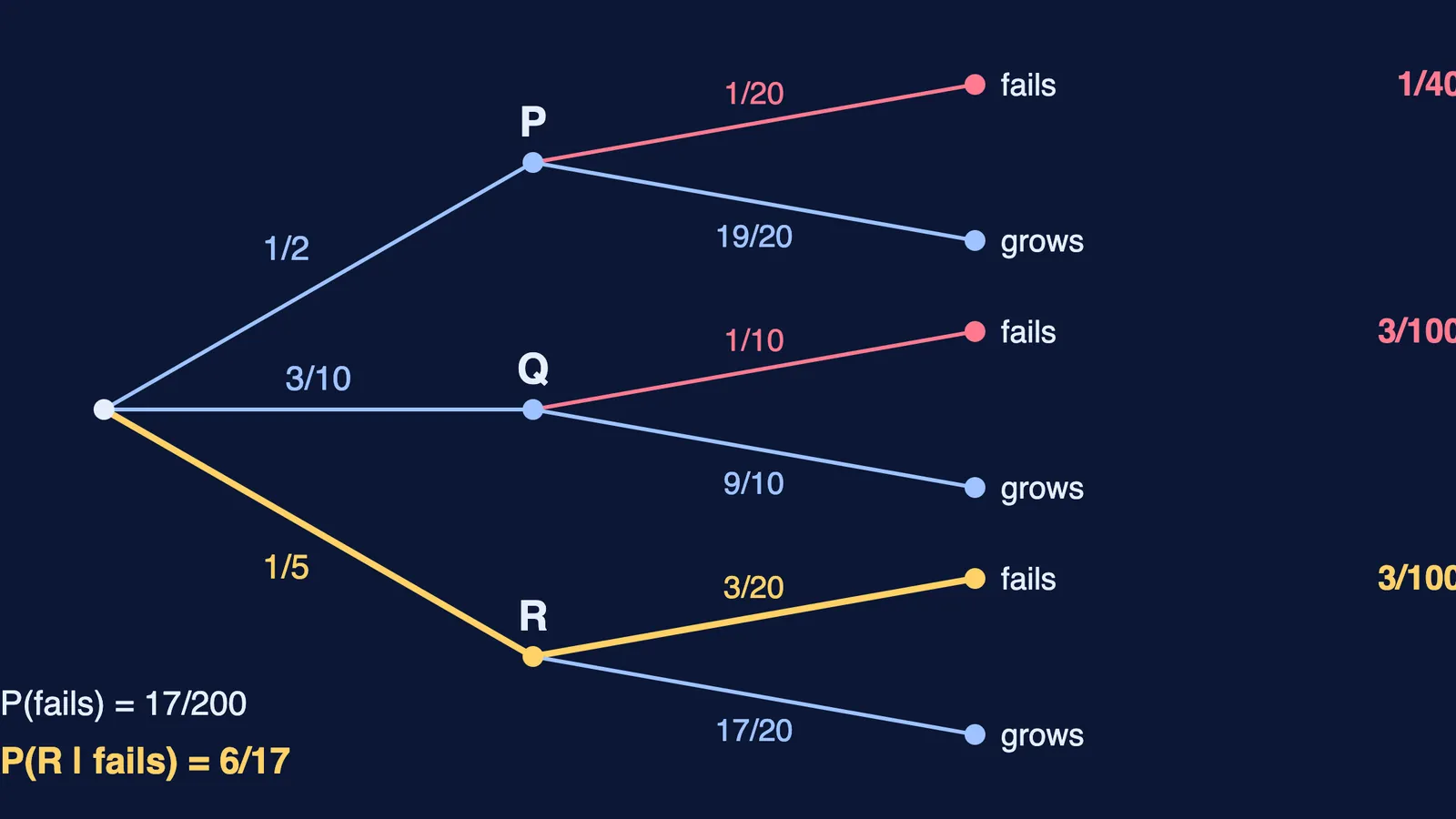
Your school eco-club buys marigold seeds from three nurseries: 1/2 from Nursery P, 3/10 from Q and 1/5 from R. A seed fails to sprout with probability 1/20 from P, 1/10 from Q and 3/20 from R. A seed picked at random fails. Find the probability it came from R.
Method 1: the board layout. Let E1, E2, E3 be "seed from P, Q, R" and A be "seed fails". E1, E2, E3 form a partition: P(E1) = 1/2, P(E2) = 3/10, P(E3) = 1/5. Also P(A|E1) = 1/20, P(A|E2) = 1/10, P(A|E3) = 3/20.
By total probability, P(A) = 1/2 × 1/20 + 3/10 × 1/10 + 1/5 × 3/20 = 1/40 + 3/100 + 3/100 = 17/200.
By Bayes' theorem, P(E3|A) = (3/100) ÷ (17/200) = 6/17.
Method 2: count seeds. Picture 200 seeds: 100 from P, 60 from Q, 40 from R. Of these, 5, 6 and 6 fail: 17 failures, 6 of them from R. That is 6/17 again.
What traps hide in assertion-reason and case-study questions?
In the sample paper these formats test other units, but Probability can appear in them. Watch for:
Independent is not mutually exclusive. NCERT notes that two events with non-zero probabilities cannot be both.
A reversed condition. P(E|F) and P(F|E) usually differ. Check which event is "given".
A missing condition. P(E|F) needs P(F) ≠ 0; a reason that drops it may be incomplete.
Percentages in a passage. Convert 45% to 0.45 and check the priors add to 1 first.
Linked parts. A later part may reuse an earlier answer, so write each one clearly.
How should you revise Probability in two weeks?
Days 1-2: conditional probability, NCERT Exercise 13.1.
Days 3-4: multiplication theorem and independence, Exercise 13.2. Label each pair independent, mutually exclusive or neither.
Days 5-7: total probability and Bayes, Exercise 13.3, using the four-step layout.
Days 8-9: the Miscellaneous Exercise, under a timer.
Days 10-11: sample paper Q16-Q18 and Q35, marked against the scheme.
Days 12-14: two Bayes questions a day from memory; fix the step you dropped.
If one step keeps going wrong, the Fermi Problem Library has worked problems with a step-by-step solver that explains the reasoning rather than printing an answer. On exam day, our 20-minute triage plan for running out of time helps protect step marks.