On this page
A family has two children and at least one is a boy. What is the probability that both are boys? Many people answer 1/2. The textbook answer is 1/3, worked as Example 2 in the Probability chapter of the NCERT Class 12 Mathematics textbook. To see why, write out every possible family and cross out the ones the information rules out.
Why is the answer 1/3 and not 1/2?
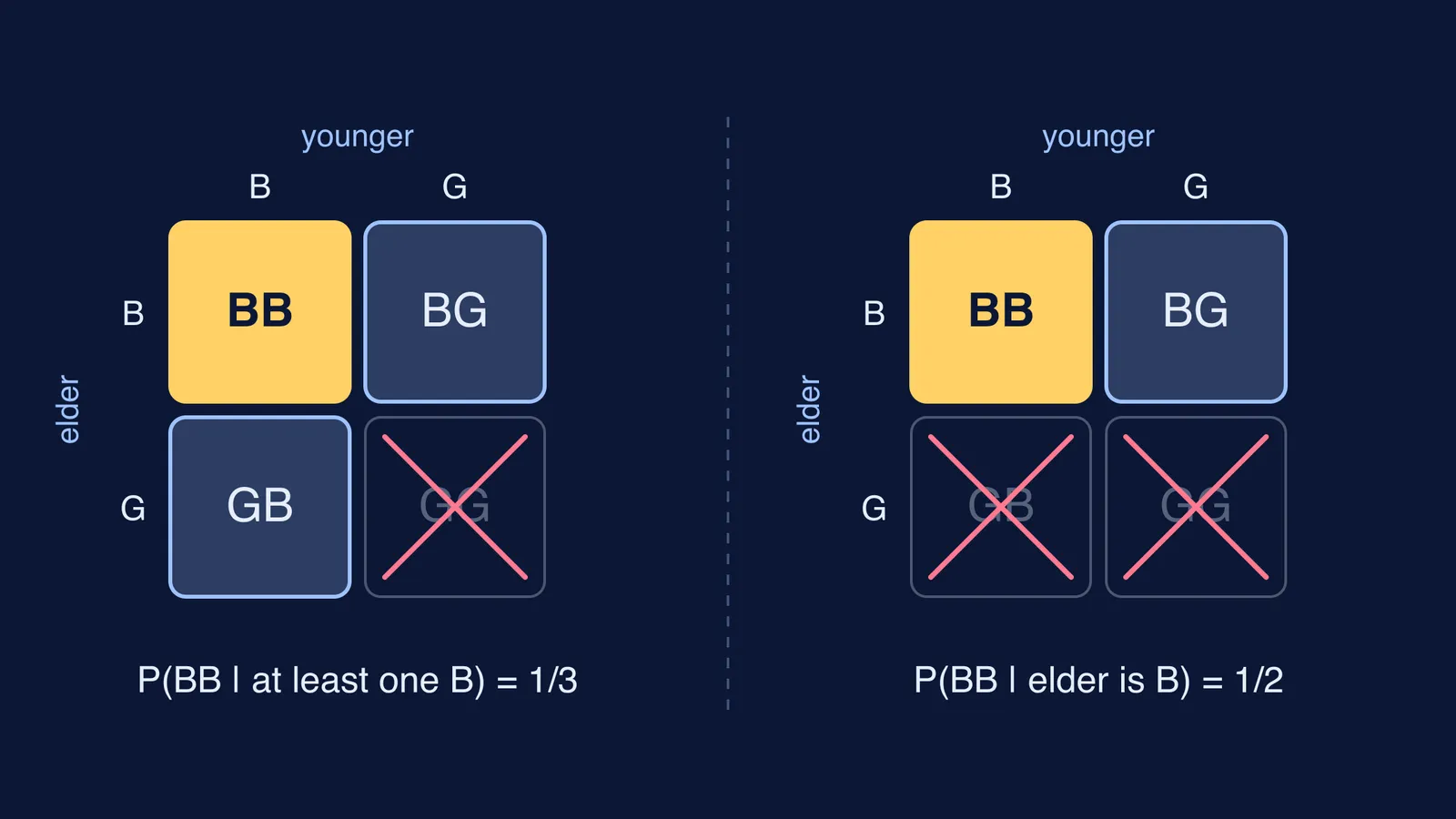
Write each family elder child first, using B for boy and G for girl. The sample space has four outcomes: BB, BG, GB and GG. The NCERT chapter treats outcomes as equally likely unless stated otherwise, so each family has probability 1/4 (NCERT Class 12, Chapter 13).
Start with S = {BB, BG, GB, GG}.
"At least one boy" rules out only GG, leaving {BB, BG, GB}.
Only one of those three, BB, has two boys.
So P(both boys | at least one boy) = 1/3.
In formula form, with E = both boys and F = at least one boy, P(E | F) = P(E ∩ F) / P(F) = (1/4) / (3/4) = 1/3, exactly as NCERT sets it out.
The 1/2 answer goes wrong at the words "the other child". "At least one is a boy" does not say which child is the boy, so there is no single other child. BG and GB are different families, both survive the condition, and both contain a girl.
If you would rather watch the 1/3 appear, our post that simulates thousands of two-child families counts it out.
What changes if the elder child is a boy?
Change one word: the elder child is a boy. Now cross out every outcome whose first letter is G, so GB and GG both go. The reduced sample space is {BB, BG}, one of the two is BB, and the probability is 1/2.
Here "the other child" makes sense, because you know which child is the boy. Naming a particular child throws out two of the four outcomes; knowing only that a boy exists throws out just one.
At least one boy: keep BB, BG, GB, so 1/3.
The elder child is a boy: keep BB, BG, so 1/2.
The younger child is a boy: keep BB, GB, so 1/2.
Where does the puzzle come from, and can it ever be 1/2?
Martin Gardner posed the puzzle in his Mathematical Games column in Scientific American in May 1959, next to a version in which the older child is a girl. He gave the answers 1/2 for the older-girl version and 1/3 for the at-least-one-boy version, and later acknowledged that the second was ambiguous (Boy or girl paradox, Wikipedia).
The ambiguity is about how you learnt the fact. If a family is picked at random from all two-child families with at least one boy, the answer is 1/3. If one of the two children is picked at random and that child is a boy, you have learnt about a particular child, and the answer is 1/2 (Wikipedia). Maya Bar-Hillel and Ruma Falk examined puzzles like this in a 1982 Cognition paper, "Some teasers concerning conditional probabilities" (DOI), and the Wikipedia article credits them with confirming that the ambiguity depends on the exact wording and assumptions.
In a CBSE board or JEE Main paper, read the wording literally: "given that at least one is a boy" is the event F = {BB, BG, GB}, and the NCERT answer is 1/3.
How do you solve 'given that' problems without guessing?
Use the same cross-out method every time; it also works for conditional probability with two dice when the sum is even.
Give the objects an order (elder and younger, first and second), even if the question doesn't.
List the full sample space and check the outcomes are equally likely. If that feels shaky, revise sample space and types of events from Class 11.
Cross out every outcome the condition rules out.
Count the favourable outcomes in what is left, and divide.
Check with P(E | F) = P(E ∩ F) / P(F).
Ask whether the condition named a specific child, die or card.
Try three children, at least one a girl: what is the probability all three are girls? There are 8 outcomes, the condition removes only BBB, and one of the remaining seven is GGG, so the answer is 1/7. If instead the eldest is a girl, four outcomes remain and the answer is 1/4.
If you keep landing on 1/2 in problems like these, the Fermi Problem Library has worked problems with a step-by-step solver that explains the reasoning rather than printing an answer, so you can see the step where the sample space shrinks. For the idea underneath, the Fermi Concept Library gives each concept in mathematics its own lesson.
Next time a question says "given that", write the families down before you write a fraction.