

On this page
Roll two dice and there are 36 equally likely outcomes. A question that adds "given the sum is even" is telling you that some of those outcomes did not happen. There are two ways to use that information, and each one checks the other.
What does "given the sum is even" do to the sample space?
It throws away every outcome with an odd sum. The free OpenStax textbook puts it in one line: "A conditional probability reduces the sample space" (OpenStax Statistics, section 3.1). An online probability textbook says the same thing more bluntly: once B has occurred, "every outcome that is outside B should be discarded" (probabilitycourse.com, conditional probability).
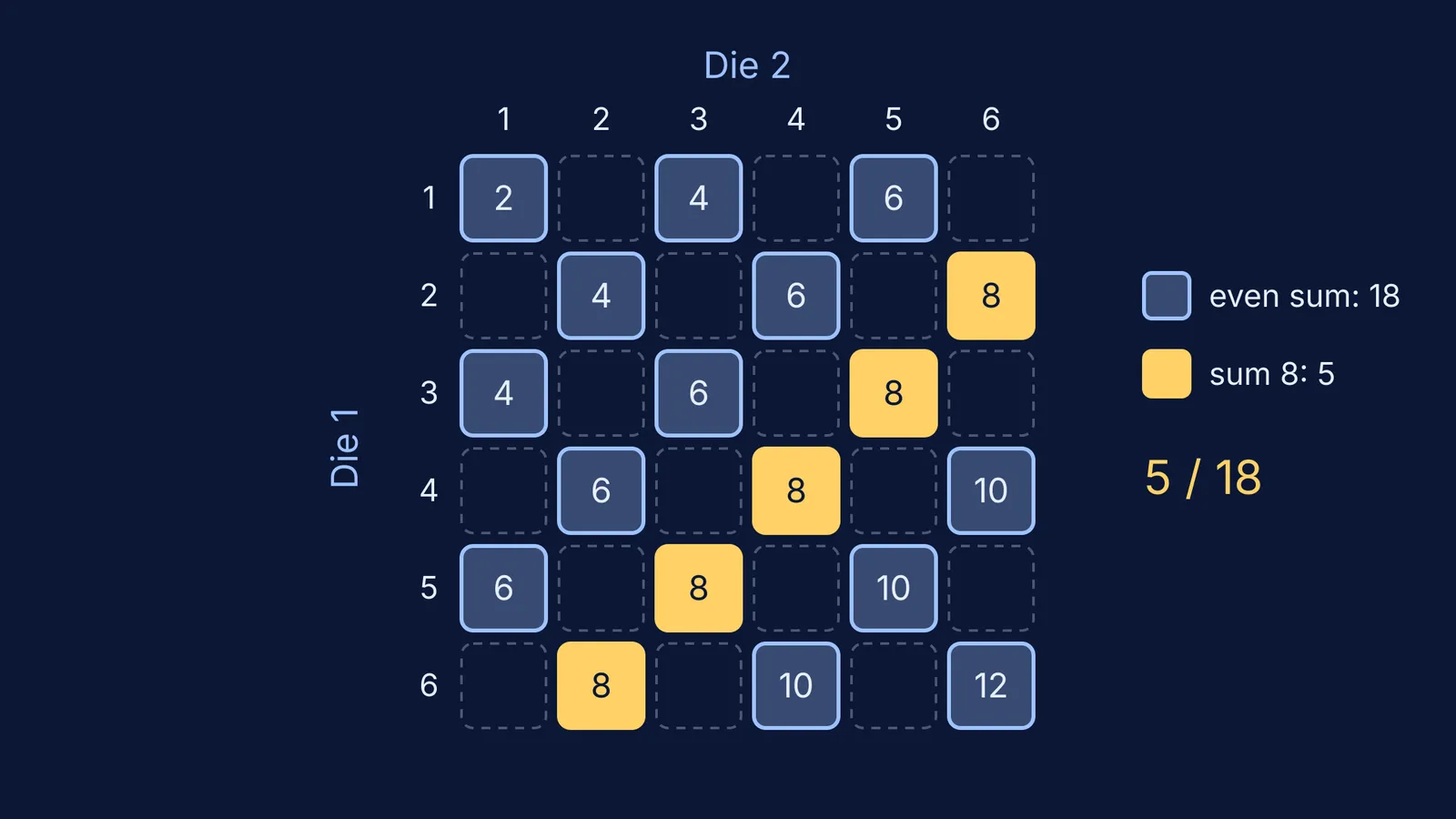
So count what is left. A sum is even only when both dice are odd or both are even. There are 3 × 3 = 9 odd-odd outcomes and 3 × 3 = 9 even-even outcomes, so the new sample space has 18 outcomes, exactly half of the 36.
Broken down by sum, the 18 are: sum 2 (1 way), 4 (3 ways), 6 (5 ways), 8 (5 ways), 10 (3 ways) and 12 (1 way). If listing outcomes still feels shaky, start with sample space and types of events in Class 11 probability.
How do you find P(sum is 8 | sum is even)?
Let E be "the sum is 8" and F be "the sum is even". Here are both methods, side by side.
Method 1 is to shrink the sample space. Inside the 18 even-sum outcomes, a sum of 8 comes from (2, 6), (3, 5), (4, 4), (5, 3) and (6, 2). That is 5 outcomes. All 18 are still equally likely, so P(E | F) = 5/18.
Method 2 is to use the formula. NCERT defines the conditional probability of E given F as P(E | F) = P(E ∩ F)/P(F), with P(F) ≠ 0 (NCERT Exemplar, Class 12 Mathematics, Chapter 13).
Every sum of 8 is even, so E ∩ F is just E, and P(E ∩ F) = 5/36. The even sums give P(F) = 18/36. Divide: (5/36) ÷ (18/36) = 5/18.
Same answer. The 36s cancel, and that is the whole idea: dividing by the probability of the given event is done "so that the conditional probability of the new sample space becomes 1" (probabilitycourse.com).
When should you shrink, and when should you use the formula?
Shrink when outcomes are equally likely and the given event is small enough to list: dice, coins, a few cards.
Use the formula when outcomes are not equally likely, or when the question gives you numbers such as P(F) and P(E ∩ F) instead of outcomes.
Use both whenever time allows. One is the answer and the other is the check.
One trap: shrink by outcomes, never by sums. The six even sums (2, 4, 6, 8, 10, 12) are not equally likely, so calling P(sum 8 | even) "1 out of 6" is wrong. Here is why the sum of two dice is not equally likely.
Three practice questions with answers
P(doubles | sum is even). All 6 doubles have even sums. Shrink: 6/18 = 1/3. Formula: (6/36) ÷ (18/36) = 1/3. Knowing the sum is even doubles the chance from 1/6.
P(first die shows 1 | sum is even). The second die must then be odd: (1, 1), (1, 3), (1, 5). Shrink: 3/18 = 1/6. Formula: (3/36) ÷ (18/36) = 1/6. That equals the plain chance of a 1, so here the information changes nothing.
P(sum is not 8 | sum is even). Shrink: 13 of the 18 outcomes are not 8, so 13/18. Check with the property P(E′ | F) = 1 − P(E | F): 1 − 5/18 = 13/18. More rules like this are in properties of conditional probability.
A four-step checklist for any "given" question
Name the events: E is what you want, F is what you know.
Shrink: list or count F. This is your new sample space.
Count E inside F. That is E ∩ F, never E on its own.
Check with the formula P(E ∩ F)/P(F), using the full sample space. If the two answers differ, a count is wrong.
The usual slip is step 3: counting E across all 36 outcomes, then dividing by 18. With sum 8 you get away with it, because every 8 is even. With "sum is at least 11" you would wrongly count (5, 6) and (6, 5), and step 4 catches it.
If your two answers disagree and you cannot see why, the Fermi Problem Library has worked problems with a step-by-step solver that explains the reasoning rather than printing an answer. For the definitions underneath, the Fermi Concept Library gives each mathematics concept its own lesson.
Next time you see "given", draw the 6 × 6 grid, cross out what did not happen, and count what is left.


