

On this page
When you learn conditional probability, the formula P(A|B) = P(A ∩ B) / P(B) is just the start. To solve exam questions quickly, you need to know how the standard rules of probability change—or stay the same—when a condition is applied.
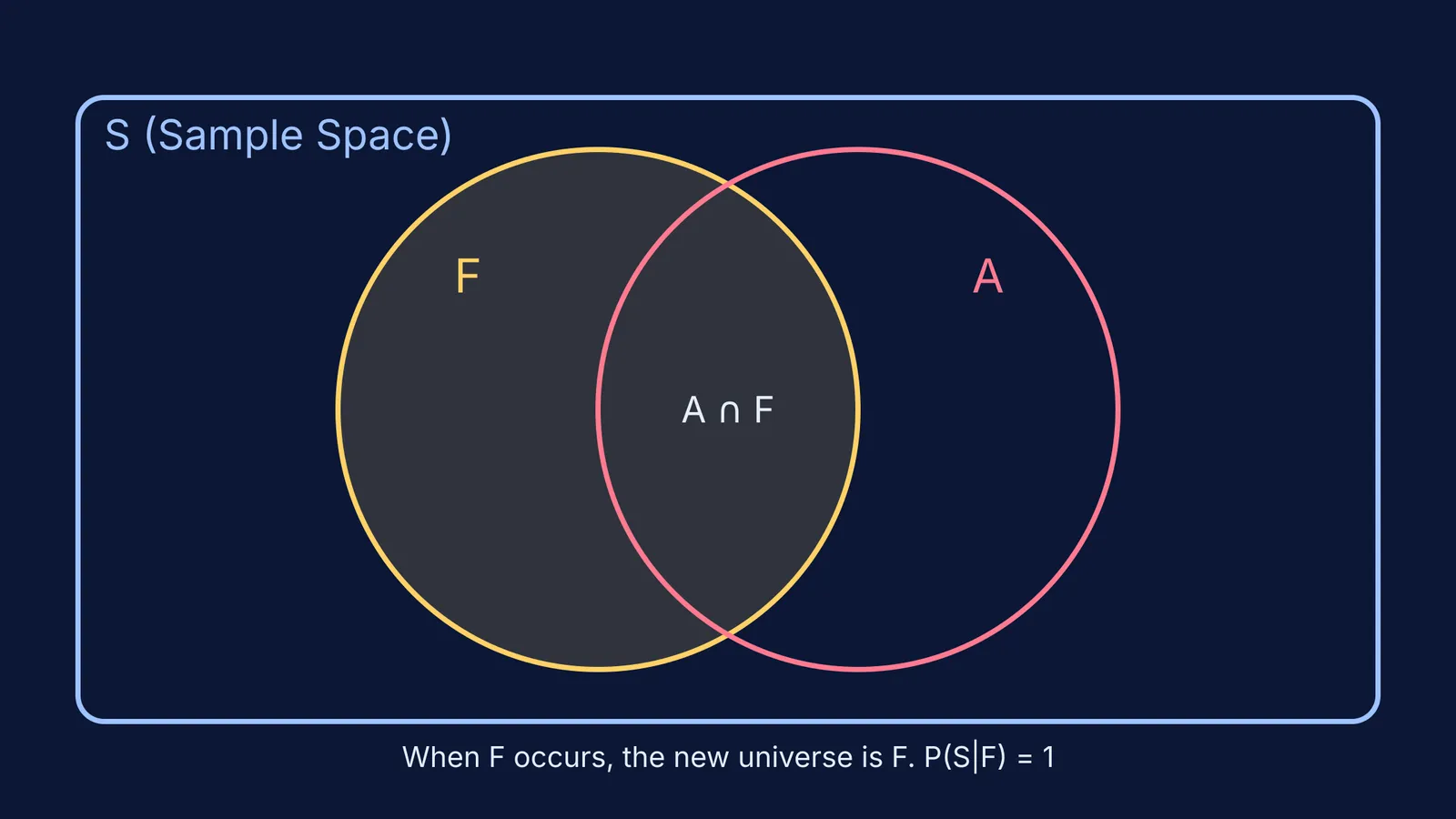
The good news is that conditional probability behaves exactly like regular probability, just in a smaller universe. Once you know that event F has happened, F becomes your new sample space. Everything outside F vanishes.
Let's look at the three main properties, how they work, and a quick way to use them.
Property 1: Why does P(S | F) = 1?
According to standard probability theory, the conditional probability of the entire sample space S, given an event F, is exactly 1.
By the definition of conditional probability, P(S|F) = P(S ∩ F) / P(F). Since the event F is entirely contained within the sample space S, their intersection is simply F. This gives P(F) / P(F) = 1.
Similarly, the probability of an event occurring given that it has already occurred is certainty: P(F|F) = 1. If you are looking for more intuition on how sample spaces shrink, the Fermi Concept Library has its own lesson on probability spaces so you can see why the denominator changes.
Property 2: What is P(A complement given F)?
A frequent search question is about the complement rule inside a condition: how do you find P(A'|F)?
The complement rule survives perfectly intact inside a conditional universe. The probability of the complement of an event A, given F, is P(A'|F) = 1 − P(A|F).
This is incredibly useful. If calculating the probability of A happening is complicated, but finding the probability of A not happening is easy, you can just subtract the easier result from 1. The condition F just sits quietly in the background of both terms.
Property 3: The addition rule inside a conditional
The standard addition rule for the union of two events is P(A ∪ B) = P(A) + P(B) − P(A ∩ B). If you know that event F has occurred, this entire rule still applies, with F attached to every term:
P(A ∪ B | F) = P(A | F) + P(B | F) − P(A ∩ B | F)
If A and B are disjoint events (they cannot happen at the same time), their intersection is empty, and the formula simplifies to P(A ∪ B | F) = P(A | F) + P(B | F).
A worked example: rolling a die
Let's put these properties to work. Suppose you roll a fair six-sided die.
Let F be the event "the number is even" = {2, 4, 6}.
Let A be the event "the number is a multiple of 3" = {3, 6}.
Let B be the event "the number is less than 4" = {1, 2, 3}.
You are told the roll is even. What are the properties in action?
The sample space: P(S|F) is the probability of getting any number from 1 to 6, given it is even. Since {2, 4, 6} are all in the sample space, P(S|F) = 1.
The complement: First, find P(A|F). The only even multiple of 3 is 6. There are three even numbers, so P(A|F) = 1/3. Using the complement property, P(A'|F) = 1 − 1/3 = 2/3. (Indeed, the even numbers that are not multiples of 3 are 2 and 4, which is 2 out of 3).
The union: We want P(A ∪ B | F).
P(B|F) is the probability of being less than 4, given it is even. The only even number less than 4 is 2. So P(B|F) = 1/3.
P(A ∩ B | F) is the probability of being a multiple of 3 AND less than 4, given it is even. There are no such numbers (3 is odd). So P(A ∩ B | F) = 0.
P(A ∪ B | F) = 1/3 + 1/3 − 0 = 2/3.
By keeping the rules straight, you avoid having to manually count outcomes for complex unions or complements. For more practice on setting up these cases, you can read our guide on with and without replacement: probability problems compared or see how overlaps are counted in three-set Venn problems.


