

On this page
If you roll a single fair die, your chance of getting a 3 is exactly the same as your chance of getting a 6. But when you roll two dice and add them together, the possible sums from 2 to 12 are not equally likely. It is a mathematical trap that catches almost everyone at some point, blending our intuition about randomness with a misunderstanding of how probability actually works.
What is the equiprobability bias?
When faced with a random event, we often assume that because we cannot predict the outcome, every result must have the same chance of happening. In a 1992 study published in *Educational Studies in Mathematics*, researcher Marie-Paule Lecoutre gave this exact dice problem to students and found that 51% of them fell for what she called the "equiprobability bias". Many argued that because a dice roll is a matter of chance, rolling a 9 must be just as likely as rolling a 10.
Surprisingly, Lecoutre's study showed that taking a formal probability course did not wipe out the misconception. Students simply carried the rule for a single coin or die and wrongly applied it to the sum of two dice.
Why are outcomes not equally likely sum of two dice?
The mistake lies in confusing the final result (the sum) with the sequences that build it.
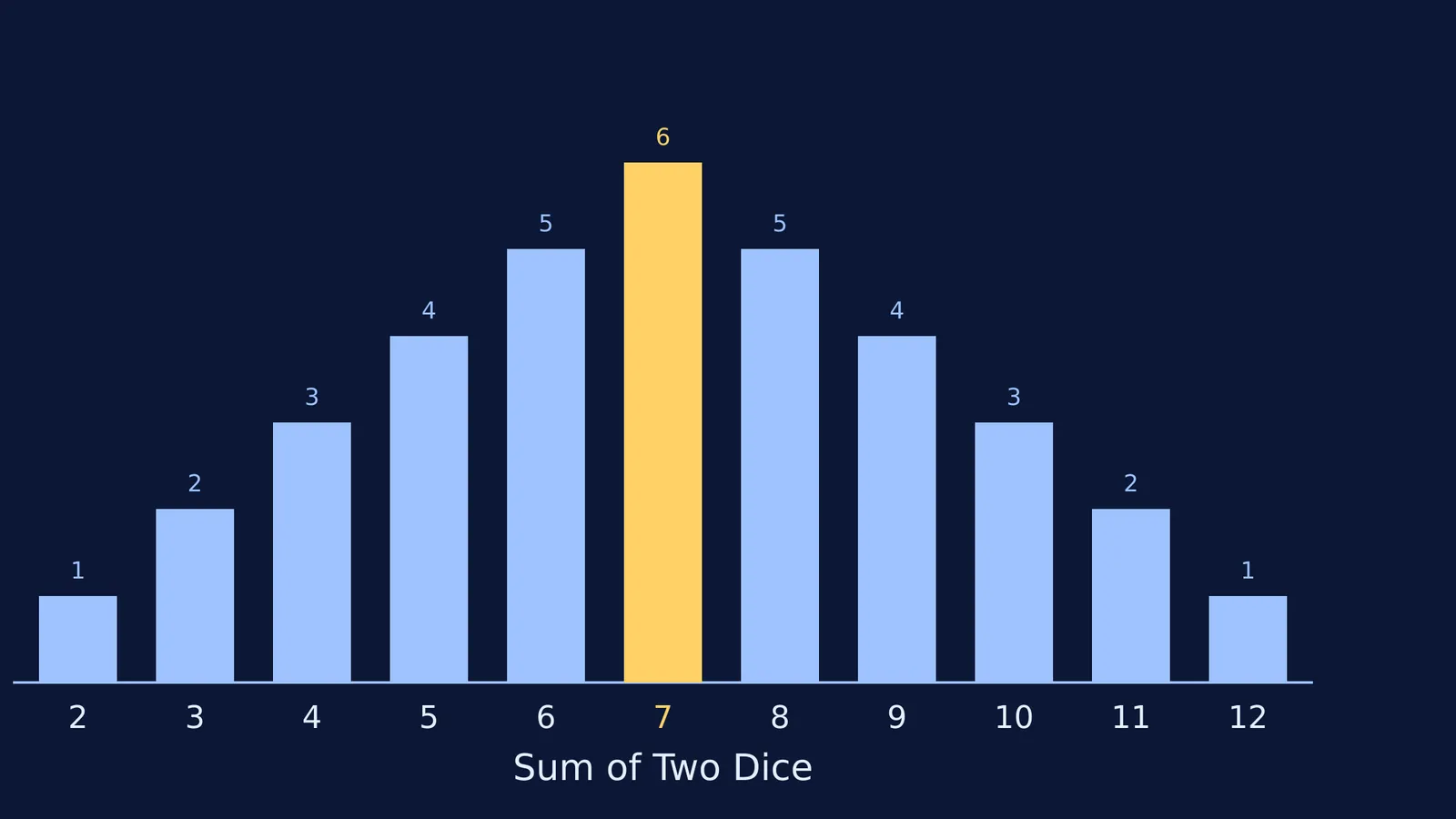
If you roll a red die and a blue die, there are 36 distinct, equally likely sequences (from 1-and-1 to 6-and-6). But those 36 sequences do not map evenly onto the 11 possible sums.
There is only one way to get a sum of 2: both dice must show a 1. That is a 1 in 36 chance. But there are six different ways to get a sum of 7: 1+6, 2+5, 3+4, 4+3, 5+2, and 6+1. The sum of 7 has a 6 in 36 chance, making it six times more likely than rolling a 2.
Educators often use a 6 by 6 grid to break the trap. Along the top, you write the numbers 1 to 6 for the first die, and down the side, 1 to 6 for the second die. Filling in the grid gives you 36 boxes. When you look at the sums inside those boxes, a pattern emerges: the sums of 7 form the longest diagonal right across the middle of the grid, while the sums of 2 and 12 sit alone in the far corners. This visual proof makes it instantly clear why the outcomes cannot be treated equally.
Heads count versus sequences
You see the exact same trap when flipping coins. If you flip three coins, getting three heads feels less likely than getting two heads and one tail. Yet many students think that 0, 1, 2, or 3 heads are the four possible outcomes, so each has a 25% chance.
To find the true probability, you have to break the count down into distinct sequences. There are 8 equally likely sequences for three flips. The sequence HHH (three heads) is just one of those 8. But the count of "two heads" can happen in three different ways: HHT, HTH, or THH. Just like the dice sums, the distinct sequences are equally likely, but the final counts are not.
Psychologically, our brains fall into this trap because of what is known as the representativeness heuristic. We tend to think that a mixed sequence like HTH looks "more random" than a straight sequence like HHH. In reality, the coin has no memory and does not know it is forming a pattern; every specific sequence of three flips is exactly as likely as any other. If you find counting cases difficult, the Fermi Problem Library provides a step-by-step solver that explains the reasoning behind permutations and combinations rather than just printing an answer.
Why does the classical formula need equally likely outcomes?
In 1812, Pierre-Simon Laplace formalised the classical definition of probability in his book *Théorie analytique des probabilités*. He wrote that the probability of an event is the number of favourable outcomes divided by the total number of possible outcomes.
But Laplace added a crucial condition: this division only works if all the outcomes are *equally possible*. When you use this formula on the 11 sums of two dice, you violate Laplace's rule, because a 7 is much easier to get than a 2. You have to apply the formula to the 36 underlying sequences instead.
Whether you are calculating odds in favour and odds against a hand in a game, or comparing probabilities with and without replacement from a bag of marbles, identifying the true, equally likely microstates is your first step. And when you cannot see how to break a complex problem down, Fermi's AI tutor can work out what you already know and build a plan for the session, guiding you to the right sample space.


