On this page
The Living World opens NCERT Class 11 Biology with two questions: how biologists give each organism one name used worldwide, and how they rank organisms into groups.
What does The Living World cover in 2026-27?
The CBSE 2026-27 Biology curriculum lists the chapter as biodiversity, need for classification, three domains of life, taxonomy and systematics, concept of species and taxonomical hierarchy, and binomial nomenclature.
Marks are printed per unit. Unit I, Diversity of Living Organisms, carries 15 of the 70 theory marks, shared by The Living World, Biological Classification, Plant Kingdom and Animal Kingdom. No chapter figure is printed.
The NCERT chapter (Reprint 2026-27) is split into just two numbered parts: Diversity in the Living World (1.1) and Taxonomic Categories (1.2). It has no section on the defining features of life, so guides that spend pages on growth, reproduction and metabolism go beyond this reprint. The three-domain system is mentioned briefly in the next chapter, Biological Classification, so ask your teacher how your school will test it.
The curriculum also boxes topics that "will be assessed only formatively to reinforce understanding without adding to summative assessments". For Class XI that box lists Digestion and Absorption, not this chapter.
How does binomial nomenclature work?
NCERT puts known and described species at 1.7-1.8 million. Local names vary from place to place, so each gets one scientific name. Plant names follow the International Code for Botanical Nomenclature (ICBN); animal names follow the International Code of Zoological Nomenclature (ICZN).
Carolus Linnaeus gave biology the binomial system: every name pairs a generic name with a specific epithet. Take mango, *Mangifera indica*: *Mangifera* names its genus, and *indica* is its specific epithet. The rules:
Names come from Latin, or are Latinised, and appear in italics in print.
The first word is the genus; the second is the specific epithet.
When handwritten, each word is underlined separately.
Capitalise the genus; begin the epithet in lower case.
The author's name comes last, abbreviated: *Mangifera indica* Linn. shows Linnaeus first described it.
What is the taxonomic hierarchy?
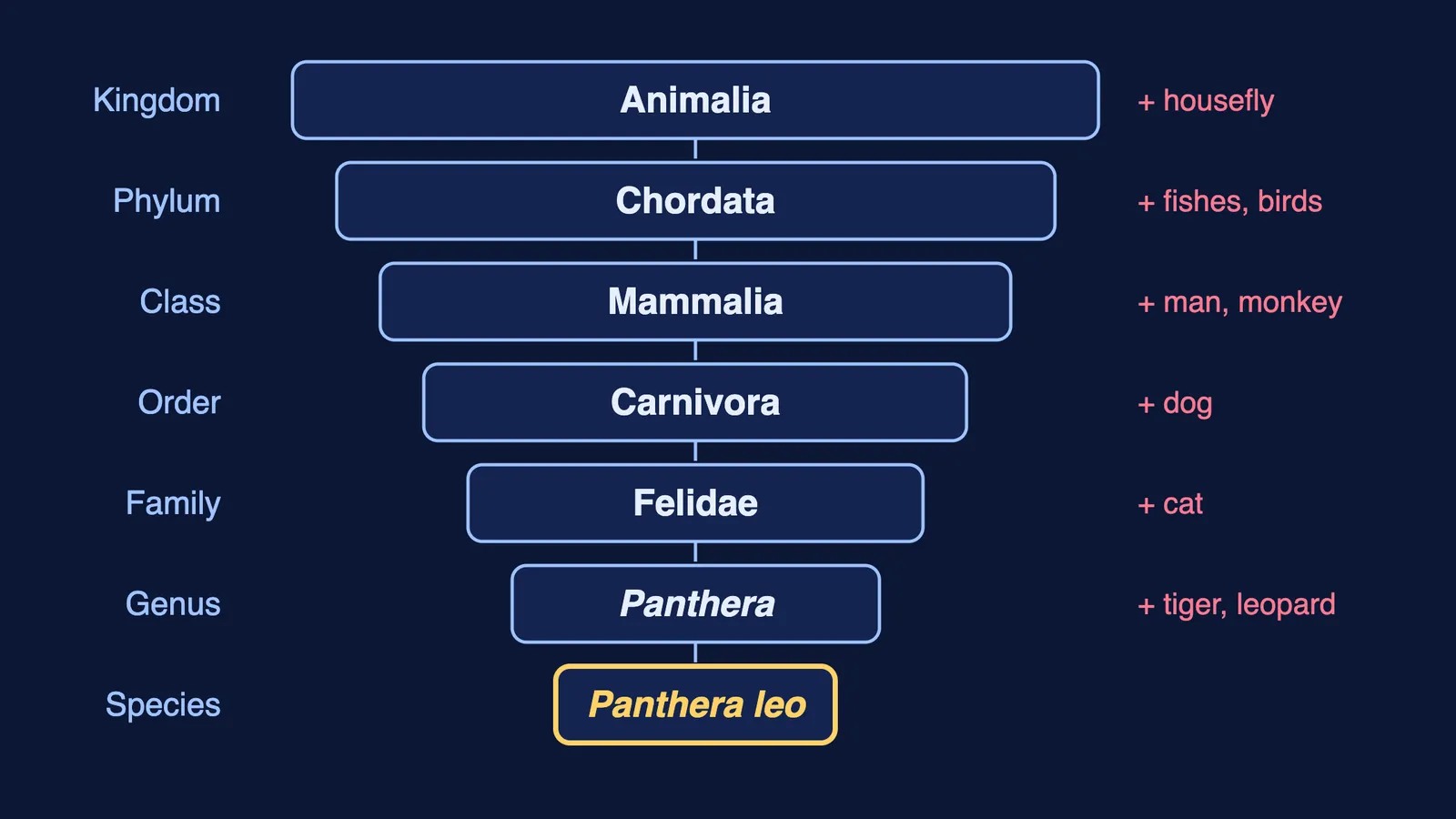
NCERT calls the grouping of organisms by characters taxonomy, and the study of their relationships systematics, which also takes evolution into account. Classification works in steps. Each step is a rank, or taxonomic category; together they form the taxonomic hierarchy. A group at any rank is a taxon (plural taxa). Climbing up from the bottom, the seven ranks run species, genus, family, order, class, phylum and kingdom; for plants, division replaces phylum.
Going up, members share fewer characters. The diagram above assembles the lion's full chain from facts spread through the chapter: *Panthera leo*, genus *Panthera*, family Felidae, order Carnivora, class Mammalia, phylum Chordata, kingdom Animalia.
Lion and tiger: both *Panthera*, so genus.
Lion and cat: cats are genus *Felis*, but both are Felidae, so family.
Lion and dog: dogs are Canidae, but both are Carnivora, so order.
Lion and man: man is order Primata (NCERT Table 1.1), but both are Mammalia, so class.
Lion and housefly: the housefly is phylum Arthropoda, so only kingdom Animalia.
In plants, *Solanum* (potato, brinjal), *Petunia* and *Datura* share the family Solanaceae.
Revising with a chatbot? Our check of AI's taxonomy against Table 1.1 shows how to mark its answers.
What practice questions should you try?
CBSE's 2026-27 Biology sample paper is for Class XII; it mixes 1-mark multiple-choice and assertion-reason items with 2-, 3-, 4- and 5-mark questions. These questions are our own, and the mark labels are our suggestion, not CBSE's.
(1 mark) A student handwrites the potato's scientific name with one line under both words. What is wrong?
(1 mark) Assertion (A): Members of order Carnivora share fewer characters than members of family Felidae. Reason (R): Order is a higher category than family. Is R the correct explanation of A?
(2 marks) Name the lowest rank brinjal and *Petunia* share, and say why it is not genus.
(3 marks) Give the family, order and class of the dog, and the lowest rank it shares with the cat.
Answers: (1) Each word must be underlined separately. (2) Both true, and R explains A. (3) Family Solanaceae; they are in different genera, *Solanum* and *Petunia*. (4) Canidae, Carnivora, Mammalia; order.
Which mistakes cost marks?
Giving the epithet a capital letter. In *Solanum tuberosum*, the "t" stays small.
Writing the epithet on its own. *leo* is not the lion's name; *Panthera leo* is.
Saying higher ranks share more features. It runs the other way: the higher the rank, the fewer characters its members share.
Calling plant groups phyla. NCERT's plant rank above class is division.
Writing "taxa" for one group. One group is a taxon.
Preparing for NEET too? Our The Living World for NEET guide covers the same ranks; the five kingdoms compared leads into the next chapter.
Not sure where to begin? Fermi's AI tutor works out what you already know and builds a plan for the session.