On this page
You've just finished section 1.2 of The Living World and want a quick self-test. Here's one: ask an AI chatbot for the genus, family and order of four organisms, then mark its answer against the table NCERT prints at the end of that section. Marking the AI's work makes you read every cell of Table 1.1 in NCERT Class 11 Biology, Chapter 1 closely.
What does NCERT Table 1.1 say about mango, wheat, housefly and man?
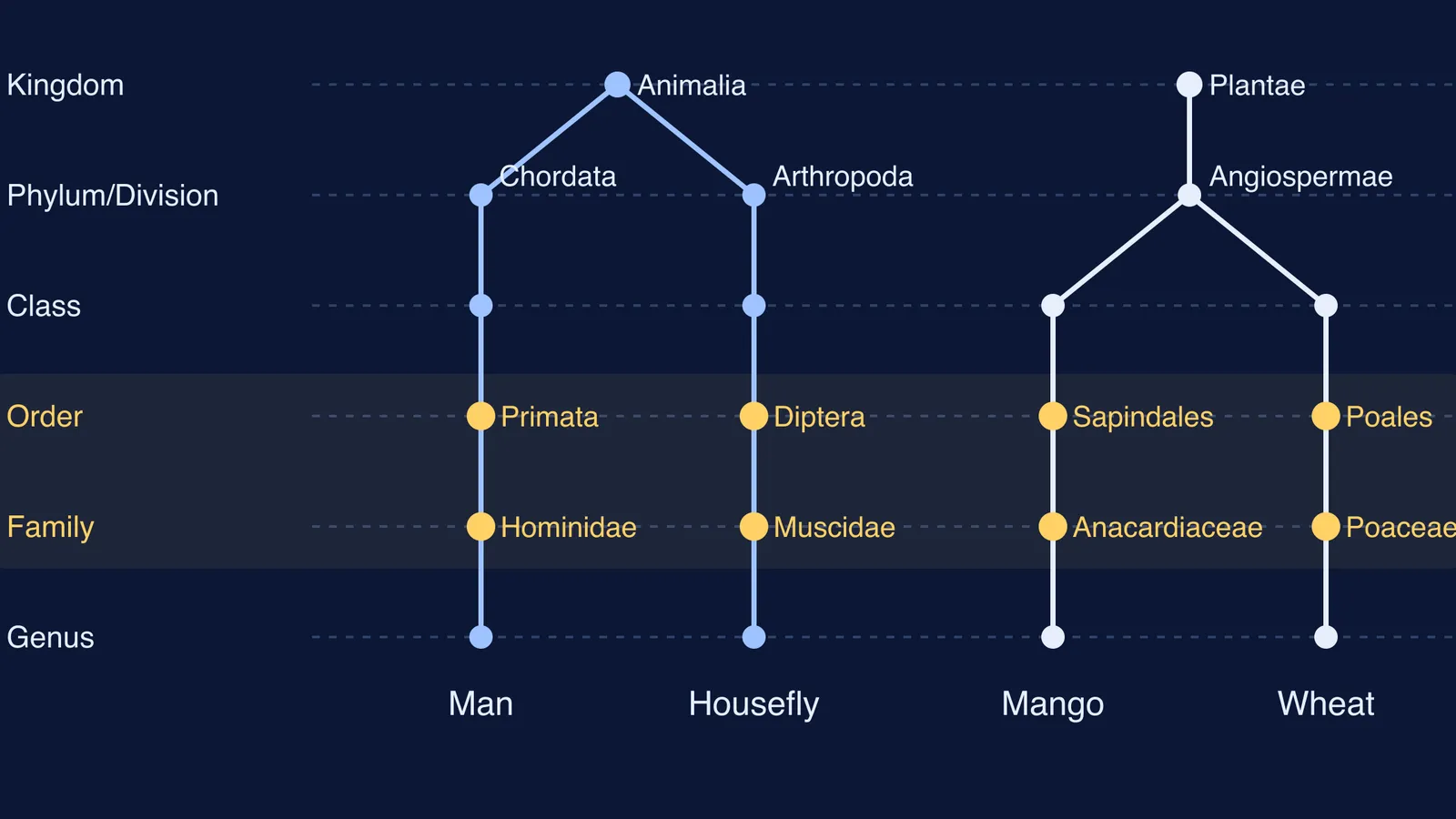
The table, "Organisms with their Taxonomic Categories", is on page 8 of the 2026-27 reprint of NCERT Class 11 Biology, Chapter 1. This is your answer key, in the order genus, family, order, class, phylum or division:
Man (*Homo sapiens*): Homo, Hominidae, Primata, Mammalia, Chordata
Housefly (*Musca domestica*): Musca, Muscidae, Diptera, Insecta, Arthropoda
Mango (*Mangifera indica*): Mangifera, Anacardiaceae, Sapindales, Dicotyledonae, Angiospermae
Wheat (*Triticum aestivum*): Triticum, Poaceae, Poales, Monocotyledonae, Angiospermae
Keep the definitions beside it. In NCERT's words, a genus "comprises a group of related species", a family "has a group of related genera", and an order "is the assemblage of families which exhibit a few similar characters" (NCERT, sections 1.2.2 to 1.2.4).
How do I ask AI for the taxonomic categories of mango and human?
Don't paste the table into the chat; you want the AI's own answer to mark. Copy this prompt:
"For man, housefly, mango and wheat, give the biological name, genus, family, order, class and phylum or division. Use the names a Class 11 NCERT Biology textbook would use. Put each organism on its own line. Don't explain anything yet."
The last line keeps the answer short, so it's quick to mark and a wrong family can't hide inside a paragraph.
How do I check each answer against Table 1.1?
Work through one cell at a time.
Cover the AI's answer and write your own from memory first. The AI's answer is a second paper to mark.
Tick every cell that matches NCERT letter for letter, including the spelling. Anacardiaceae and Monocotyledonae are easy to misspell.
Circle any cell that's different. Decide whether it's wrong (a different family altogether) or just another name for the same group (see the next section).
Check how the biological names are written. NCERT's own Exercise 5 asks you to choose between "Mangifera Indica" and "Mangifera indica". The genus starts with a capital letter and the specific epithet with a small one (NCERT Chapter 1, rule 4).
Test the logic, not just the labels. Ask the AI: "Which two of these four share a division, and at which rank do they split?" According to the table, mango and wheat are both Angiospermae and split at class: Dicotyledonae and Monocotyledonae.
Write each circled cell on a flashcard, with the NCERT answer on the back.
Why does AI say Primates or Magnoliopsida instead?
Sometimes the AI isn't wrong. It's using a different classification system. The NCBI Taxonomy records give the human order as Primates, where NCERT writes Primata. The same records put mango and wheat in class Magnoliopsida and phylum Streptophyta, not NCERT's Dicotyledonae, Monocotyledonae and Angiospermae.
Those NCBI records agree with NCERT on genus and family for all four organisms, and on order too, apart from the Primates spelling. So a mismatch at family or order deserves a second look, while a mismatch at class or division may just come from a different system. NCERT itself notes that taxonomists "have also developed sub-categories in this hierarchy" (NCERT, section 1.2.7), and the NCBI records include ranks such as subfamily and superorder.
When you're answering from your NCERT textbook, write the NCERT name.
What should I do with the mistakes I find?
Go back to each circled cell. Say out loud why the organism belongs in that group, using the definitions above. Then widen the test. NCERT's own examples put potato and brinjal in the genus *Solanum*, and *Solanum*, *Petunia* and *Datura* in the family Solanaceae (NCERT, sections 1.2.2 and 1.2.3). Ask the AI to place those too, and mark them the same way.
If the same rank keeps going wrong, the problem is usually the idea, not the name. The Fermi Concept Library gives every concept in biology its own lesson and shows its place in the map, so you can see how genus, family and order fit together before you go back to the table. If you'd rather have help, Fermi's AI tutor works out what you already know, builds a plan for the session and checks your understanding as it goes.
For more practice, read our guide to the taxonomic hierarchy order from kingdom to species, the chapter-wise list of scientific names in NCERT biology and our overview of taxonomic categories and naming in The Living World.