On this page
In rotational motion, angular velocity is treated as a vector, but a finite angular displacement is not. A book and two quarter-turns will show you why both are true.
What makes a quantity a vector?
Size and direction are not enough. A vector must also add by the triangle law, and that addition must not care about order: A + B = B + A.
As Oscar Bolina and J. A. da Silva Neto put it in a short paper in The Physics Teacher, finite rotations “can be represented by a magnitude (equal to the angle of rotation) and a direction (that of the axis of rotation)”, yet “they do not act like vectors”, because combining rotations about different axes “is dependent on the order of addition” (Bolina and da Silva Neto, 1998; free preprint on arXiv).
Why is finite angular displacement not a vector?
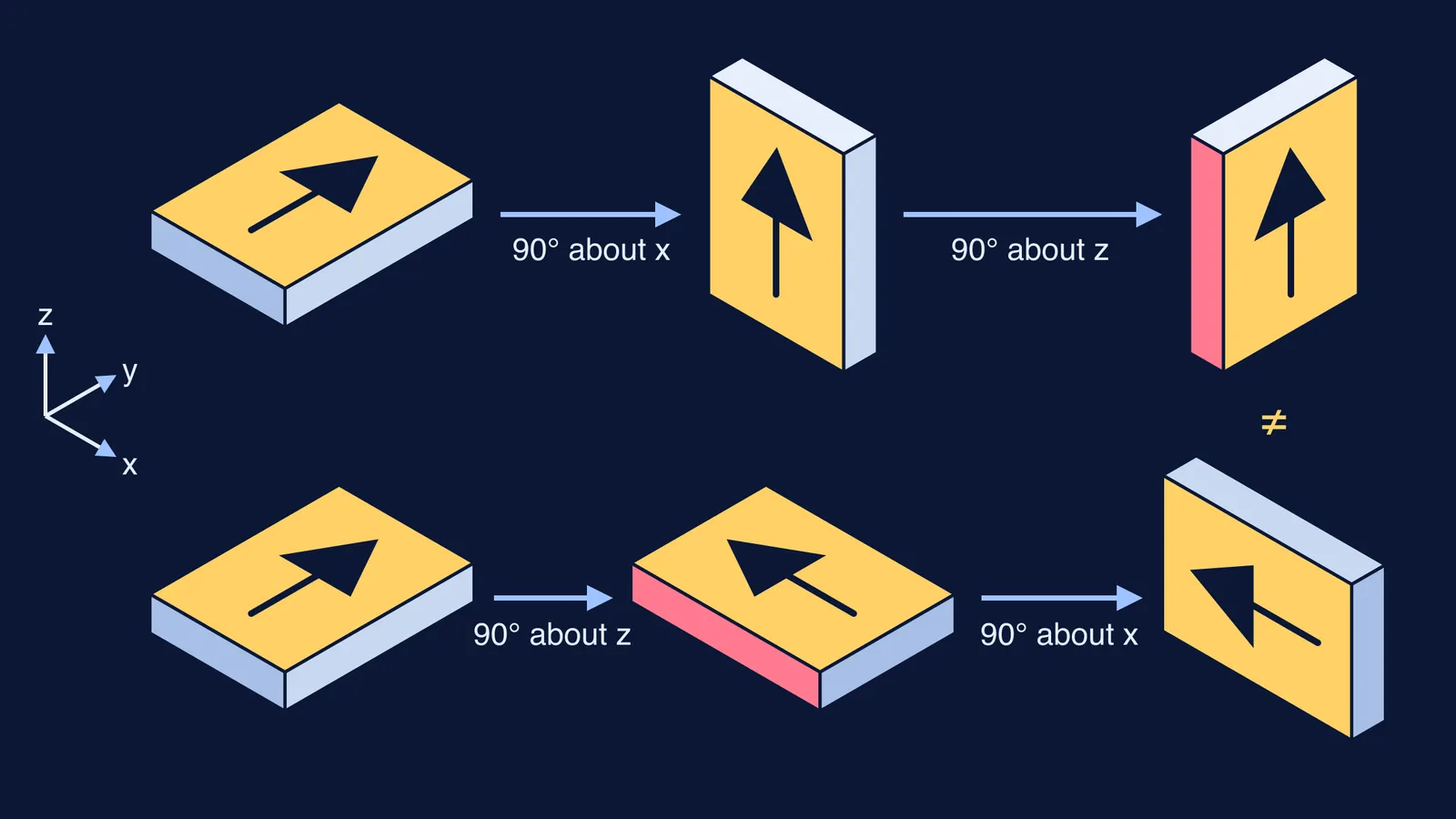
Fix axes on your desk: x points to your right, y points away from you, z points up. Every turn follows the right-hand rule. Lay a book flat, front cover up, spine on the left, top of the cover pointing away from you.
Turn X: 90° about the x axis. Lift the far edge until the book stands upright, cover facing you.
Turn Z: 90° about the z axis, anticlockwise as seen from above.
Now test it:
Do X, then Z. The book ends upright like a book on a shelf, spine facing you, cover facing right.
Put the book back in the starting position.
Do Z, then X. The spin comes first, so the top points left; then the far edge lifts. The book ends standing on its spine, cover facing you, top pointing left.
Same two turns, same angles, same axes, two different books. If rotations were vectors, X + Z would equal Z + X and both orders would land the same way.
What does the maths say?
Rotations about one fixed axis do commute, and their angles simply add, so 30° then 40° about the same axis is just 70° (Littlejohn, Berkeley Physics 221A notes on rotations). For different axes, the same notes state that rotations “do not commute in general”: R1R2 is not equal to R2R1.
How far apart do the two books end up? The single rotation that carries the first finished book onto the second sends x to −y, y to z and z to −x. The trace (sum of the diagonal entries) of that 3×3 matrix is 0, and for any rotation the trace equals 1 + 2cos θ, so cos θ = −1/2 and θ = 120°. Two quarter-turns, swapped, leave the books a full 120° apart.
Why do small rotations add like vectors?
The Berkeley notes write a rotation close to “no turn” as R = I + εA, where I is the identity matrix and ε is small (Littlejohn). Multiply two small turns, with angles θ and φ and matrices A and B:
First A, then B: I + θA + φB + θφBA
First B, then A: I + θA + φB + θφAB
The first-order parts, θA + φB, match in both orders; that is ordinary vector addition. Only the θφ term differs. For two 1° turns (0.0175 radian each), θφ is about 0.0003 radian, roughly 60 times smaller than either turn. Bolina and da Silva Neto reach the same result with geometry: the difference between the two final positions “vanishes more rapidly than either of the single rotations” (arXiv preprint).
Redo the book test with 10° turns: the two finished books now look almost the same.
This is why angular velocity is a vector. In a tiny time dt the body turns through a tiny dθ, and tiny turns commute, so ω = dθ/dt adds like a vector. Its direction comes from the right-hand rule, explained in our post on the direction of the angular velocity vector.
How should you write this in an exam?
A three-line answer that covers the marks:
A vector must obey the commutative law of addition, A + B = B + A.
Two finite rotations about different axes, done in different orders, give different final orientations (a book turned 90° about x then z ends differently from z then x), so finite angular displacement is not a vector.
Infinitesimal rotations commute to first order, so dθ, and hence ω = dθ/dt, are vectors.
One trap: do not write that rotations “have no direction”. They do; the problem is the addition law.
Rotations are matrices, so this is the same reason (A + B)² fails for matrices. For more on spinning bodies, try our rotational motion simulation predictions.
If the commutative law itself feels shaky, the Fermi Concept Library gives each concept its own lesson and shows its place in the map, so you can step back to vector addition before returning to rotation. When you are ready to practise, the Fermi Problem Library has worked problems with a step-by-step solver that explains the reasoning rather than printing an answer.
Tonight, grab a book and try both orders yourself.