On this page
This problem joins two NCERT chapters. An electron drops between Bohr levels in hydrogen or He+, the emitted photon lands on a metal, and you are asked for the maximum kinetic energy of the photoelectrons or the stopping potential. Marks are lost where the two steps meet: a sign, a missing Z², or a needless switch to joules.
How do you find the photon energy from a hydrogen transition?
Bohr's third postulate says the emitted photon carries exactly the energy difference between the initial and final states, hν = E_i − E_f (NCERT Class 12 Physics, Chapter 12: Atoms).
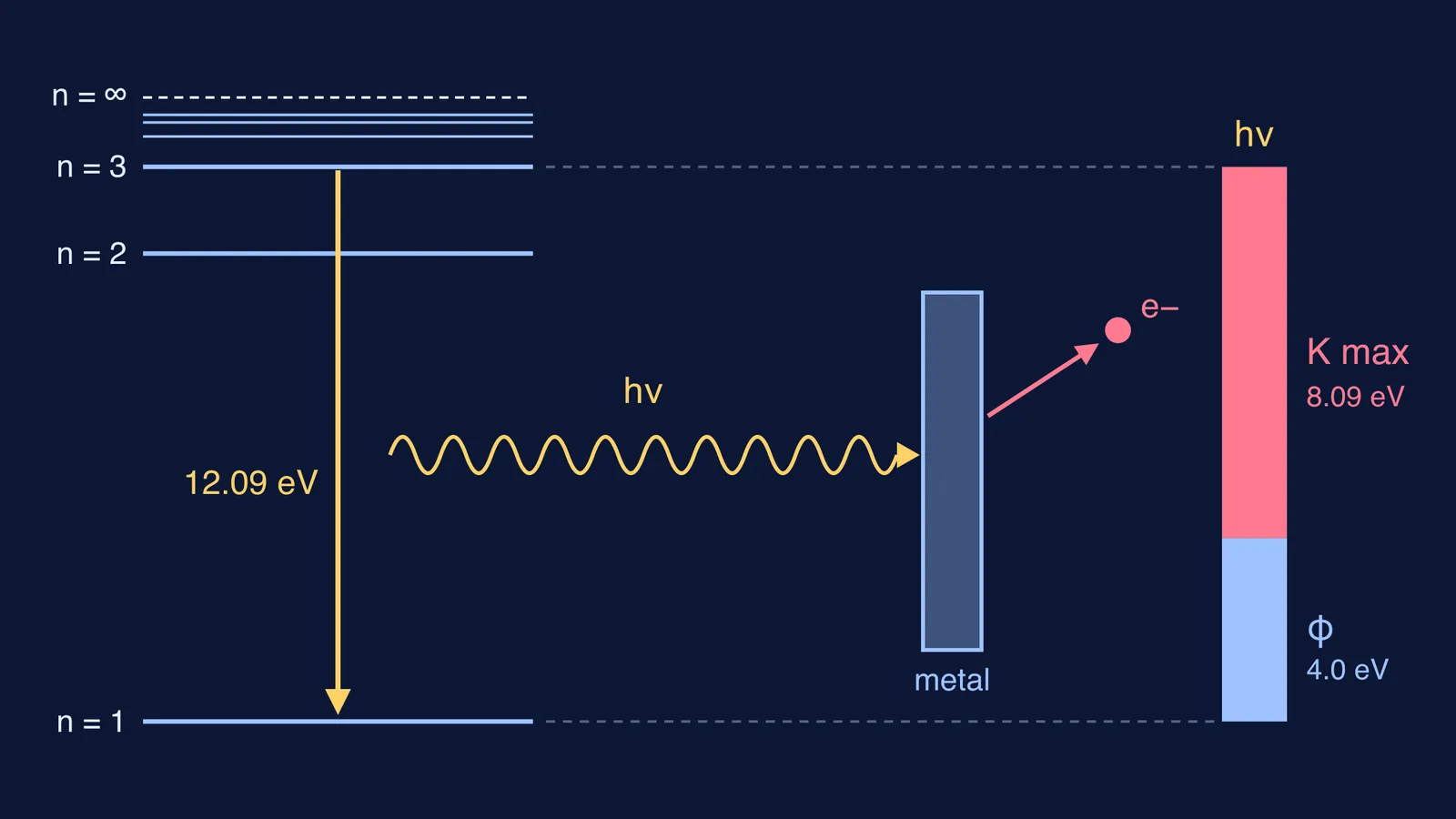
For hydrogen, the same chapter gives E_n = −13.6/n² eV, so E_2 = −3.40 eV, E_3 = −1.51 eV, and the jump from n = 3 to n = 1 releases 12.09 eV.
For one-electron ions such as He+ (Z = 2), the energies scale as Z²/n², as in equation 2.14 of NCERT Class 11 Chemistry, Unit 2: Structure of Atom. Put the two together:
Photon energy (eV) = 13.6 × Z² × (1/n_f² − 1/n_i²), with n_i greater than n_f.
The 13.6 eV is the Rydberg energy, which NIST lists as 13.605 693 122 990 eV, rounded. If the minus signs in E_n feel odd, our post on why hydrogen's energy levels are negative explains them.
How do you get the stopping potential from the photon energy?
Einstein's photoelectric equation is K_max = hν − φ0, where the work function φ0 is the minimum energy an electron needs to escape the metal surface (NCERT Class 12 Physics, Chapter 11: Dual Nature of Radiation and Matter). The same chapter links the stopping potential to the fastest electrons through K_max = eV0, and shows that emission happens only if hν is greater than φ0.
The convenient part: with every energy in electron-volts, K_max in eV is the same number as V0 in volts. You never need joules.
For wavelengths, use λ (nm) ≈ 1240 / E (eV). NIST gives h = 4.135 667 696… × 10⁻¹⁵ eV s (NIST, Planck constant in eV) and c = 299 792 458 m/s (NIST, speed of light), both exact, so hc = 1239.84 eV nm.
For where the equation comes from, read how Einstein's photoelectric equation is derived.
What does a worked JEE-style example look like?
Each example uses the formulas from the NCERT chapters above. Work functions are given as problem data.
Example 1: hydrogen, n = 3 to n = 1, metal with φ0 = 4.0 eV.
Z = 1, n_i = 3, n_f = 1.
E = 13.6 × (1 − 1/9) = 13.6 × 8/9 = 12.09 eV, and λ ≈ 1240/12.09 ≈ 102.6 nm.
12.09 eV is greater than 4.0 eV, so electrons are emitted.
K_max = 12.09 − 4.0 = 8.09 eV, so V0 ≈ 8.09 V.
Example 2: He+, n = 4 to n = 2, metal with φ0 = 4.2 eV.
Z = 2, so Z² = 4.
E = 13.6 × 4 × (1/4 − 1/16) = 13.6 × 4 × 3/16 = 10.2 eV.
10.2 eV is greater than 4.2 eV, so emission happens.
K_max = 6.0 eV and V0 = 6.0 V.
That 10.2 eV equals hydrogen's n = 2 → 1 energy: the He+ jump from 2n to 2m always matches hydrogen's n to m. Our post on matching He+ spectral lines with hydrogen works through this pattern.
Example 3: hydrogen, n = 4 to n = 2, the same 4.2 eV metal.
E = 13.6 × (1/4 − 1/16) = 2.55 eV, which is less than 4.2 eV. No photoelectrons come out, however bright the light. The answer is "no emission", not a negative stopping potential.
Which mistakes cost marks in this problem?
Forgetting Z² for He+, or using Z instead of Z².
Swapping n_i and n_f. The photon energy is always the positive gap.
Converting eV to joules and back. Stay in eV.
Adding the work function instead of subtracting it.
Reporting a negative V0 when the photon is below threshold.
Where can you practise this two-step problem?
Make three variations on paper: change the metal, change Z to 3 for Li2+, and ask for the wavelength instead of the energy. The whole chain should fit in four lines.
If a step keeps failing, the Fermi Problem Library has worked problems with a step-by-step solver that explains the reasoning rather than printing an answer, so you can see where your chain broke. If the gap is the idea itself, such as what a work function is or why levels are quantised, the Fermi Concept Library gives every concept in physics and chemistry its own lesson.
Next time a transition photon falls on a metal, write the four lines first.