

On this page
When you study atomic spectra in physics and chemistry, you are almost guaranteed to see a question like this: *Which transition in He⁺ has the same wavelength as the first Balmer line in hydrogen?*
The calculation looks long if you write out the full Rydberg equation for both atoms, equate them, and solve for the unknown quantum numbers. But there is a shortcut that lets you answer this in seconds just by looking at the atomic number.
Here is why helium's spectral lines perfectly overlap with hydrogen's, and how to spot the matching transitions instantly.
Why does He⁺ have the same wavelengths as hydrogen?
A neutral hydrogen atom (H) has one proton and one electron. A helium ion (He⁺) has two protons and one electron. Because He⁺ has only one electron, it behaves just like hydrogen, but its positively charged nucleus pulls on that electron much harder.
The wavelengths of light emitted or absorbed by a one-electron atom are given by the Rydberg formula for hydrogen-like ions. The formula scales the standard hydrogen equation by the square of the atomic number (Z²) to account for the stronger nuclear charge.
For hydrogen (Z = 1), the formula is: 1/λ = R(1/n₁² − 1/n₂²)
For the helium ion (Z = 2), the formula becomes: 1/λ = 4R(1/N₁² − 1/N₂²)
For the two atoms to emit the exact same wavelength, the bracketed terms must balance out the factor of 4. This happens whenever the He⁺ quantum numbers (N₁ and N₂) are exactly twice the hydrogen quantum numbers (n₁ and n₂).
Mathematically, 4/(2n)² is equal to 1/n². Doubling the energy levels perfectly offsets the quadrupled nuclear charge, making the energy gap—and therefore the photon's wavelength—identical.
Which transition in He⁺ has the same wavelength as a hydrogen line?
To find the matching He⁺ transition, simply multiply both the starting and ending quantum numbers of the hydrogen transition by 2.
Here is a practical framework you can use for any exam question:
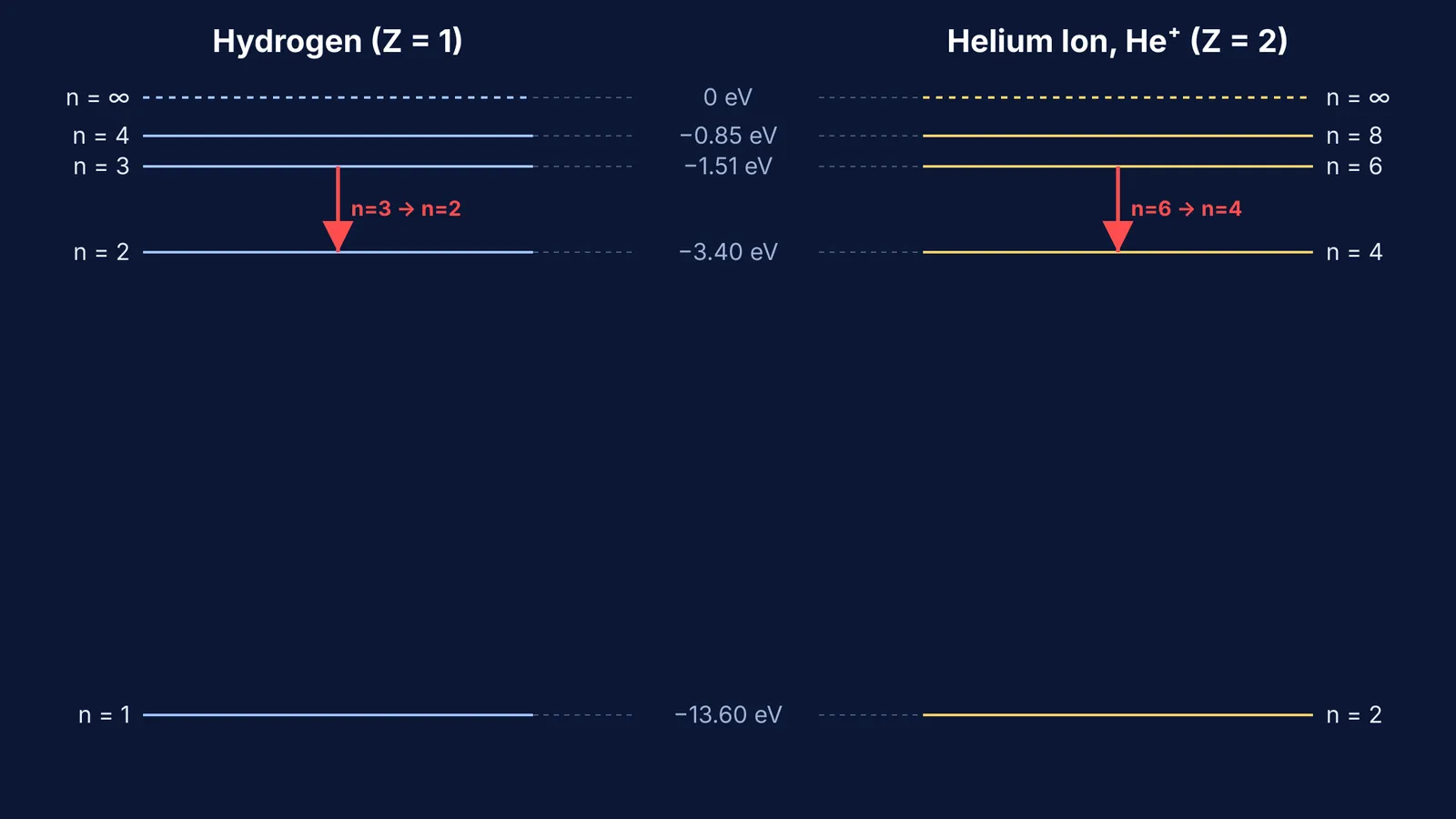
Identify the hydrogen transition. For example, the first line of the Balmer series is a drop from n = 3 down to n = 2.
Double both numbers. For He⁺, multiply them by 2. The matching transition is from n = 6 down to n = 4.
Verify the energy. The n = 2 level in hydrogen sits at −3.40 eV, and the n = 4 level in He⁺ also sits at −3.40 eV. The energy levels map perfectly onto each other.
If you struggle to remember the names of the spectral series under exam pressure, the Fermi Problem Library includes a step-by-step solver that explains the reasoning behind each series rather than just printing an answer.
Does the shortcut work for other ions?
You can apply the exact same logic to any hydrogen-like ion by multiplying the hydrogen quantum numbers by the ion's atomic number.
For a doubly ionised lithium atom (Li²⁺), the atomic number is Z = 3. The Rydberg formula scales by 3², which is 9. To find a matching wavelength, you must balance this factor of 9 by multiplying the hydrogen quantum numbers by 3. A transition from n = 3 to n = 2 in hydrogen matches a transition from n = 9 to n = 6 in Li²⁺.
This pattern continues across the periodic table as long as the ion has only one electron left. For Be³⁺ (Z = 4), you multiply the hydrogen quantum numbers by 4.
How do you match spectral lines in exam questions?
Let's test the rule on two common exam patterns. If you need more practice with the energy formulas, you can review our guide on hydrogen spectrum problems and the photon energy formula.
Example 1: The Lyman series match *Question:* Which transition in He⁺ matches the first line of the Lyman series in hydrogen? *Solution:* The Lyman series ends at n = 1. The "first line" means it comes from the next level up, so the transition is n = 2 to n = 1. Doubling these numbers gives the He⁺ transition: n = 4 to n = 2.
Example 2: The reversed question *Question:* The transition from n = 8 to n = 6 in He⁺ has the same wavelength as which transition in hydrogen? *Solution:* Since we are going from He⁺ (Z = 2) back to hydrogen (Z = 1), we do the reverse: divide the quantum numbers by 2. The hydrogen transition is n = 4 to n = 3 (the first line of the Paschen series).
Understanding this Z² relationship saves you from grinding through the Rydberg algebra. When Fermi's AI tutor builds a plan for a session on atomic structure, it often starts by checking if you see this pattern—because once you know the rule, the matching wavelength problems solve themselves.


