On this page
Many textbooks give the hyperbola two definitions a few pages apart: points whose distances from two fixed points differ by a constant, and points whose distance from a focus is e times the distance from a directrix. They describe the same curve, and four lines of algebra show why.
What does |PS − PS′| = 2a actually say?
Take the standard hyperbola x²/a² − y²/b² = 1, with foci S(ae, 0) and S′(−ae, 0), eccentricity e > 1, and b² = a²(e² − 1).
The OpenStax algebra text defines a hyperbola as "all points in a plane where the difference of their distances from two fixed points is constant" and writes that constant as |d₁ − d₂| = 2a (OpenStax Intermediate Algebra 2e on LibreTexts/11:_Conics/11.05:_Hyperbolas)). The same page gives c² − a² = b², where c is the distance from the centre to a focus.
So 2a is the length of the transverse axis, the gap between the vertices (±a, 0).
Why is the difference of focal distances 2a?
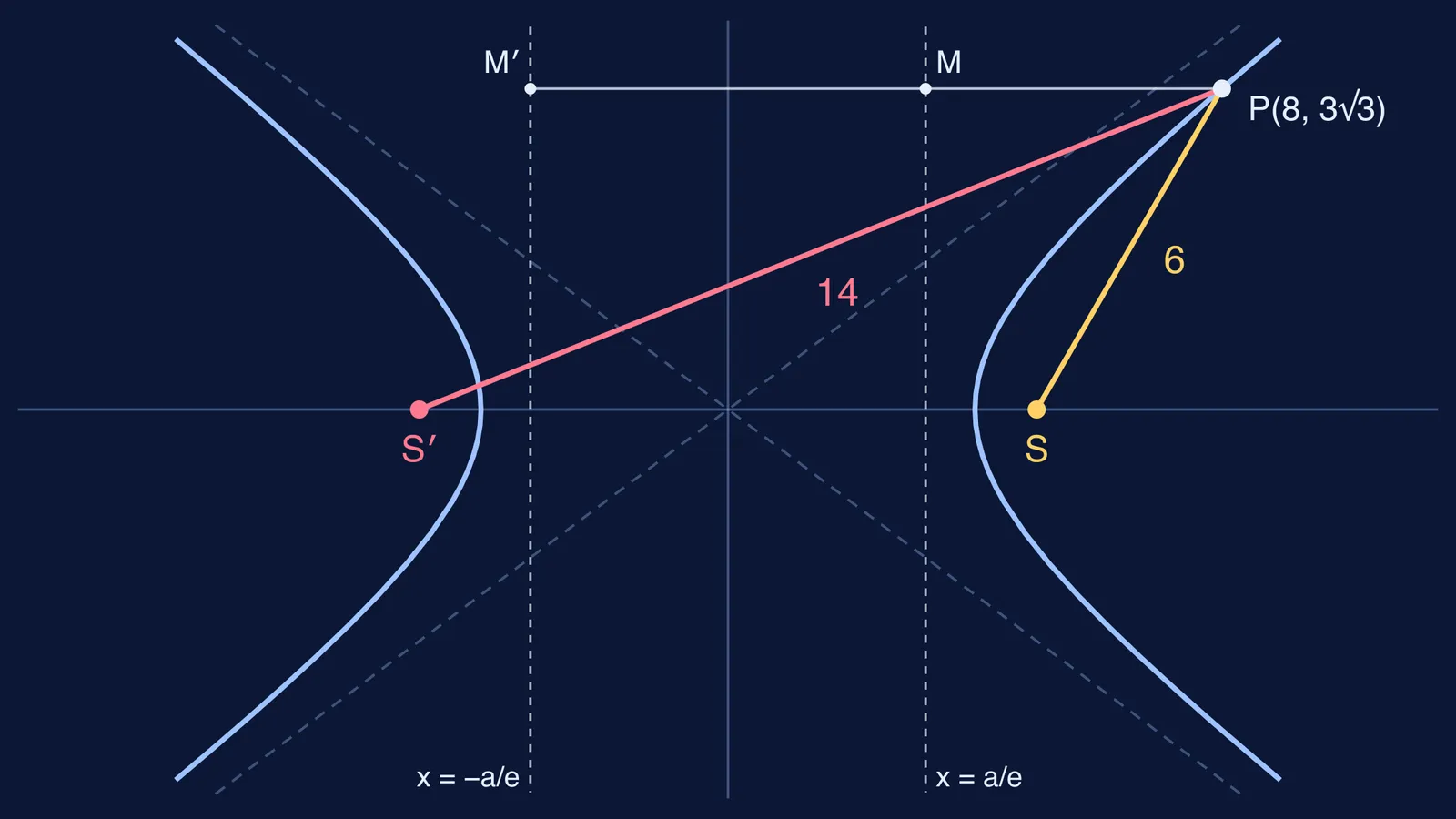
The focus-directrix definition says P is on the conic when PS = e · PM, where M is the foot of the perpendicular from P to the directrix. For the focus S(ae, 0) the directrix is x = a/e; our post on why the directrix of a hyperbola is x = a/e shows where that comes from.
Squaring gives (x − ae)² + y² = e²(x − a/e)², which simplifies to x²/a² − y²/(a²(e² − 1)) = 1. Replace x with −x and nothing changes. That symmetry is the key: the same curve also has the focus S′(−ae, 0) with directrix x = −a/e, so PS′ = e · PM′ too.
For P(x, y) on the right branch (x ≥ a):
Distance to x = a/e: PM = x − a/e, so PS = ex − a.
Distance to x = −a/e: PM′ = x + a/e, so PS′ = ex + a.
Subtract: PS′ − PS = (ex + a) − (ex − a) = 2a.
On the left branch the roles swap: PS = a − ex and PS′ = −a − ex, so PS − PS′ = 2a. Either way, |PS − PS′| = 2a. The same focal-distance formulas and conclusion appear in CodeCogs's analysis of the hyperbola.
Compare why the focal distances on an ellipse add up to 2a. On an ellipse, P lies between the two directrices, so the distances add. On a hyperbola, P lies on the same side of both, so they subtract.
How do you use it to find a locus?
Question: find the locus of P if |PA − PB| = 6, where A(5, 0) and B(−5, 0).
A and B are the foci, so c = 5. The constant is 2a = 6, so a = 3.
b² = c² − a² = 25 − 9 = 16.
The locus is x²/9 − y²/16 = 1.
Check two things first. The constant must be less than AB, which is 10 here; at exactly 10 the locus collapses to two rays of the x-axis, and above 10 no point works. And watch the modulus: PA − PB = 6 without the bars puts P nearer B, so the locus is only the left branch, x ≤ −3.
When the fixed points are not on an axis, our five-step method for locus problems sets up the algebra from scratch.
Given one focal distance, how do you find the other?
Question: P lies on x²/16 − y²/9 = 1 and is 6 units from the focus S. Find PS′ and the coordinates of P.
Here a = 4, b = 3, c² = 16 + 9 = 25, so c = 5 and e = 5/4. Take S(5, 0) and S′(−5, 0).
|PS − PS′| = 2a = 8, so PS′ = 14 or −2.
A distance cannot be negative, so PS′ = 14.
PS < PS′, so P is on the branch near S. Use PS = ex − a: (5/4)x − 4 = 6, so x = 8.
Then y² = 9(64/16 − 1) = 27, so P = (8, ±3√3).
Check: from (8, 3√3) to (5, 0) is √(9 + 27) = 6, and to (−5, 0) is √(169 + 27) = 14.
A common slip is step 2: writing PS′ = PS − 2a out of habit and landing on −2. The other is missing that any point on the far branch is at least c + a = 9 from S, so PS = 6 already fixes the branch.
If a step in your own working goes wrong and you can't see where, the Fermi Problem Library has worked problems with a step-by-step solver that explains the reasoning rather than printing an answer. To revisit eccentricity and directrices from the start, the Fermi Concept Library gives each concept its own lesson.