On this page
A block of mass m is released from the top of a smooth wedge of mass M, which rests on a smooth floor. As the block slides down, the wedge slides back the other way. JEE problems ask how far. You don't need normal forces, pseudo forces or accelerations. One fact does the whole job.
Why does the wedge move at all?
The block presses on the wedge through the normal force, and that force has a horizontal part. The block pushes the wedge backwards, and the wedge pushes the block forwards. Those two pushes are internal to the block-plus-wedge system, so they cancel when you add them up.
The outside forces are gravity and the floor's normal force, and both are vertical. The floor is smooth, so there is no friction. That leaves no horizontal external force on the system at all.
OpenStax *University Physics* states the rule we need: "in the absence of an external force, the velocity of the center of mass never changes" (OpenStax University Physics Volume 1, section 9.6). Apply it to the horizontal direction only. The system starts at rest, so the horizontal velocity of its centre of mass is zero and stays zero. The horizontal position of the centre of mass therefore never moves.
How far does the smooth wedge move when the block slides down?
The centre of mass is a mass-weighted average of position (OpenStax, section 9.6). If it stays fixed, the mass-weighted horizontal shifts must add to zero:
m × (block's horizontal shift) = M × (wedge's horizontal shift), in opposite directions.
Now use the geometry. When the block drops a height h along a slope at angle θ, it moves h·cotθ horizontally relative to the wedge. That is the horizontal length of the part of the slope it covered.
Say the wedge moves back by X. Then the block moves forward, relative to the ground, by h·cotθ − X. Setting the two weighted shifts equal:
m(h·cotθ − X) = M·X
m·h·cotθ = (M + m)·X
X = m·h·cotθ / (M + m)
No forces, no accelerations, no time. If the question gives the slope length L instead of h, use h·cotθ = L·cosθ.
A worked example with numbers
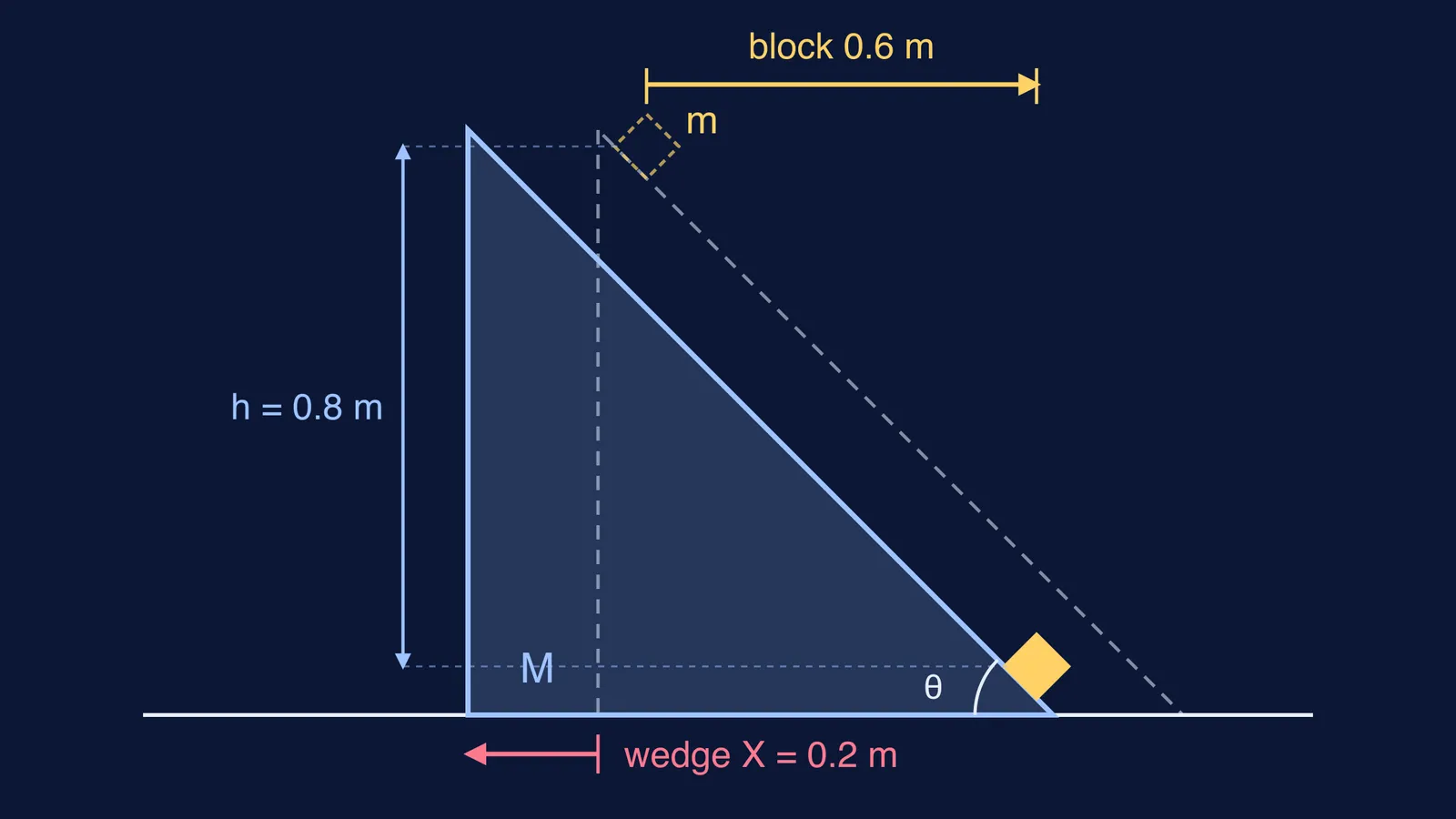
A 2 kg block slides from the top of a 6 kg smooth wedge with a 45° incline. The block drops 0.8 m to the bottom. The floor is smooth.
Horizontal travel relative to the wedge: h·cotθ = 0.8 × cot 45° = 0.8 × 1 = 0.8 m.
Wedge displacement: X = (2 × 0.8) / (6 + 2) = 1.6 / 8 = 0.2 m, backwards.
Block's horizontal displacement relative to the ground: 0.8 − 0.2 = 0.6 m, forwards.
Check: 2 × 0.6 = 1.2 and 6 × 0.2 = 1.2. The weighted shifts balance, so the centre of mass has not moved.
The diagram at the top of this page is drawn to scale from these numbers.
This is the same reasoning as a person walking along a boat on still water; we work through that version in man walks on a boat: how far does the boat move?
How do you check the answer is right?
Test the formula at extremes.
Very heavy wedge (M much larger than m): X tends to 0. A fixed incline does not move. Correct.
Very light wedge (M tends to 0): X tends to h·cotθ. The block falls almost straight down and the wedge slides fully out from under it. Correct.
Steep slope (θ tends to 90°): cotθ tends to 0, so X tends to 0. The block falls freely and never presses on the face. Correct.
Direction: the wedge moves opposite to the block's horizontal motion. If your X comes out with the same sign as the block's shift, you have a sign error.
Units: masses cancel, leaving metres. Correct.
When does this shortcut fail?
The method needs two conditions. First, no horizontal external force: floor friction, or a hand holding the wedge, lets the horizontal centre of mass move. Second, the system must start at rest; otherwise the centre of mass drifts at constant velocity and you need the time taken too.
For the opposite case, where the wedge is pushed so the block stays put, see wedge acceleration so the block does not slide. For why internal forces leave the centre of mass alone, see why centre of mass velocity is unchanged by internal forces.
If you want more practice, the Fermi Problem Library has worked problems with a step-by-step solver that explains the reasoning rather than printing an answer. To revisit the idea itself, the centre of mass has its own lesson in the Fermi Concept Library.