

On this page
You step forward on a small boat at a ghat and the boat slides back under you. Exam papers turn this into a numerical: how far does the boat move? You can solve it in two lines, with no forces or speeds, once you trust one idea: the centre of mass of the person-plus-boat system does not move.
Why does the boat move back when you walk forward?
Your feet push the deck backwards and the deck pushes you forwards. Both forces act inside the system of you plus the boat, so they cancel. Ignoring water drag, nothing outside pushes horizontally.
OpenStax University Physics states the rule directly: in the absence of an external force, the velocity of the center of mass never changes. The same page describes the centre of mass as the weighted average position of a system's mass. So if you and the boat start at rest, the centre of mass stays put, however you walk. A Duke University physics FAQ uses the same recipe: find the centre of mass before and after, and set them equal.
How far does the boat move when a man walks on it?
Call the person's mass m, the boat's mass M, and the distance the person walks along the deck L. Take the walking direction as positive and measure every displacement from the shore, not from the boat. Two equations do all the work:
Fixed centre of mass: m Δx(person) + M Δx(boat) = 0.
Walking relative to the deck: Δx(person) − Δx(boat) = L.
Solve them together and you get Δx(boat) = −mL/(m + M) and Δx(person) = +ML/(m + M).
The boat moves backwards by mL/(m + M), where L is the distance walked relative to the boat. The person covers the rest, ML/(m + M), relative to the shore, and the two add up to L.
Worked example: a 60 kg person on a 140 kg boat
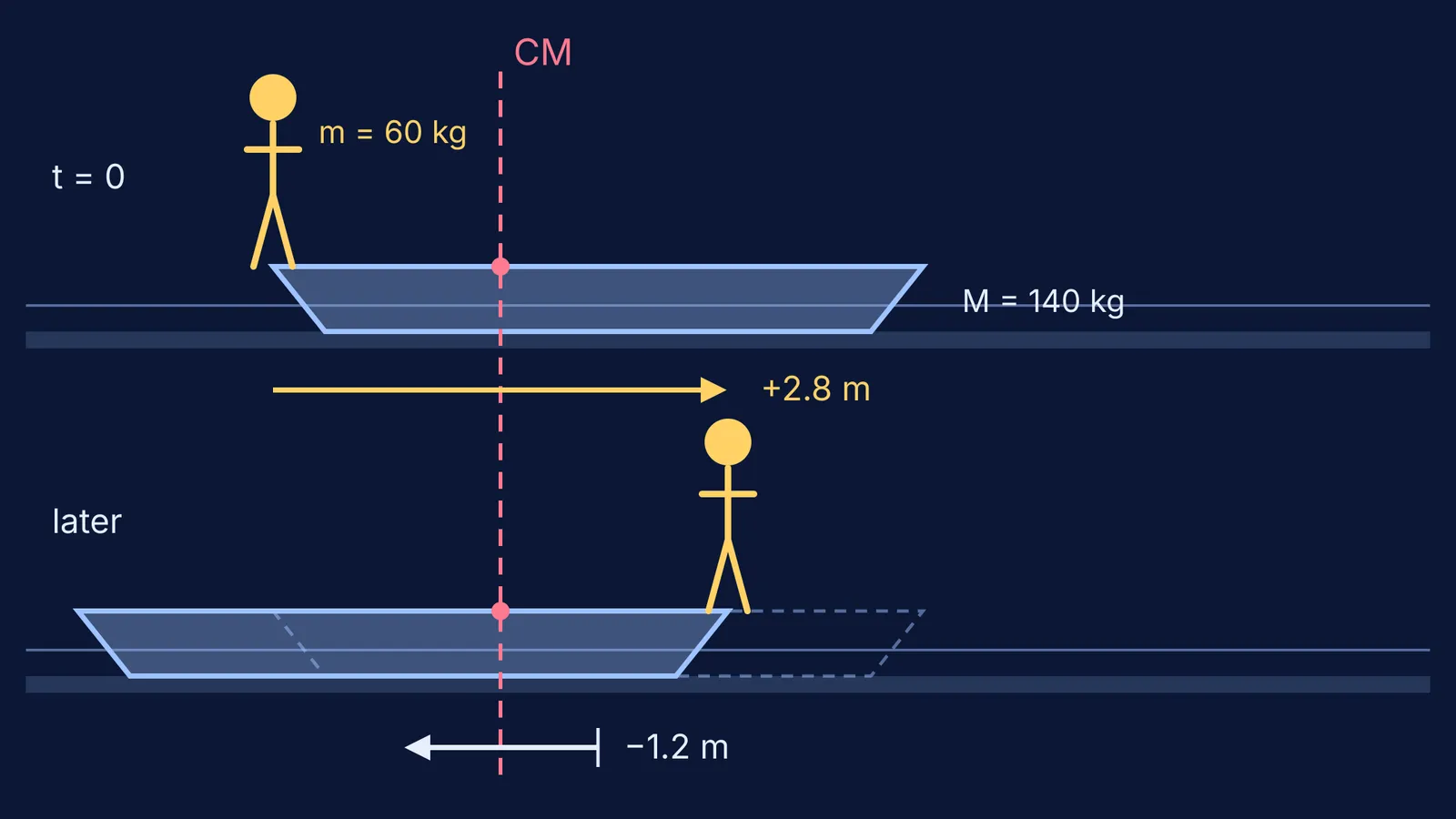
A 60 kg person walks the full 4 m length of a 140 kg boat, from the stern to the bow. The total mass is 200 kg.
Boat: Δx = −(60 × 4) / 200 = −1.2 m, so it moves 1.2 m backwards.
Person: Δx = +(140 × 4) / 200 = +2.8 m relative to the shore.
Check: 60 × 2.8 = 168 and 140 × 1.2 = 168, so the centre of mass has not moved.
How far from the shore does the person end up?
A 5 kg dog stands on a 20 kg boat, 10 m from the shore, and walks 4 m along the boat towards the shore. The tempting answer is 10 − 4 = 6 m. But 4 m is the walk relative to the boat, and the boat slides away from the shore as the dog walks.
The dog's ground displacement is ML/(m + M) = (20 × 4) / 25 = 3.2 m towards the shore, so the dog ends up 6.8 m from the shore. The boat moved 0.8 m the other way, and 3.2 + 0.8 = 4 m.
Does the same method work for planks, carts and two people?
Yes, whenever there is no horizontal external force. A plank on frictionless ice or a cart on smooth rails behaves like the boat. With several movers, the sum of every mass times its ground displacement is zero.
Two people of 50 kg and 70 kg stand at opposite ends of a 3 m, 100 kg boat and swap places. Let the boat's displacement be d, positive in the direction the 50 kg person walks. Then 50(d + 3) + 70(d − 3) + 100d = 0, so 220d = 60 and d ≈ +0.27 m. The boat drifts the way the lighter person walked. With angular momentum in place of the centre of mass, the same bookkeeping solves a man walking to the edge of a rotating platform.
Which sign traps should you watch for?
Using L as the ground displacement. L is measured along the deck.
Dropping the minus sign. With one walker, the boat always moves the opposite way.
Dividing by M instead of m + M.
Thinking speed matters. Fast or slow, the answer is the same, and when you stop, the boat stops.
Forgetting a starting velocity. If the boat was drifting, the centre of mass keeps that constant velocity instead of staying put.
Ignoring ground friction. Horizontal friction from the ground is an external force, so the centre of mass is no longer fixed.
For background, read why friction points forward when you walk. For practice, the Fermi Problem Library has worked problems with a step-by-step solver that explains the reasoning rather than printing an answer, so you can see where a sign goes wrong. If centre of mass itself feels shaky, the Fermi Concept Library gives it its own lesson.


