

On this page
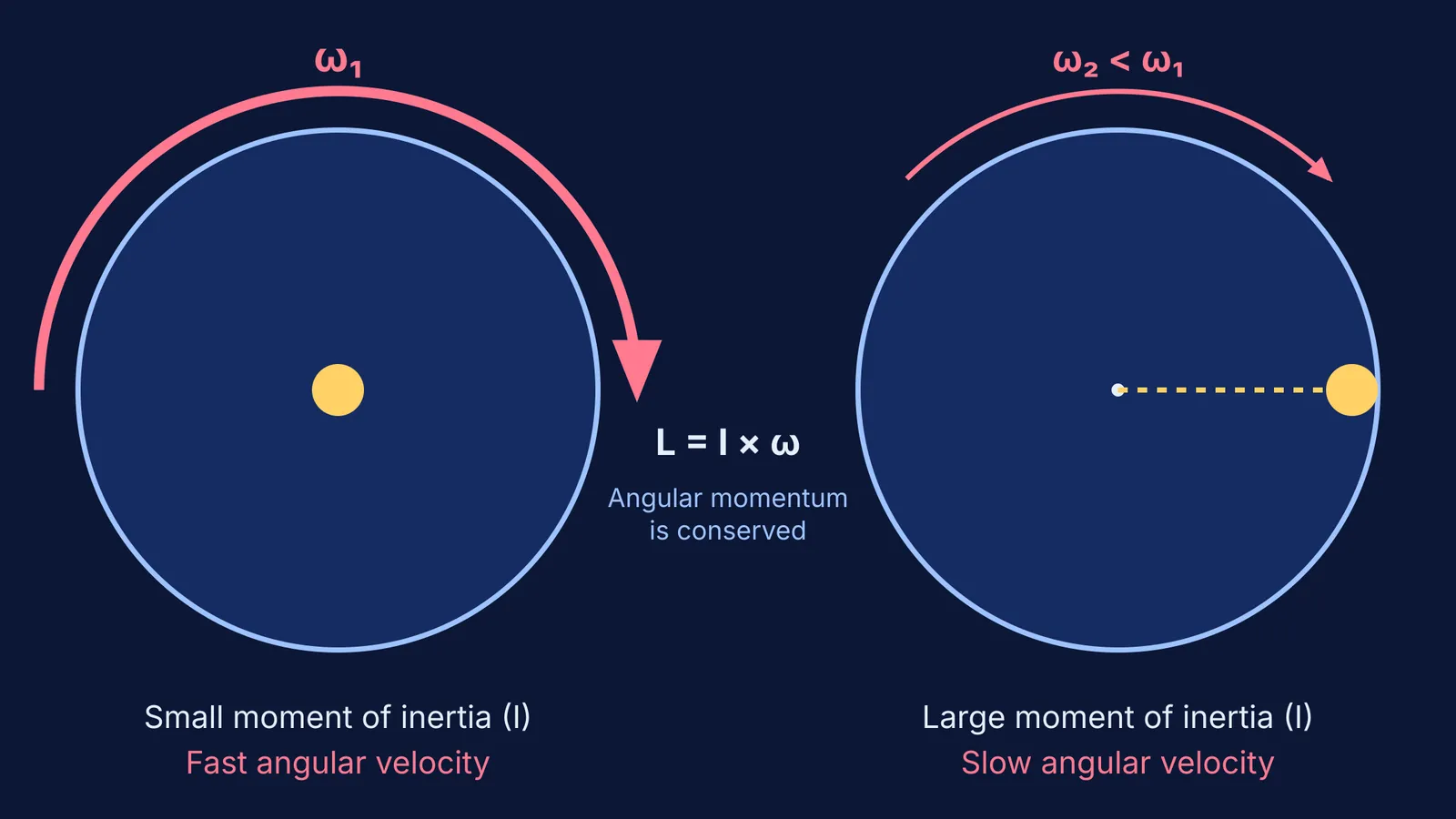
If you watch a spinning ice skater pull their arms in, you see them speed up. A classic physics problem (covered in texts like University Physics) tests the exact reverse of this: a person standing at the centre of a rotating platform (like a merry-go-round) walks outward to the edge.
What happens to the angular velocity, and why does the kinetic energy change? The answer lies in the conservation of angular momentum.
Why does the platform slow down?
In rotational mechanics, angular momentum (L) is the product of a system's moment of inertia (I) and its angular velocity (ω).
L = I × ω
As long as there are no net external torques acting on the platform (such as friction from the ground acting on the axle), the total angular momentum remains perfectly constant.
When the person stands exactly at the centre, their distance from the axis of rotation is zero (r = 0), so they contribute almost nothing to the moment of inertia. As they walk to the edge (r = R), their mass is distributed further away from the axis. Because a point mass's moment of inertia is m × r², the system's total moment of inertia increases.
To keep L constant while I goes up, the angular velocity ω must decrease. The platform slows down.
How to find the new angular velocity?
You can find the final angular velocity by setting the initial angular momentum equal to the final angular momentum. If you want to practise this type of calculation, the Fermi Problem Library has worked problems with a step-by-step solver that explains the reasoning.
Let's solve a standard example: A 60 kg person stands at the centre of a 120 kg solid disc platform with a radius of 2.0 m. The platform is spinning at 2.0 radians per second. The person walks to the edge.
Step 1: Find the initial state The platform is a solid disc, so its moment of inertia is I_disc = 1/2 M × R².
I_disc = 1/2 × 120 kg × (2.0 m)² = 240 kg m²
Initial moment of inertia (I_i) = 240 kg m² (the person at r = 0 adds 0).
Initial angular momentum (L) = I_i × ω_i = 240 × 2.0 = 480 kg m²/s.
Step 2: Find the final moment of inertia When the person reaches the edge, they act as a mass at r = 2.0 m.
I_person = m × r² = 60 kg × (2.0 m)² = 240 kg m²
Final total inertia (I_f) = I_disc + I_person = 240 + 240 = 480 kg m².
Step 3: Solve for final angular velocity Because L is conserved: I_i × ω_i = I_f × ω_f 480 = 480 × ω_f ω_f = 1.0 rad/s
The platform's angular velocity is exactly halved.
What happens to the kinetic energy?
While angular momentum is conserved, rotational kinetic energy is not. The rotational kinetic energy of a system is given by:
K = 1/2 I × ω²
Kinetic energy and momentum are linked. We can rewrite the kinetic energy formula in terms of angular momentum: K = L² / 2I.
Because L stays the same but I increases, the total kinetic energy must decrease. In our worked example:
Initial kinetic energy: 1/2 × 240 × (2.0)² = 480 J
Final kinetic energy: 1/2 × 480 × (1.0)² = 240 J
Half of the system's kinetic energy has vanished. Where did it go?
When a person walks outward on a spinning platform, they feel a centrifugal effect pulling them away from the centre. To avoid being thrown off, they have to control their movement, effectively braking against the platform with their muscles and shoes. This internal friction and muscle exertion turns mechanical energy into heat, causing the system to lose kinetic energy.
(Conversely, if the person were to walk back *toward* the centre, they would have to do physical work to pull themselves inward, converting their own energy back into the system's rotational kinetic energy.)
Mastering these energy-loss scenarios is crucial for physics exams. If you have concept gaps about why energy isn't conserved, exploring the mechanics in the Fermi Concept Library can help bridge the gap between the mathematics and the real world.


