On this page
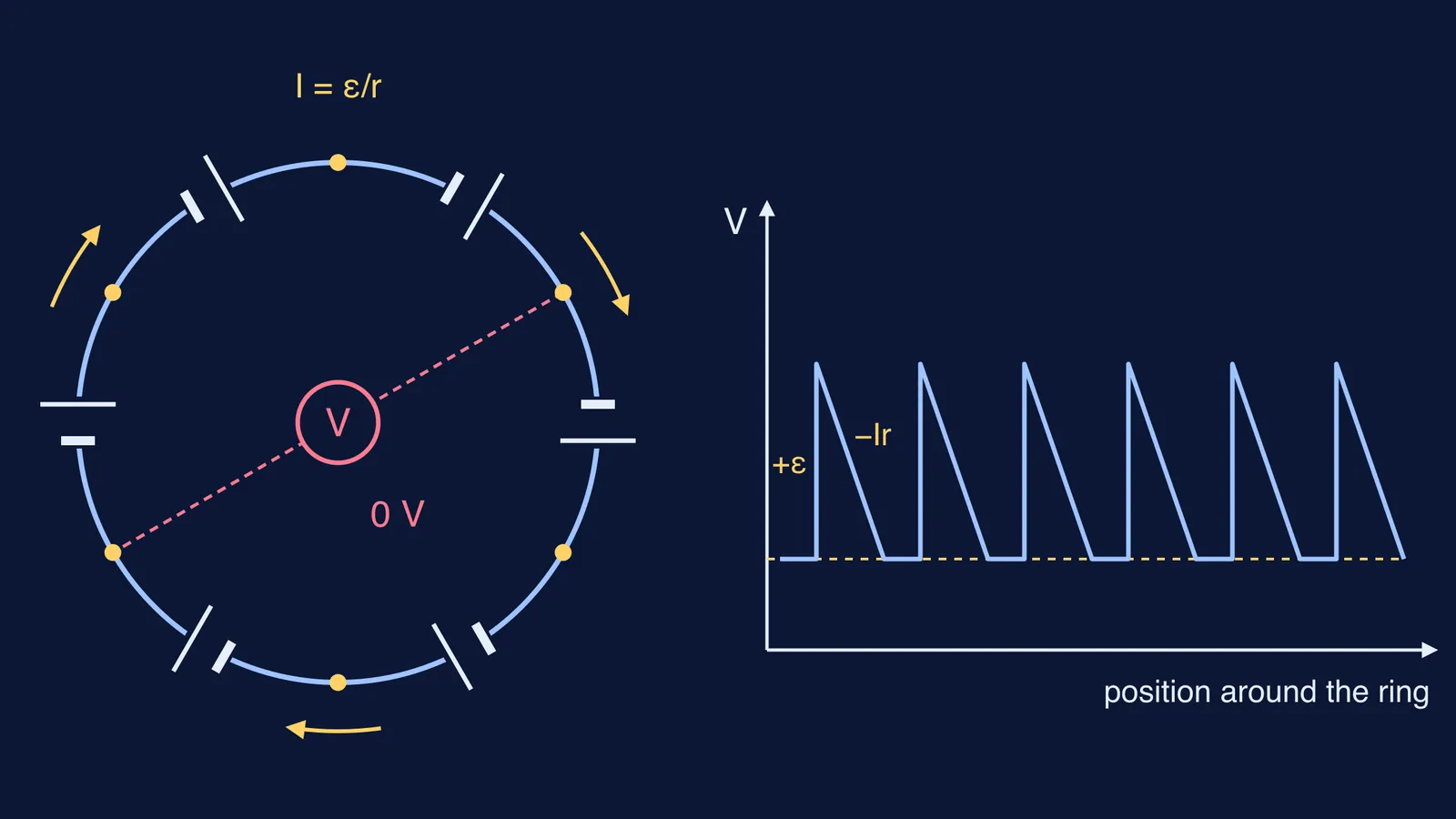
Join n identical cells in a ring, the plus terminal of each to the minus terminal of the next, with nothing else in the circuit. Current flows, yet a voltmeter across any two points reads zero. Two lines of algebra show why.
What does a voltmeter read across cells connected in a closed ring?
Call each cell's emf ε and its internal resistance r. NCERT Class 12 Physics states that for n cells in series, the equivalent emf is the sum of the individual emfs and the equivalent internal resistance is the sum of the internal resistances (NCERT Physics Part I, Chapter 3, Section 3.11). A ring is a series chain whose ends are joined, so:
total emf = nε
total resistance = nr (the connecting wires are ideal)
current I = nε / nr = ε / r
When current I flows through a cell from its negative terminal to its positive terminal, the potential difference across its terminals is V = ε − Ir (NCERT, Eq. 3.38, restated in Section 3.12; also OpenStax University Physics, Section 10.1). Put in I = ε/r and you get V = ε − ε = 0 for every cell.
With zero across every cell and across the ideal wires, every junction is at the same potential, so the voltmeter reads 0 V wherever you connect it.
How do Kirchhoff's laws confirm the zero reading?
Kirchhoff's loop rule says the algebraic sum of changes in potential around any closed loop is zero (OpenStax University Physics, Section 10.3). By the junction rule, the same current I flows through every cell of a single loop.
Now pick two junctions, A and B, with k cells between them going one way round and n − k cells going the other way.
Through the k cells: V(B) − V(A) = k(ε − Ir) = k(ε − ε) = 0.
Through the other n − k cells: (n − k)(ε − Ir) = 0 as well.
Round the whole ring: n(ε − Ir) = 0, which is exactly the loop rule.
Both paths agree: A and B are at the same potential, whatever k is.
Worked example: four 1.5 V cells in a ring
Take four cells, each 1.5 V with internal resistance 0.5 Ω, and apply the series rules and V = ε − Ir from NCERT Chapter 3. Total emf is 6 V and total resistance is 2 Ω, so I = 3 A. Each cell's terminal voltage is 1.5 − 3 × 0.5 = 0 V. A voltmeter across one, two or three cells reads 0 V.
A real voltmeter also reads zero: connecting any resistance between two points already at the same potential changes nothing, the same idea as the balanced Wheatstone bridge in NCERT Section 3.13. For a meter across a plain wire, see why a voltmeter across an ideal wire reads zero.
A ring of real cells is a short circuit: the cells heat up and drain, so keep this one on paper.
What changes if the cells are not identical?
The zero needs every cell to have the same ratio ε/r. The same NCERT rules (Sections 3.11 and 3.12) show what happens otherwise.
Unequal internal resistance: three 1.5 V cells with r = 0.5 Ω, 0.5 Ω and 1.0 Ω give I = 4.5/2.0 = 2.25 A. The two 0.5 Ω cells each show 1.5 − 1.125 = 0.375 V; the 1.0 Ω cell shows 1.5 − 2.25 = −0.75 V. They still add to zero round the loop, but a voltmeter across one cell no longer reads zero.
One cell reversed: in the four-cell ring above, the net emf becomes 3 × 1.5 − 1.5 = 3 V, so I = 1.5 A. Each forward cell shows 1.5 − 0.75 = 0.75 V. The reversed cell has current pushed through it from + to −, so it shows V = ε + Ir = 2.25 V, as in NCERT equation 3.60.
Our guide to Kirchhoff loop law sign errors walks through the common ones. To measure r in the lab, see how to find a cell's internal resistance with a potentiometer.
A four-step check for any ring-of-cells question
Add the emfs with signs: a reversed cell subtracts.
Add every resistance in the loop, internal and external.
Find I = net emf ÷ total resistance.
For each cell write ε − Ir (or ε + Ir if the current is forced backwards), add along the shorter path between your two points, then check that the longer path gives the same answer.
For more practice, the Fermi Problem Library has worked problems with a step-by-step solver that explains the reasoning rather than printing an answer. If emf and internal resistance still feel shaky, the Fermi Concept Library covers every concept in physics, each with its own lesson.