

On this page
Kirchhoff's loop rule is short. The hard part is bookkeeping: one wrong sign and the whole answer goes wrong. Here is a way to use AI that keeps the thinking yours: you write the equations, and the AI checks only the signs.
What are the sign rules for Kirchhoff's loop law?
OpenStax University Physics states the loop rule as “the algebraic sum of changes in potential around any closed circuit path (loop) must be zero” (OpenStax, Kirchhoff's Rules). Each sign comes from the way you walk compared with the current you assumed:
Crossing a resistor in the same direction as your assumed current: write −IR.
Crossing a resistor against your assumed current: write +IR.
Crossing a battery from − to +: write +E.
Crossing a battery from + to −: write −E.
The same OpenStax section notes that a wrongly guessed current direction just comes out negative and is still correct. So the guess is never the mistake; a sign that contradicts your own guess is.
Why ask AI to check only the signs?
Pasting a circuit photo and asking for the answer skips the part the exam tests, and hands the AI a harder task. In a 2026 preprint, Amir Bralin and N. Sanjay Rebello tested OpenAI's o4-mini on end-of-chapter problems from Halliday and Resnick's Fundamentals of Physics: it scored about 96% on text-only problems but 79% on problems that needed it to interpret an image alongside the text (Bralin and Rebello, arXiv 2026). A circuit diagram is that kind of image.
So describe the circuit in words, keep the equations yours, and give the AI one narrow job: compare each term with the four rules.
Where does the sign slip happen in a two-loop circuit?
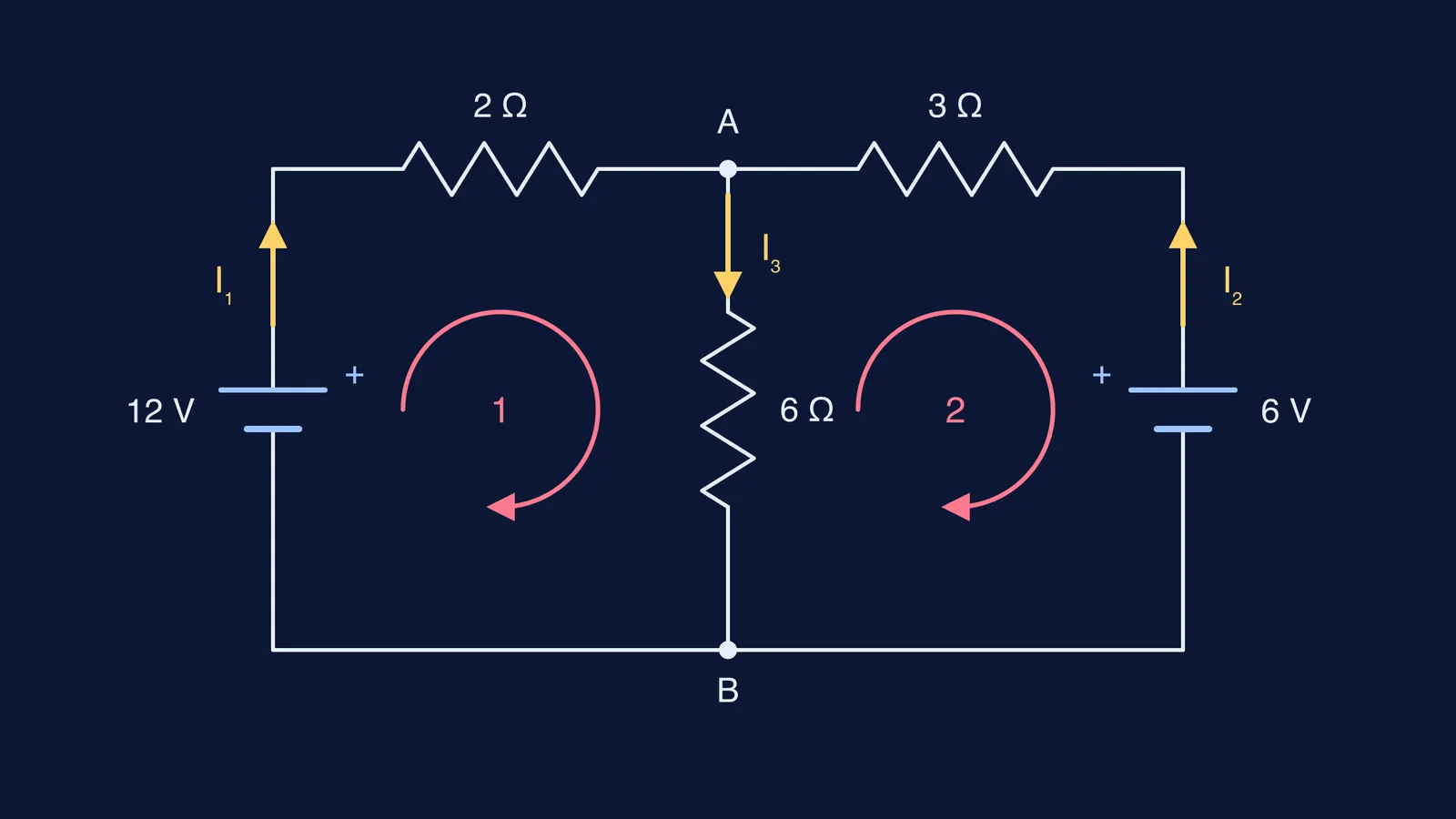
Take the circuit in the diagram above. Nodes A (top) and B (bottom) are joined by three branches:
Left branch: a 12 V battery, + terminal towards A, in series with 2 Ω.
Middle branch: 6 Ω.
Right branch: a 6 V battery, + terminal towards A, in series with 3 Ω.
Assume I1 flows up the left branch to A, I2 flows up the right branch to A, and I3 flows down the middle from A to B. At junction A, I1 + I2 = I3. Here is why Kirchhoff's junction rule follows from charge conservation. Walk both loops clockwise.
Loop 1 (left): up through the 12 V battery from − to + gives +12; across 2 Ω along I1 gives −2I1; down through 6 Ω along I3 gives −6I3. So 12 − 2I1 − 6I3 = 0.
Loop 2 (right): from A, across 3 Ω against I2 gives +3I2; down through the 6 V battery from + to − gives −6; up through 6 Ω against I3 gives +6I3. So 3I2 − 6 + 6I3 = 0.
Solving gives I1 = 2 A, I2 = −2/3 A and I3 = 4/3 A. The minus sign on I2 means current really flows down the right branch, charging the 6 V battery. Check: every branch must give the same potential difference from A to B. Middle: 6 × 4/3 = 8 V. Left: 12 − 2 × 2 = 8 V. Right: 6 − 3 × (−2/3) = 8 V. All three agree.
Now the common slip: writing −3I2 for the 3 Ω resistor out of habit, as if every resistor were a drop. That gives I1 = 0, I2 = 2 A and I3 = 2 A. The branch check exposes it: the middle branch gives 12 V, but the right branch gives 6 − 3 × 2 = 0 V.
What should you type to the AI?
Copy this and fill in your circuit:
“My circuit in words: [each branch, its components, which battery terminal faces which node].”
“My assumed currents: [I1 up the left branch, and so on]. Do not change them.”
“Both loops walked clockwise. My equations: [paste].”
“Do not solve. For each term, say whether its sign follows these rules: −IR along the current, +IR against it, +E from − to +, −E from + to −. Name the rule for every term.”
“If a sign is wrong, name the term, not the corrected equation.”
The last line matters: you fix the term yourself, so the correction stays in your head. Then solve, and run the branch check before trusting any number.
For more circuits worked this way, see current electricity with an AI tutor, solved in steps and the Kirchhoff sign conventions that stop circuit mistakes.
How does an AI tutor help with this?
Fermi's AI tutor teaches rather than answers: it notices where you are stuck and decides whether to explain, ask or show. For practice, the Fermi Problem Library has worked problems with a step-by-step solver that explains the reasoning rather than printing an answer.
Next time you set up a loop, write the four sign rules at the top of the page before your first equation.


