

On this page
You use Kirchhoff's junction rule in almost every circuit numerical, from Class 12 boards to JEE Main. It is really a statement about charge: a junction has nowhere to store any, so it must pass every bit along. See that, and you also see where the rule seems to break: the plate of a charging capacitor.
What does Kirchhoff's junction rule actually say?
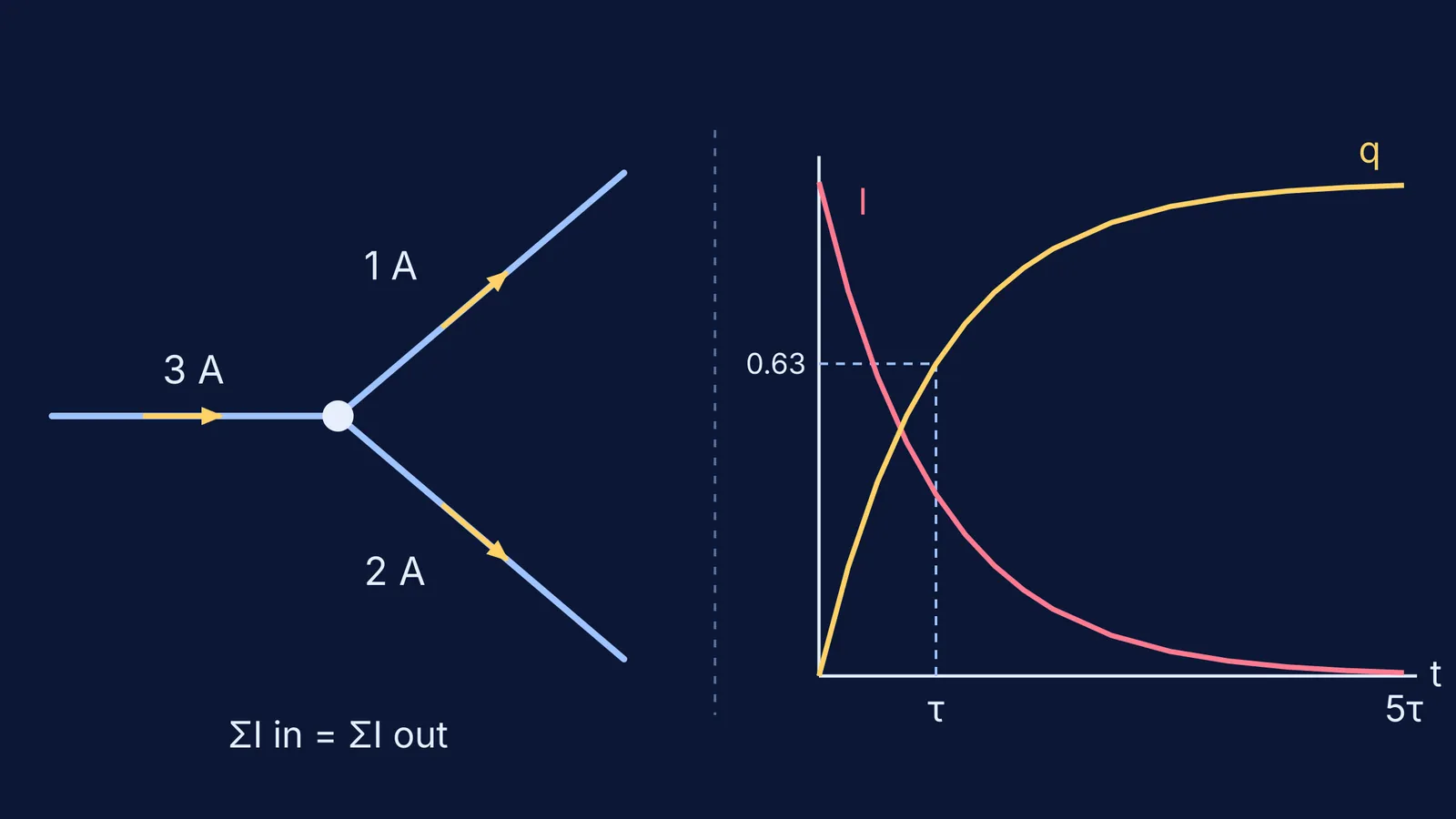
The sum of all currents entering a junction equals the sum of all currents leaving it, ΣI_in = ΣI_out (OpenStax University Physics Vol. 2, section 10.3). A junction is any point where three or more wires meet.
The same textbook gives the reason in one line: current is the flow of charge, and charge is conserved, so whatever charge flows into the junction must flow out.
Why does charge conservation force the rule?
Start from what current is. Current is the rate at which charge passes a point, I = dQ/dt, and one ampere is one coulomb per second (OpenStax, section 9.1).
Draw a small imaginary box around a junction. Each second, ΣI_in coulombs go in and ΣI_out coulombs come out. Charge cannot be created or destroyed inside the box, so the charge stored inside changes at the rate dQ_inside/dt = ΣI_in − ΣI_out.
The junction rule is this equation with the left side set to zero. That is the real assumption: in steady state, charge does not pile up at the node.
Why is that fair for a wire junction? Imagine 5 A flowing in while only 4.9 A flows out: 0.1 C would collect every second, 6 C in a minute. Even a tiny excess sets up an electric field that pushes incoming charge back and outgoing charge along, so the currents balance again almost at once.
For the sign mistakes that creep in once you add the loop rule, see our guide to Kirchhoff's laws sign conventions.
Does the junction rule fail when a capacitor is charging?
It depends on where you draw the box. A capacitor plate can store charge. While a capacitor charges, current flows into one plate through the wire, but no charge crosses the gap. Treat a single plate as your node and current in does not equal current out: the rule fails, and the difference goes into the plate's growing charge.
Draw the box around the whole capacitor and the rule works again. Current into one plate equals current out of the other, because the plates gain equal and opposite charges.
Ampère's law hit the same gap. For a charging capacitor, one surface bounded by a loop catches the wire current while another passing between the plates catches none. Maxwell fixed it with the displacement current, I_d = ε₀ dΦ_E/dt, which stands in for the wire current inside the gap (OpenStax, section 16.1). Our explainer on why Maxwell added displacement current walks through that step.
A worked example: one plate of an RC circuit
Take a 10 µF capacitor charged through a 1 kΩ resistor from a 10 V cell. The charging formulas are q(t) = Q(1 − e^(−t/τ)) and I(t) = I₀e^(−t/τ), with τ = RC and I₀ = ε/R (OpenStax, section 10.5).
Time constant: τ = RC = (1000 Ω)(10 × 10⁻⁶ F) = 10 ms.
Final charge: Q = Cε = (10 µF)(10 V) = 100 µC. Starting current: I₀ = 10 V ÷ 1000 Ω = 10 mA.
At t = τ, the plate holds 63.2% of its final charge, as the same OpenStax section shows, so q = 63.2 µC.
Current into the top plate at that moment: I = 10 mA × 0.368 = 3.68 mA.
Current leaving the top plate across the gap: zero.
So the plate breaks the in-equals-out rule by 3.68 mA. Check: dq/dt = (Q/τ)e^(−1) = (100 µC ÷ 10 ms)(0.368) = 3.68 mA. The missing current is the plate's charge rising.
By 5τ, e^(−5) ≈ 0.0067, so the current is below 1% of I₀ and in equals out again, both close to zero.
When can you write current in = current out?
Check before you write the equation:
A junction of wires: yes. A bare node stores no charge worth counting.
A resistor, cell or bulb as a box: yes. Current in one end equals current out the other.
A whole capacitor treated as a box: yes. Its plates gain equal and opposite charge.
One plate of a charging or discharging capacitor: no. Write I_in − I_out = dq/dt instead.
If switch-and-capacitor questions are where you lose marks, try our method for finding the charge that flows through a switch, which uses the same charge counting. For practice circuits, the Fermi Problem Library has worked problems with a step-by-step solver that explains the reasoning rather than printing an answer. If the idea itself is the gap, the Fermi Concept Library gives each physics concept its own lesson and its place in the map.


