

On this page
Paste a photo of a circuit into an AI chatbot, ask for “the current through the 2 Ω resistor”, and you will get a neat answer. That answer may rest on a diagram the AI misread. A safer routine for current electricity is to make the AI work in small steps you can check. It describes the circuit in words, labels the nodes, then applies Kirchhoff's laws one loop at a time. You do the final checks yourself.
Why does AI get circuit problems wrong?
The weak point is often reading the circuit, not the algebra. A team led by Liangliang Chen tested Gemini 2.5 Pro on undergraduate circuit analysis problems, in a paper first posted in December 2025 (arXiv: Chen et al.). They found two main failure modes. The first was misreading the circuit, especially the polarity of voltage and current sources. The second was reasoning mistakes such as wrong assumptions about current direction. Baseline Gemini scored 79.52% on 83 problems. On four hand-drawn versions of the diagrams it scored between 60.61% and 71.21%. Their fix added a step that re-checks source polarity and a loop that verifies answers with a circuit simulator, which lifted accuracy to 97.59% on the 83 problems.
A study in Frontiers in Education found a related pattern in physics more broadly (Wang et al., 2024). ChatGPT with GPT-4 solved 62.5% of the well-specified problems from a college-level engineering physics course. The first failure mode the authors list is “failure to construct accurate models of the physical world”.
You don't have a circuit simulator at your desk, but you can be the checker. That is the whole idea of the routine below.
What are Kirchhoff's two laws?
The junction rule says the sum of all currents entering a junction equals the sum of all currents leaving it (OpenStax University Physics, Kirchhoff's rules).
The loop rule says the algebraic sum of changes in potential around any closed loop is zero (same source).
Every equation below applies one of these two rules to one junction or one loop.
How do you get an AI tutor to solve a circuit step by step?
Send one prompt per step, and read each reply before you send the next.
Redraw in words: “Before solving anything, describe this circuit in words. List each branch from junction to junction, what is in it, and which way each battery's positive terminal faces.” Compare this with your diagram. The research above found that misreading the circuit is one of the main sources of errors.
Label: “Name the junctions P and Q. Give each branch one current, I1, I2 and I3, with an assumed direction. Do not solve yet.”
Junction rule: “Write the junction rule at P only.”
One loop: “Write the loop rule for loop 1 only, going clockwise, and give the sign of each term and the reason for it.” Check every sign, then ask for loop 2.
Solve and stop: “Solve these three equations, then stop. I will check the totals.”
Worked example: two batteries, three resistors
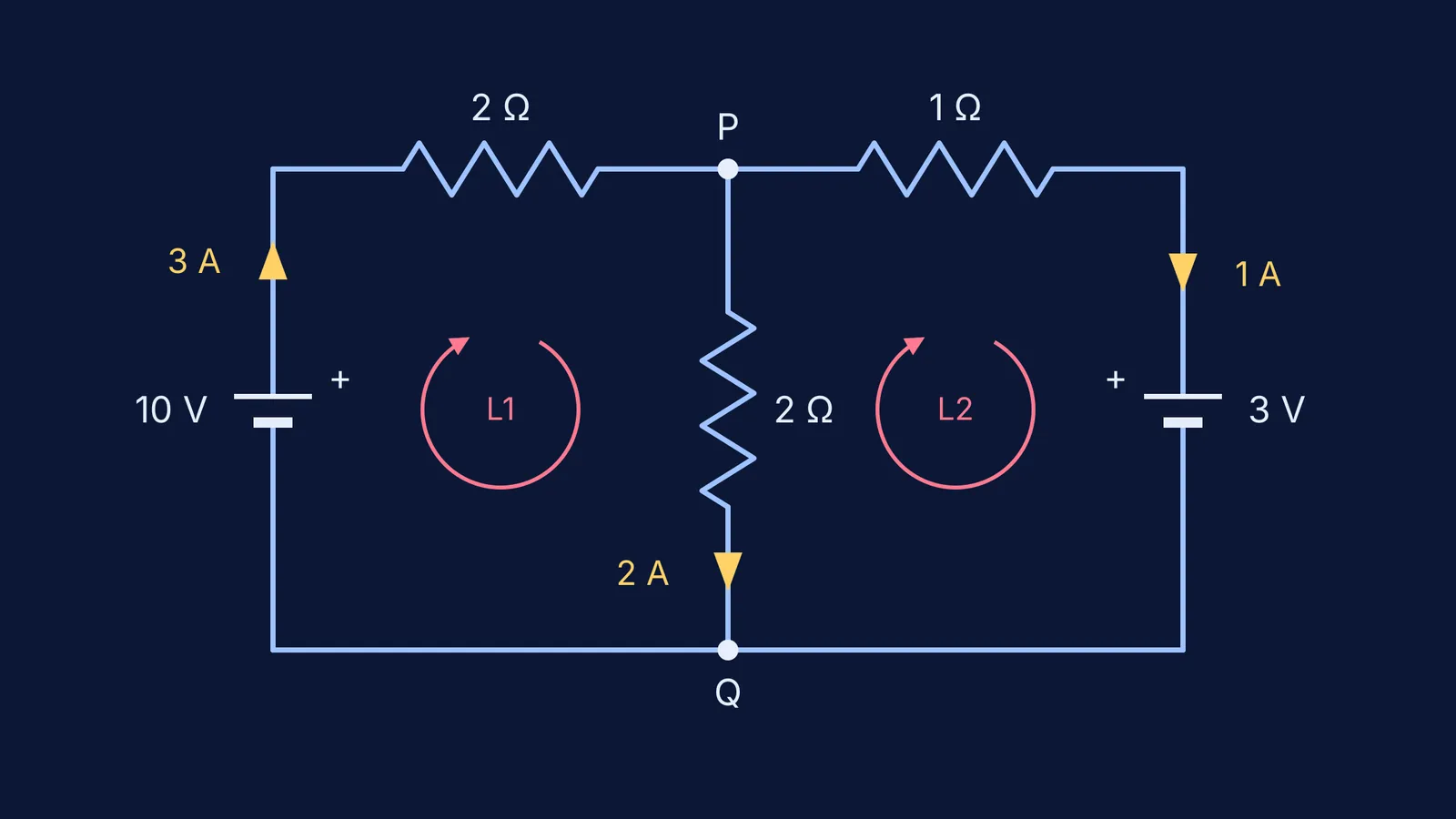
The diagram at the top of this page has two junctions, P (top) and Q (bottom), joined by three branches:
Left: a 10 V battery with its positive terminal facing up, and a 2 Ω resistor.
Middle: a 2 Ω resistor.
Right: a 3 V battery with its positive terminal facing up, and a 1 Ω resistor.
Assume I1 flows up the left branch into P, I2 flows up the right branch into P, and I3 flows down the middle from P to Q.
Junction P: I1 + I2 = I3.
Loop 1 (left loop, starting at Q, up through the 10 V battery): +10 − 2I1 − 2I3 = 0.
Loop 2 (right loop, starting at Q, up through the 3 V battery, across to P, down the middle): +3 − 1·I2 − 2I3 = 0.
Solving gives I1 = 3 A, I3 = 2 A and I2 = −1 A.
How do you check the totals yourself?
Don't ask the AI “is this right?” Do these four checks with a pencil instead:
Other junction: at Q, 2 A arrives from the middle branch and I1 + I2 = 3 + (−1) = 2 A leaves. It balances.
Unused loop: go clockwise around the outside loop. You pass both batteries, the 2 Ω resistor on the left and the 1 Ω on the right. +10 − 2(3) + 1(−1) − 3 = 0, as it should be.
Same voltage on every branch: the middle branch puts P at 2 × 2 = 4 V above Q. The left branch gives 10 − 2 × 3 = 4 V. The right branch gives 3 − 1 × (−1) = 4 V.
Power balance: the 10 V battery supplies 10 × 3 = 30 W and the 3 V battery takes in 3 × 1 = 3 W. The resistors use 18 + 1 + 8 = 27 W, which is 30 − 3.
If a check fails, go back to the equation that check depends on, not to the final answer. Tell the AI which check failed and ask it to find the line that caused it.
The same routine works on bigger networks, such as finding the current through the galvanometer in an unbalanced Wheatstone bridge. In Class 10, start with Ohm's law numericals, where you ask the AI to redraw first. Parents can read what to say when an AI tutor gives your child a wrong answer.
We built Fermi's AI tutor to teach rather than just answer. It holds a line of reasoning across the session, notices where you are stuck and draws the figure as it goes. For more practice, the Fermi Problem Library has worked problems with a step-by-step solver that explains the reasoning rather than printing an answer.
Tonight, take one two-loop circuit from your textbook and run it through the five prompts. Then do the four checks yourself.


